In April 2024, a law written in 1967 met a machine built for the 2030s
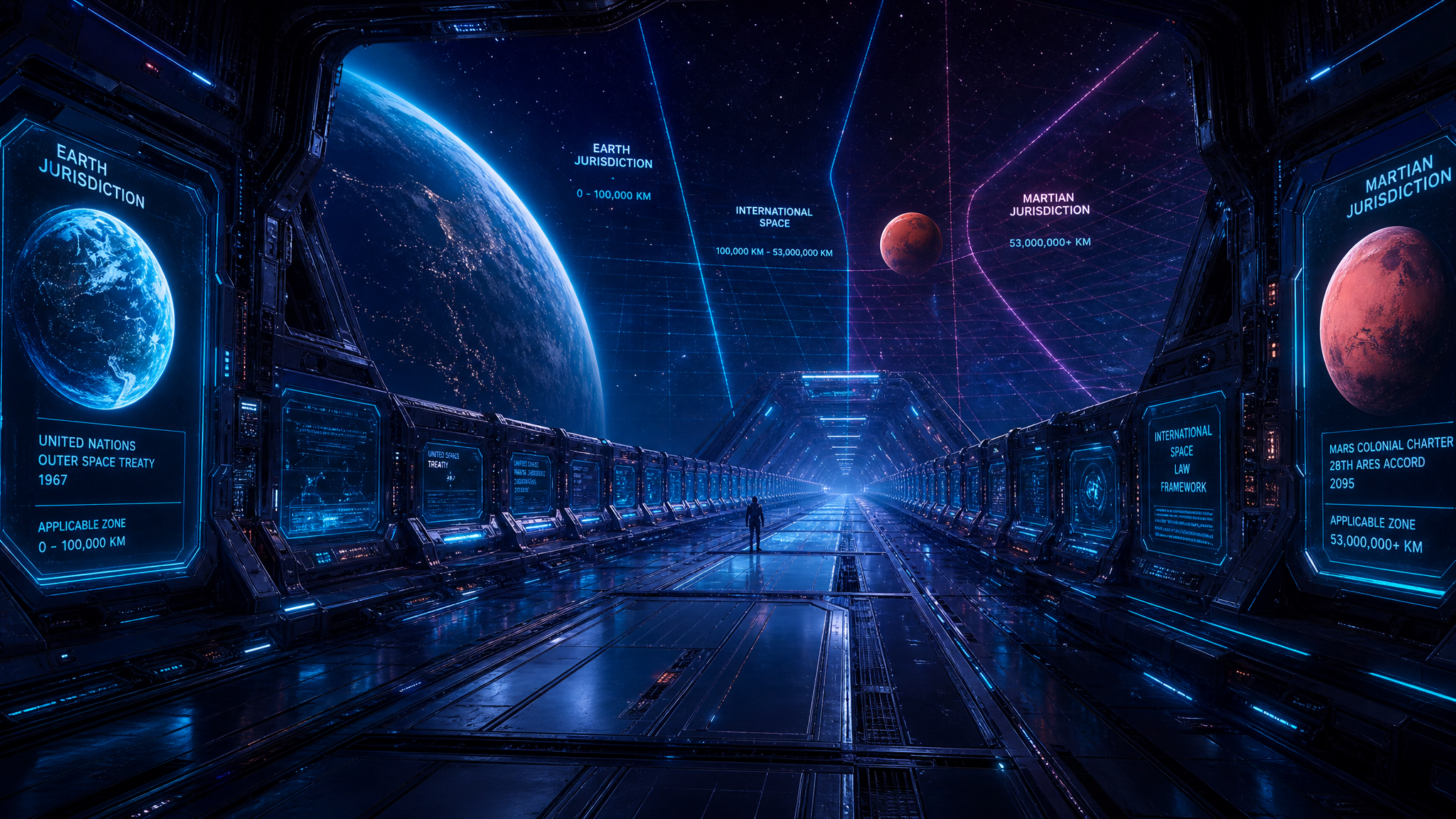
When NASA’s Psyche spacecraft settled into its long cruise towards a metal-rich asteroid, it did so under a legal architecture drafted before the microprocessor, before the commercial launch market, and before software had become the operating system of civilisation. The Outer Space Treaty, opened for signature in 1967, remains the constitutional backbone of space law. It was elegant, prudent and historically indispensable. It helped prevent the Cold War from extending cleanly into celestial territory. But it was written for an age of states, rockets and flags — not an age of autonomous mining systems, reusable heavy launch, private launch megafirms, cislunar logistics and plausible plans for persistent human presence beyond Earth.
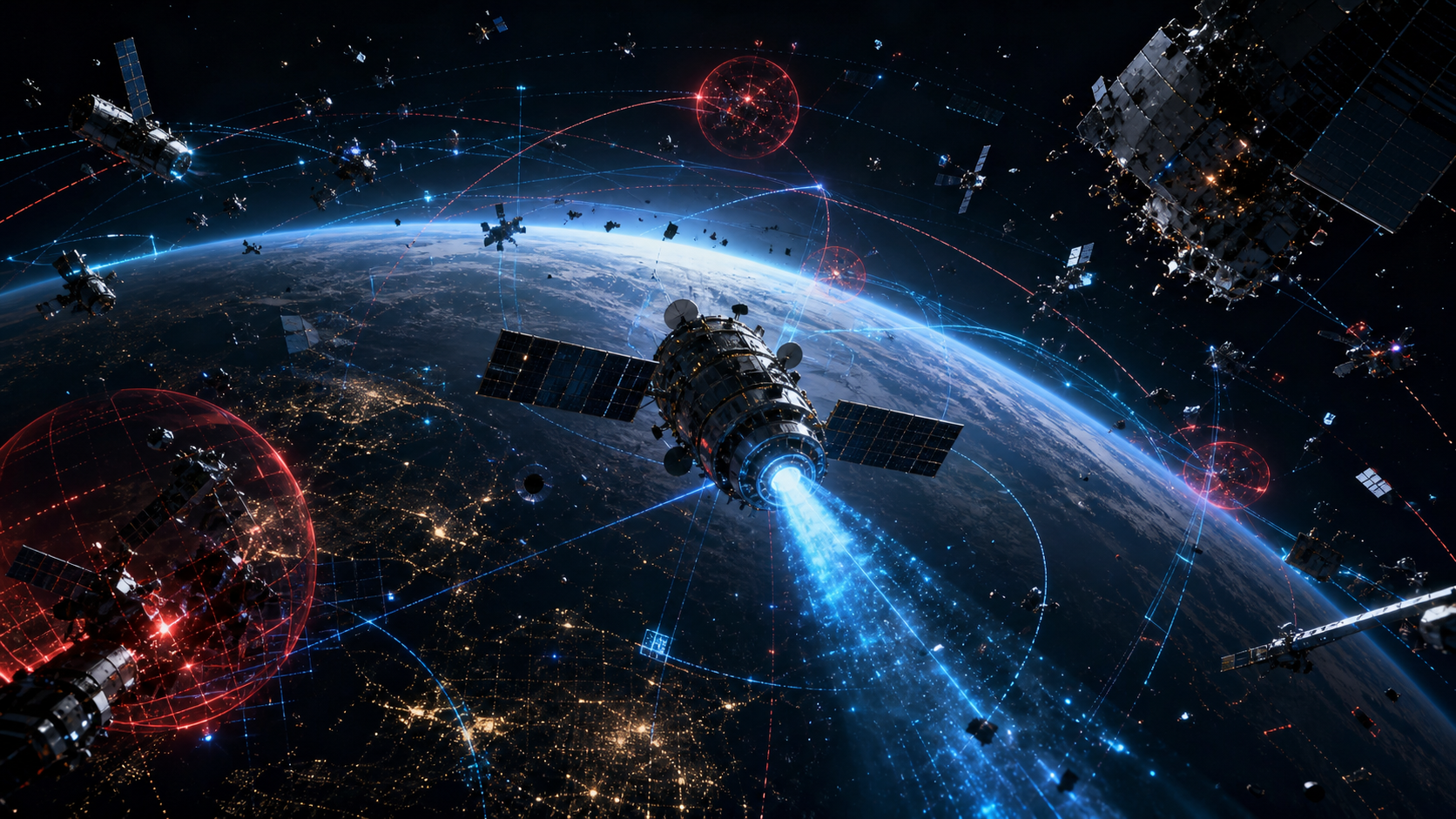
That mismatch now matters. SpaceX has made Starship the central industrial wager of contemporary spaceflight. NASA’s Artemis programme is designed to return humans to the Moon and establish a sustained presence there, using the Lunar Gateway and surface architecture as stepping stones. China’s Chang’e programme has moved from demonstration to methodical capability-building, including sample return and plans associated with an International Lunar Research Station. Blue Origin continues to set out visions for large-scale space infrastructure and orbital habitats. None of this is science fiction. It is procurement, launch cadence, hardware testing, industrial policy and national strategy.
The result is a sovereignty gap: a widening distance between what humanity can do in space and the governance frameworks available to decide who may act, on what authority, using whose data, with which obligations, and under what form of review or revocation. The gap is not merely about territorial ownership, though that is the question that attracts headlines. It is also about identity, liability, machine agency, resource rights, operational safety, evidence trails and the practical meaning of lawful conduct when a decision is made 384,000 kilometres away, or later, millions of kilometres beyond.
This is where the debate must become more precise. The problem is not that space lacks law. It is that the law it has was built for a simpler ontology than the one now arriving.
The old settlement: noble principles, narrow assumptions
The 1967 Outer Space Treaty established several enduring principles. Outer space is the province of all humankind. It is not subject to national appropriation by claim of sovereignty, use or occupation, or any other means. States bear international responsibility for national activities in outer space, whether conducted by governmental or non-governmental entities. They are also liable, in specified circumstances elaborated by later conventions, for damage caused by their space objects.
These principles still do serious work. They place a check on overt colonial land-grabs. They ensure that private actors do not operate in a legal vacuum simply because they are private. They embed due regard, peaceful purposes and a baseline expectation of international responsibility. One should be wary of treating them as obsolete simply because they are old.
Yet their assumptions are visible everywhere.
First, the treaty imagines states as the principal meaningful actors. Private companies appear largely as entities for which states remain responsible. That made sense in an era when only superpowers could reach orbit. It is less adequate when launch providers, satellite operators, in-space manufacturers, data platforms and future extraction ventures may possess capabilities greater than many sovereign governments.
Secondly, it assumes a world in which physical acts are easier to identify than computational ones. The treaty can cope more comfortably with launching, landing, damaging or occupying than with algorithmic decision-making, autonomous navigation, machine-to-machine contracting, remote operation through layered subcontractors, or AI systems reallocating scarce power, water or communications bandwidth in an off-world habitat.
Thirdly, it is strikingly thin on the governance of resource extraction and operational exclusivity. Article II forbids national appropriation. But it does not offer a detailed, modern doctrine for usufruct, extraction rights, exclusion zones, environmental stewardship, emergency access, or the treatment of digital and physical artefacts generated by off-world activity.
The consequence is not legal emptiness. It is legal ambiguity at precisely the points where money and mission design are now converging.
The partial patchwork: Artemis, the Moon Agreement and diverging blocs
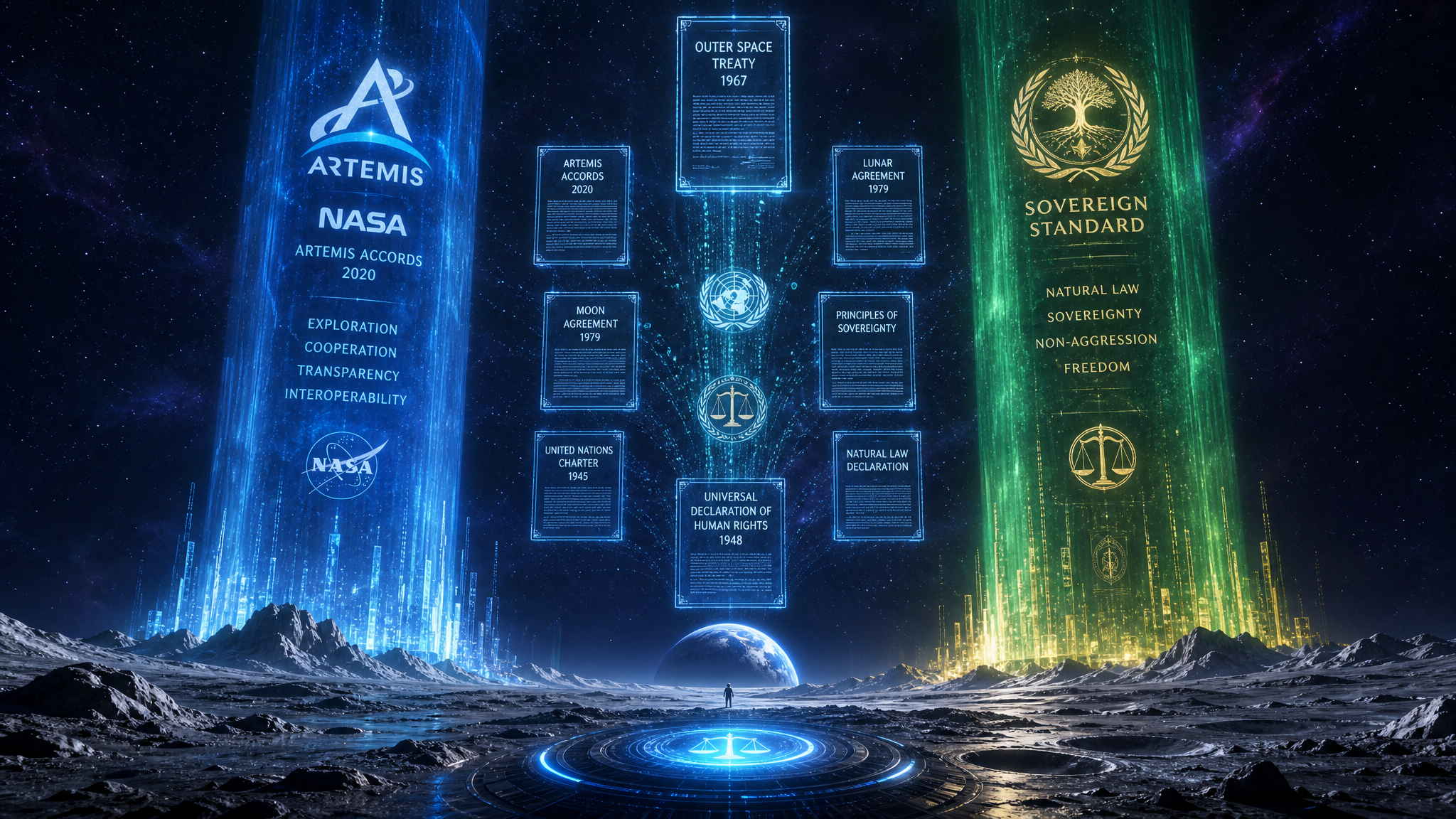
The most notable contemporary attempt to update practice is the Artemis Accords, a set of non-binding political commitments first signed in 2020 and subsequently joined by a growing number of states. The Accords build on the Outer Space Treaty rather than replacing it. They emphasise interoperability, emergency assistance, registration, release of scientific data, preservation of outer space heritage, deconfliction of activities and the controversial idea of “safety zones” to avoid harmful interference.
The Accords are important because they move the conversation from abstraction to operations. They acknowledge what serious lunar activity requires: traffic rules, notice, coordination, technical standards and practical methods for avoiding conflict. In effect, they admit that a world with sustained lunar operations cannot be governed by poetry alone.
But the Artemis Accords also reveal the limits of the present order.
- They are not a universal treaty.
- They are politically aligned instruments, shaped by a coalition rather than a truly global constitutional process.
- They leave unresolved the hardest jurisprudential question: how to reconcile non-appropriation with economically meaningful and legally reliable resource use.
By contrast, the 1979 Moon Agreement tried to push further, including the proposition that the Moon and its natural resources are the common heritage of humankind and that an international regime should govern exploitation. Yet it was ratified by relatively few states and not by the major space powers. In practical terms, it never became the operative basis of the lunar economy.
This leaves an awkward geometry. The Outer Space Treaty is universal enough to matter but too sparse for modern operations. The Moon Agreement is more ambitious but lacks adoption by the states that would make it decisive. The Artemis Accords are operationally useful but partial, coalition-based and contested.
Space is no longer short of ambition; it is short of rules capable of governing machines, markets and settlements beyond Earth.
Meanwhile, national legislation has moved ahead. The United States in 2015 recognised rights over resources extracted from celestial bodies by US citizens, while Luxembourg enacted similar legislation to support space resource ventures. The United Arab Emirates and Japan have also taken steps in this direction. These moves are understandable responses to commercial uncertainty. But they also signal a deeper trend: where global law hesitates, domestic law begins to fill the gap, often in ways that favour first movers.
That is not yet fragmentation in the full sense. It is, however, the precondition for fragmentation.
The real frontier is not flags. It is systems.
Public arguments about space sovereignty often default to the image of a nation planting a flag on regolith. It is vivid, cinematic and increasingly misleading. The more consequential struggle concerns systems governance: identity, command authority, data rights, automated operations, settlement protocols, logistics chains, dispute resolution and machine conduct in environments where latency, danger and distance compress human oversight.
A permanent lunar base, if it emerges in the 2030s, will not be governed only by astronauts and diplomats. It will be governed by software stacks. Power balancing, life-support optimisation, rover dispatch, inventory management, maintenance schedules, radiation sheltering, medical triage support, habitat access control and local manufacturing workflows will all depend on digital systems, many of them semi-autonomous. A Mars mission raises the stakes further, because communication delays make direct real-time control impossible.
This creates a class of legal questions that the foundational treaties only barely anticipate.
Who, precisely, acted?
When an autonomous rover reroutes itself and damages another operator’s equipment, who acted in the legally meaningful sense: the state of registry, the manufacturer, the mission operator, the software developer, the local commander, or the AI system executing learned policies within approved bounds?
What authority did it actually have?
If an off-world system denies access to oxygen reserves, shifts bandwidth from one habitat module to another, or prioritises one medical intervention over another, by what authority was that decision made, and where is that authority recorded?
Which data governed the decision?
In extreme environments, data errors are not clerical nuisances. They are mortal hazards. If a habitat agent relied on corrupted sensor feeds or unauthorised data fusion, can later investigators reconstruct the decision chain?
How is action revoked at distance?
A governance regime that can authorise action but not reliably revoke it is incomplete. In cislunar and Martian contexts, revocation is not merely legal language. It is a systems requirement.
These are not exotic hypotheticals. They are the routine governance questions of any serious off-world operation.
The first constitutional crisis in space may not concern territory at all. It may concern a machine that acted lawfully according to one system, and unlawfully according to another.
Why the sovereignty gap is existential, not academic
The phrase “existential governance risk” can sound inflated. In this case it is not. The reason is simple: in frontier environments, governance failure quickly becomes life-support failure, collision risk, strategic mistrust or economic lock-in.
Consider four layers of exposure.
Life and safety
The first constitutional crisis in space may not concern territory at all. It may concern a machine that acted lawfully according to one system, and unlawfully according to another.
Space habitats are dependency machines. Air, water, heat, shielding, food, communications and medical support are all tightly coupled. A legal framework that cannot specify accountable authority for automated decisions in such settings leaves operators guessing at the point where they most need clarity.
Commercial legitimacy
Investors, insurers and operators can tolerate technical risk more readily than unbounded legal ambiguity. Extraction ventures, in-space manufacturing, power infrastructure and logistics networks all require durable assumptions about rights, obligations and recourse. If those assumptions are supplied only by the national law of powerful launch states, legitimacy will remain fragile.
Geopolitical stability
Ambiguity is manageable in low-stakes conditions. It becomes dangerous when multiple major powers operate in proximity around scarce or strategically attractive sites: polar ice deposits, communications corridors, stable orbits or high-value research zones. The language of “harmful interference” is useful, but without richer operational governance it may prove too supple under pressure.
Civilisational inheritance
The first durable institutions built off-world are likely to set precedents for generations. Whether they are open, auditable and rights-preserving or opaque, centralised and extractive will depend less on rhetoric than on architecture. Frontier orders harden quickly.
The point, then, is not simply that old treaties are under strain. It is that the next layer of space civilisation may be encoded before it is properly debated.
What a modern framework must contain
A plausible update to space governance will not emerge from one grand treaty alone. It is more likely to develop as a layered architecture: enduring principles at the top, technical and operational standards in the middle, and implementation protocols at the edge where systems actually run.
At minimum, such a framework would need to address six questions.
- Identity: who is the acting party — human, organisation, autonomous system, or a governed combination of the three?
- Authority: what permissions has that actor been granted, by whom, for what duration, and under what constraints?
- Resources: what rights attach to extracted materials, generated energy, processed data and manufactured outputs?
- Jurisdiction and recourse: where are disputes heard, and how are incidents evidenced?
- Environmental stewardship: what constitutes contamination, reckless depletion, heritage damage or unacceptable interference?
- Revocation and continuity: how are permissions withdrawn, systems paused, emergency powers triggered and essential services maintained?
This is precisely where broad principles and technical standards must meet. The Sovereign Standard is useful in this context not as a claim of legal authority over space, and not as a jurisdiction, but as an open framework for thinking clearly about sovereignty under conditions where agency is distributed across humans, institutions, software and machines. Space is one frontier application of that broader problem, alongside identity, data, money, health and governance on Earth.
Within that umbrella, the agent-governance pillar is F-ACT — the Framework for Agent Conformance & Trust. Its normative core is ASDAR: Authority, Scope, Data, Audit, Revocation. The phrase matters because it describes the minimum governance grammar any autonomous off-world system should satisfy before execution, not after failure.
- Authority: who empowered the system to act?
- Scope: what task boundaries, risk classes and operational limits apply?
- Data: which inputs are authorised, current and provenance-checked?
- Audit: can an independent record reconstruct the decision path?
- Revocation: can permissions be withdrawn safely and predictably?
F-ACT’s defining principle is blunt: Govern before execution — not after. In space, where “after” may mean injury, loss of habitat functionality or irreversible contamination, that principle becomes more than good compliance. It becomes a design requirement.
From principle to mechanism: the role of the 42 Protocols
Frameworks are only as good as their operational expression. For frontier environments, elegant declarations must become executable governance. That is the role of the 42 Protocols, Society OS’s implementation mechanism for operationalising the Sovereign Standard across six domains: Individual, Economy, Enterprise, State, Mind and Infrastructure. If the Sovereign Standard provides the worldview, and F-ACT supplies the agent-governance standard within it, the 42 Protocols are the deployable stack that turns intent into infrastructure.
In space, three elements are especially salient.
Human-Twin-Agent identity
Govern before execution — not after.
Off-world governance will require much richer identity than a name on a manifest or a corporate registration number on Earth. The Human-Twin-Agent Protocol offers a way to distinguish and bind together the human principal, the digital twin representing authorised state and history, and the machine agent executing tasks. That matters when actions are delegated across distance and time. It clarifies not only who may act, but under which continuity of identity and consent.
HEARTrank trust
Trust in space is not a branding exercise; it is an operational variable. Systems will need ways to evaluate the reliability of actors, devices, agents, counterparties and information flows. HEARTrank is relevant here as the trust layer: not a social popularity metric, but a structured method for assessing whether an entity should be relied upon in a high-stakes governed agent network.
WISE Contracts
The legal and technical world has spent years admiring “smart contracts”, many of which merely automate execution regardless of whether the surrounding legal context is wise. WISE Contracts are a different aspiration: instruments that execute law, not merely code. In a lunar resource environment, that distinction could be decisive. A contract governing extraction quotas, emergency access, habitat maintenance obligations or shared infrastructure use should be capable of reflecting normative rules, exceptions, overrides and auditability — not simply triggering actions because a condition evaluated as true.
This is where the motif becomes more than branding: 42 years. 42 protocols. 42 papers. Frontier governance cannot be improvised from a single white paper and a launch schedule. It must be built as a living stack.
Space law’s next chapter will be written by institutions that can bridge law and software
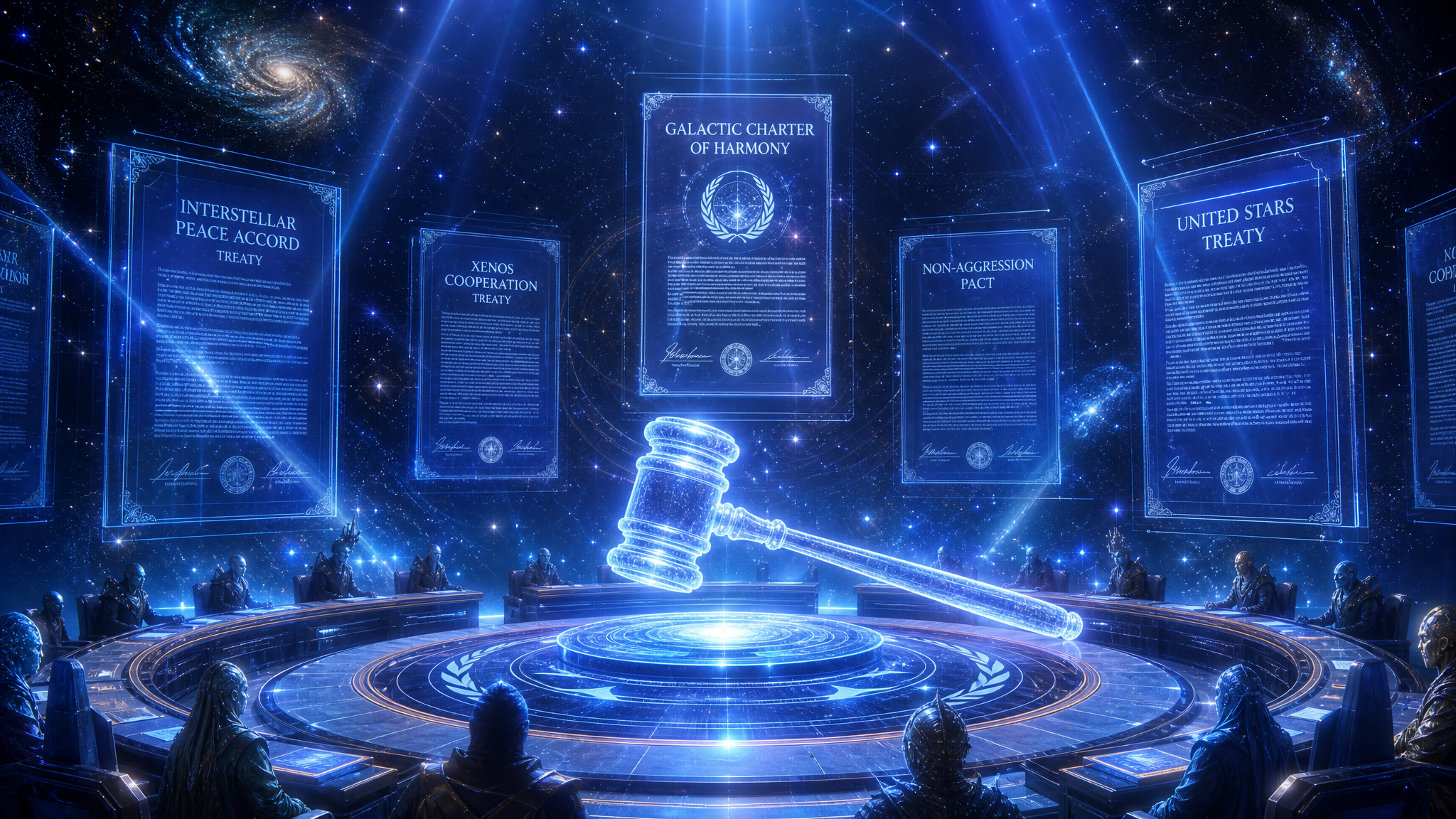
It would be foolish to suggest that any private framework, however thoughtful, can replace treaty law or sovereign decision-making. It cannot. The authority to make public international law remains with states. The point is subtler and, in practice, more important. The next generation of space governance will require institutions capable of translating legal principles into operational standards for real systems.
Today, the international system has fragments of this capacity. The United Nations Committee on the Peaceful Uses of Outer Space remains an indispensable forum, particularly for norm development and legitimacy. National space agencies and regulators are producing practical requirements in licensing, debris mitigation and mission assurance. Industry consortia and standards bodies are beginning to tackle interoperability and safety questions. But these efforts remain uneven and often siloed.
What is missing is a coherent bridge between constitutional principle and machine-level execution.
That bridge should have several characteristics.
- It should be open, so that legitimacy does not depend on proprietary opacity.
- It should be vendor-neutral, so that conformance does not collapse into platform dependence.
- It should be auditable, so that incidents can be reconstructed across jurisdictions and organisations.
- It should be revocable by design, especially where autonomous systems control critical resources.
- It should be portable across domains, because the same governance problem appears in lunar habitats, orbital platforms, terrestrial infrastructure and future settlements.
Society OS’s contribution should be understood in precisely that spirit: as a forward-looking attempt to build such a bridge through the Living OS, the Sovereign Stack and the 42 Protocols, with F-ACT as the narrow technical layer for governing autonomous agents. It is not space law. It does not claim to supersede public authority. It is an implementation architecture for a world in which lawful action increasingly depends on governed computation.
For that reason, the intellectual challenge of space governance now resembles the challenge of constitutional design in the digital age more broadly. We are no longer deciding only what is permitted. We are deciding how permission itself is instantiated, evidenced, constrained and withdrawn inside systems that act.
The Moon will not wait for jurisprudence
The history of frontier law is rarely tidy. Practice runs ahead, commercial pressure accumulates, states harden positions, and only later does doctrine catch up. Space is unlikely to be different. Artemis will continue. Starship testing will continue. China’s lunar ambitions will continue. Robotic missions will multiply. The economics of launch, in-space services and strategic resource access will keep sharpening the incentives to move first.
That is exactly why this moment deserves sobriety. The 1967 settlement was a diplomatic achievement of a dangerous age. But it cannot, by itself, govern a 2026 reality in which non-state operators are central, autonomous systems are maturing, and off-world activity is becoming infrastructural rather than symbolic.
The sovereignty gap in space law is therefore best understood not as an argument for celestial nationalism, nor as a complaint that the old rules are inconvenient. It is an argument that humanity needs better governance machinery for a domain it is rapidly making real.
The choice is not between law and innovation. It is between two kinds of innovation: one that races ahead of legitimacy and tries to retrofit rules after failure, and one that builds lawful, auditable, revocable authority into the operating fabric from the outset.
If the twenty-first century is to extend civilisation beyond Earth without exporting its oldest confusions intact, space will need more than rockets, habitats and capital. It will need a constitutional imagination equal to its engineering. The Moon will not wait for jurisprudence. But jurisprudence, if it is to matter, must learn to travel at the speed of systems.
Sources & Further Reading
- 1.United Nations Office for Outer Space Affairs — Treaty on Principles Governing the Activities of States in the Exploration and Use of Outer Space, including the Moon and Other Celestial Bodies (1967)
- 2.United Nations Office for Outer Space Affairs — Agreement Governing the Activities of States on the Moon and Other Celestial Bodies (1979)
- 3.NASA — The Artemis Accords
- 4.NASA — Artemis campaign
- 5.NASA — Psyche mission
- 6.SpaceX — Starship
- 7.China National Space Administration — Lunar Exploration and Chang’e programme
- 8.Blue Origin — Orbital Reef
- 9.U.S. Commercial Space Launch Competitiveness Act of 2015
- 10.Luxembourg Space Agency — Space resources initiative