Hub
Deep Dive
Artemis Accords vs. The Sovereign Standard: Two Visions for Space Governance
Space Law & PolicyDeep Dive

Artemis Accords vs. The Sovereign Standard: Two Visions for Space Governance

Diplomatic accords govern states; protocol governance may soon govern machines beyond Earth.

AI AssistedSociety OS Research16 June 202622 min read

Key Insight: The contest in space governance is not law versus code, but whether diplomacy alone can supervise autonomous systems acting millions of miles away.

Forty-three signatories, forty-two protocols

In October 2020, as the world was still measuring distance in lockdowns and test results, NASA published a set of principles for returning humans to the Moon. The Artemis Accords began with eight signatories. They now count 43. Their purpose is clear: to translate long-standing space law into practical norms for a new era of lunar exploration, resource use and multinational cooperation.

Set against that diplomatic architecture is a very different proposition. The Sovereign Standard is not a treaty, not a jurisdiction and not a claimed legal authority over space. It is a proposed, open framework for retaining sovereignty in the AI age across identity, data, money, health, governance and frontier domains including space. Its implementation mechanism is the 42 Protocols: a deployable stack led by the Sovereign Trinity of Human-Twin-Agent identity, HEARTrank trust, and WISE Contracts, which execute law rather than merely code. Nested within that framework sits F-ACT, the Framework for Agent Conformance & Trust, a neutral, vendor-neutral standard for governing AI agents through Authority, Scope, Data, Audit, Revocation.

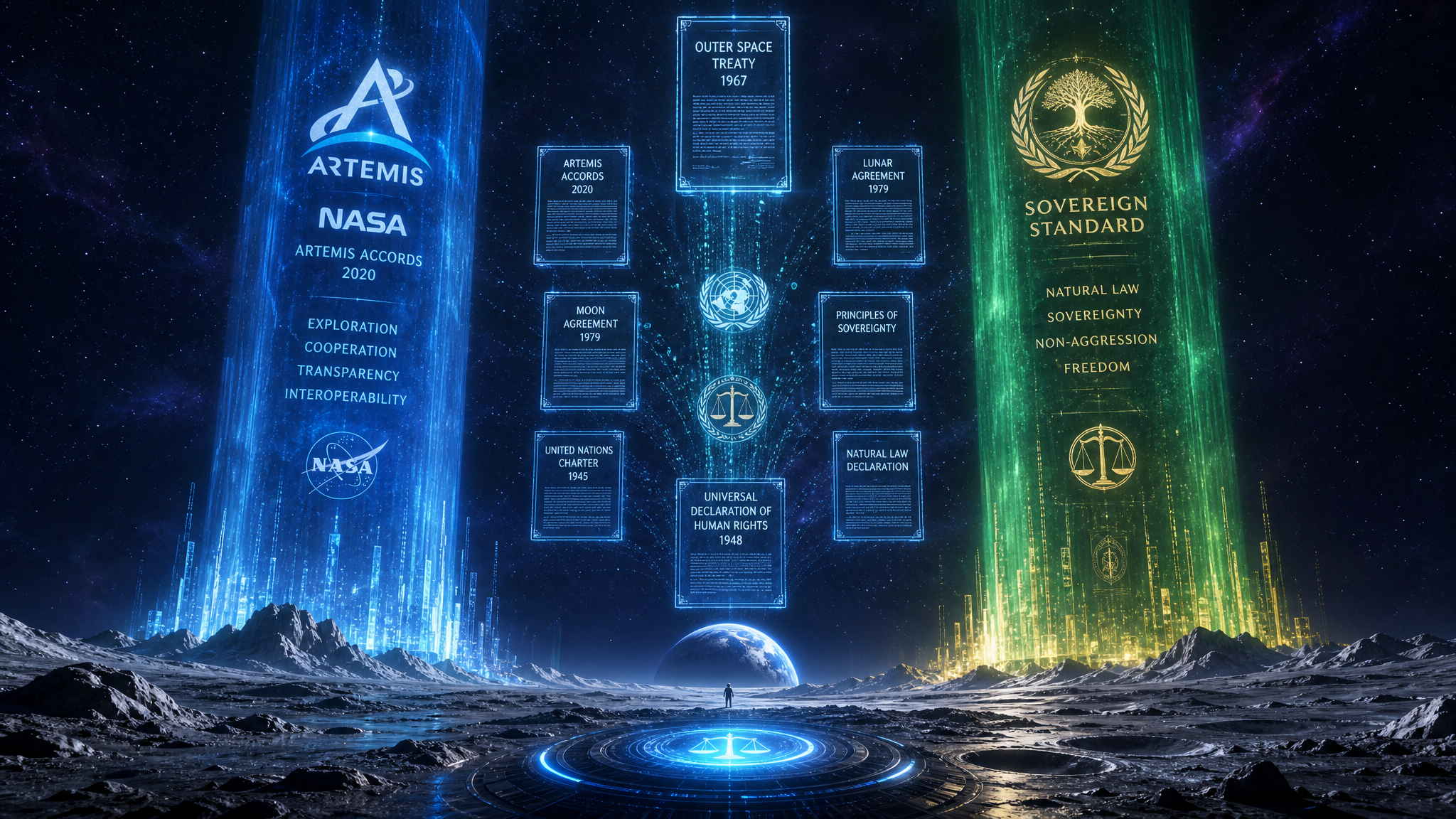
These two systems are often described as if they were destined to replace one another. That is the wrong frame. The Artemis Accords and the Sovereign Standard address different layers of the same problem. One coordinates states. The other proposes a way to govern software, machines and autonomous decision-making within the bounds that states set.

Yet a tension is unmistakable. As lunar activity accelerates, governance can no longer stop at flags, ministries and memoranda. Rovers will negotiate terrain, allocate power, triage maintenance, prioritise samples, trade bandwidth and perhaps one day transact over scarce resources with limited human supervision. Diplomatic consensus is necessary for such a world. It is not sufficient.

The deeper question, then, is not which model will prevail. It is whether space governance can mature from text that states endorse to systems that machines can verifiably obey.

The legal inheritance of the space age

Any serious discussion must begin with the actual legal order already in place. The centre of gravity remains the 1967 Outer Space Treaty, the foundational instrument of international space law. It establishes several enduring principles: outer space shall be free for exploration and use by all states; it is not subject to national appropriation by claim of sovereignty, use, occupation or any other means; states bear international responsibility for national activities in space, including those conducted by non-governmental entities; and harmful contamination should be avoided.

Those provisions were drafted for the early space age, but they remain remarkably resilient. They are broad enough to govern a world of lunar landers, private launch companies and deep-space probes, even if they do not settle every practical dispute. Around the treaty sits a wider legal scaffolding: the Rescue Agreement, the Liability Convention, the Registration Convention, and, more controversially, the 1979 Moon Agreement.

The Moon Agreement is the ghost at this particular feast. It sought to provide a fuller legal regime for celestial bodies, including the idea that the Moon and its natural resources are the “common heritage of mankind”. Yet the treaty never gained support from the major spacefaring powers. The United States, Russia and China are not parties. Nor are most of the states now shaping commercial and strategic activity beyond low Earth orbit. In practical terms, the Moon Agreement matters more as a sign of unresolved anxiety than as an operative constitution for lunar development.

That unresolved anxiety concerns extraction. Can states and companies use space resources without violating the Outer Space Treaty’s prohibition on national appropriation? The dominant interpretation among the Artemis partners is yes: one may extract and use resources without claiming sovereignty over the territory from which they are taken, just as fish may be caught on the high seas without owning the ocean. Critics remain unconvinced, arguing that resource use without a robust international regime risks turning a non-appropriation principle into an economic fiction.

This ambiguity is exactly why governance in space is moving from abstract doctrine to operational design.

What the Artemis Accords are — and are not

The Artemis Accords are often treated by admirers as a constitutional breakthrough and by critics as a covert property regime. They are neither. They are non-binding political commitments signed bilaterally with the United States, intended to guide civil space cooperation around the Artemis programme and related activities.

Their substantive principles are familiar to lawyers of the field: peaceful purposes, transparency, interoperability, emergency assistance, registration of space objects, release of scientific data, protection of heritage sites, space resource utilisation, deconfliction of activities and orbital debris mitigation. In effect, the Accords seek to render the Outer Space Treaty operational for an era in which many actors, public and private, may be active on and around the Moon at once.

That matters. Space law has always depended heavily on practice. Norms harden because states repeat them, explain them and organise behaviour around them. In that sense, the Accords are less a revolution than a diplomatic software update.

Still, they have visible limitations.

  • They are state-to-state instruments, even though much of the operational tempo in space now comes from commercial firms.
  • They rely on political alignment and administrative implementation, not machine-verifiable enforcement.
  • They articulate principles for behaviour, but not a shared execution layer for autonomous systems.
  • They are associated with a particular geopolitical coalition, which gives them reach but also exposes them to bloc politics.

The practical problem is easy to picture. A clause on “deconfliction” is intelligible to diplomats and lawyers. It is less intelligible to a mining rover, a logistics scheduler or an autonomous landing system unless translated into executable constraints. A commitment to transparency is valuable between agencies; it is another matter entirely to produce event logs, permissions and revocation states that can be inspected in real time across a multi-operator lunar environment.

The Artemis Accords tell states how they should behave. The next phase of space activity requires systems that can tell machines what they may do.

This is not a criticism of the Accords so much as a recognition of their proper domain. Diplomatic instruments establish legitimacy. They do not, by themselves, create computable governance.

Why autonomous space operations change the governance equation

For decades, space governance could assume a relatively simple chain of command: states licensed missions, agencies supervised spacecraft, and humans remained the obvious decision-makers. That assumption is fraying.

The Artemis Accords tell states how they should behave. The next phase of space activity requires systems that can tell machines what they may do.

Consider the operational realities now coming into view. SpaceX’s Starship is designed around scale, cadence and heavy lift. If it succeeds, it will not merely lower launch costs; it will increase the number and variety of missions that must be coordinated. China’s Chang’e programme has already demonstrated sustained lunar ambition, from sample return to the far side of the Moon, and points towards a longer-term cislunar architecture. NASA’s Psyche mission, headed to a metal-rich asteroid, signals a future in which deep-space operations become progressively more automated because latency and distance demand it. Even today, rovers and probes do not wait for step-by-step human instruction in every contingency. They operate through bounded autonomy.

Bounded autonomy, however, tends not to stay bounded for long. As systems become more capable, missions more distributed, and communication windows more constrained, off-world operations will increasingly depend on local machine judgement. The issue is not science fiction. It is systems engineering.

Three pressures drive the change.

Distance

A governance model built around immediate human oversight struggles when light-speed delay is measured in seconds, minutes or longer. Lunar operations may tolerate relatively close supervision; Mars and deep-space missions will not.

Complexity

A single mission can involve multiple agencies, prime contractors, sub-contractors, software vendors, communications providers and scientific institutions. If autonomous systems are to coordinate safely, authority cannot remain implicit or scattered across PDFs and procurement documents.

Scarcity

Power, bandwidth, landing windows, traversable terrain, radiation shelter and crew attention are all scarce. Scarcity produces allocation problems. Allocation problems produce governance questions.

This is where the abstract debate over law and code becomes concrete. When two autonomous systems request the same charging slot on a lunar outpost, or when a rover’s path intersects a protected heritage perimeter, or when a repair bot proposes cannibalising one asset to preserve another, what governs the decision? Not in principle, but in execution.

The answer cannot be “a diplomat in Washington will decide”, nor even “mission control will always arbitrate”. There must be an intermediate layer: policy translated into permissions, constraints, attestations, logs and revocation paths that machines can act upon.

The Sovereign Standard as a governance worldview

This is the opening in which The Sovereign Standard becomes interesting. Properly understood, it is not a rival sovereign order for space. It is a broader framework for preserving human and institutional agency in an era where decision-making is increasingly delegated to software agents and automated systems.

Space is only one application. The central proposition is wider: if identity, authority, consent, trust and execution are becoming computational, then governance itself must become legible to computational systems without surrendering legitimacy to them.

That proposition is implemented through the 42 Protocols, Society OS’s mechanism for operationalising the Standard across six domains: Individual, Economy, Enterprise, State, Mind and Infrastructure. The phrase is memorable — 42 years. 42 protocols. 42 papers. But the deeper claim is architectural. Rather than treating governance as a static legal text plus ad hoc software, the 42 Protocols propose an integrated stack in which identity, trust and enforceable action are designed together.

Its three leading components matter especially in space:

  • Human-Twin-Agent Protocol: clarifies who acts, under whose authority, and through what digital and machine representation.
  • HEARTrank: establishes what is trusted, by whom, on what basis, and with what evidentiary trace.
  • WISE Contracts: create executable governance instruments intended to enact lawful constraints, not merely automate commercial code paths.

In a terrestrial setting, that architecture can support enterprise automation or digital public infrastructure. In a frontier setting, it offers something different: a way to bind autonomous systems to declared authority before they act.

That phrase is critical because it captures the contrast with much contemporary AI oversight.

Govern before execution — not after.

In space, after-the-fact review is often too late. By the time a harmful autonomous action is discovered, the sample may be contaminated, the equipment damaged, the path obstructed or the diplomatic incident already created.

F-ACT: the agent-governance layer space will need

Inside the Sovereign Standard, the most directly relevant technical component for off-world operations is F-ACT — the Framework for Agent Conformance & Trust. F-ACT is not a space treaty. It is a neutral, open, vendor-neutral standard for governing AI agents. Its normative core is ASDAR: Authority, Scope, Data, Audit, Revocation.

Those five elements are especially well suited to autonomous space systems.

Govern before execution — not after.

Authority

Who authorised this agent to act? A national space agency, a licensed contractor, a scientific consortium, a habitat operator, a mission commander? In terrestrial systems this is often muddled; in space it must be precise.

Scope

What, exactly, may the agent do? Drive within a mapped perimeter? Allocate power within set margins? Handle scientific data but not alter mission priorities? Negotiate bandwidth but not safety-critical routing? Scope turns broad mission intent into bounded permission.

Data

Which data may the agent access, use, retain, transmit or combine? Scientific openness is one principle; operational secrecy, planetary protection and commercial confidentiality are others. A trustworthy system needs machine-readable data rights, not hand-waving.

Audit

What evidence exists that the agent acted within its authorised parameters? Audit is not just a compliance convenience. It is the basis of trust between operators who may never fully trust one another politically.

Revocation

How is authority withdrawn when circumstances change? Revocation may be the most underrated function in autonomous governance. Space is dynamic. A zone can become hazardous, a communications link compromised, a counterpart unreliable or a mission objective superseded. The ability to rescind permissions cleanly is central to safe operations.

F-ACT’s conformance tiers make this operationally legible:

  • L0 Unattested
  • L1 Declared
  • L2 Enforced
  • L3 Provable

One can imagine these tiers applied across a governed agent network supporting a lunar mission. A low-risk internal assistant might operate at L1. A habitat life-support optimiser or excavation rover near protected zones would require L2 or L3. The point is not bureaucratic ornament. It is to align the level of trust demanded with the consequence of action.

Such a model does not replace space law. It gives space law an execution grammar.

Where the two visions meet

The cleanest way to compare the Artemis Accords and the Sovereign Standard is to ask what each is good at.

The Accords are strong where legitimacy, diplomacy and inter-state signalling matter most. They can harmonise expectations, reduce mistrust among partners, and establish accepted norms for behaviour under existing international law. They are recognisable to ministries, legislatures and agencies because they emerge from the language of public authority.

The Sovereign Standard, implemented through the 42 Protocols and expressed technically through F-ACT, is strong where autonomy, verification and cross-system execution matter. It can specify not merely that an operator should respect another operator’s activity, but how an agent may discover a protected boundary, verify a relevant permission, log its choices, and have its authority revoked if conditions change.

This makes them less like rival constitutions and more like adjacent layers in a maturing stack.

The diplomatic layer

States agree principles, define lawful envelopes, issue licences, settle disputes, and represent political communities.

The protocol layer

Operators, machines and autonomous agents execute those principles through enforceable identities, permissions, trust signals and revocable action rights.

This layered view is likely to become unavoidable. The history of the internet offers a rough analogy. States still make law, but protocols determine what systems can interoperate, authenticate and verify in practice. Space is not the internet, and the analogy should not be pushed too far. Yet the institutional lesson holds: where activity becomes dense, distributed and technical, governance acquires protocol form whether policymakers intend it or not.

The central challenge is moving from consensus to conformance without losing the legitimacy that consensus provides.

The question is whether that protocol form will be coherent, open and auditable — or improvised separately by each operator.

The real points of friction

If these frameworks can complement one another, why speak of collision at all? Because complementarity in theory often produces conflict in implementation.

The first friction is jurisdictional translation. The Accords bind signatory states politically; F-ACT and the 42 Protocols would need to be adopted by operators, contractors and software systems. Translating public norms into private execution standards is never neutral. Someone must decide how a principle becomes a rule, and how a rule becomes code.

The second is geopolitical pluralism. The Artemis coalition is significant but not universal. China is not a signatory. Nor is Russia. If space governance fragments into rival blocs, protocol standards may fragment too. A vendor-neutral agent-governance standard is attractive precisely because it could, in principle, travel across political camps. But neutrality on paper is not enough; legitimacy depends on who stewards, audits and updates the framework.

The third is commercial asymmetry. Commercial operators move faster than treaty processes. That is true in launch, communications and remote sensing; it will be true on the Moon. If protocol-based governance becomes useful before states fully absorb it, the private sector may adopt de facto standards first. History suggests that governments eventually regulate around successful infrastructure rather than before it.

The fourth is planetary protection and heritage. These are domains where after-the-fact enforcement is especially weak. Once a site is disturbed, a plume contaminates a sample environment, or operational metadata goes missing, the loss may be irreversible. This creates strong demand for ex ante governance of autonomous behaviour.

None of this means the Sovereign Standard currently possesses legal standing in space. It does not. Nor should its proponents pretend otherwise. Society OS’s own intellectual property position is similarly modest in legal terms: it has 504 provisional/unexamined claims in a single Australian provisional application, number 2026900773, filed on 2 February 2026. That application is provisional and unexamined, confers no granted or enforceable rights, and lapses on 2 February 2027 unless taken further. The important point is not exclusivity. It is that the proposal exists as a designed architecture rather than a rhetorical aspiration.

A planned Swiss foundation, announced for the future on 5 September 2026, is intended to steward the standard if established. But again, future stewardship is not present authority.

What a lunar governance stack could look like

To see the practical stakes, imagine a future multinational lunar outpost operating under ordinary international law, with participating states aligned broadly to Artemis principles.

A useful governance stack might look like this:

  • Outer Space Treaty and related international law define the legal baseline.
  • Artemis-style political commitments specify operational norms among participating states and agencies.
  • National licensing regimes authorise specific missions and commercial actors.
  • The 42 Protocols provide the implementation mechanism for identity, trust and executable permissions across organisations and systems.
  • F-ACT governs the autonomous agent fleet performing local tasks under machine-verifiable authority.

In that model, a rover approaching a scientifically sensitive region would not merely “know” that caution is desirable. It would possess a scoped authority credential linked to its operator, a machine-readable perimeter definition, a trust register for counterpart signals, an audit trail for every relevant decision, and a revocation path if mission control or a designated authority changed the status of the zone.

A maintenance bot reallocating power in a habitat would act under explicit priority rules encoded through WISE Contracts. A scientific agent negotiating data release would handle openness, embargo periods and restricted telemetry according to declared data rights rather than improvised policy notes. A Human-Twin-Agent identity chain would allow human responsibility to remain visible even when the immediate action was taken by software or robotics.

This is what it means to treat space as one application of the Sovereign Standard rather than its definition. The value lies not in claiming a new cosmic constitution, but in making governance executable where distance and autonomy strain traditional supervision.

From consensus to conformance

The future of space governance will not be decided by a single signature ceremony or a single software release. It will emerge from repeated contact between law, engineering and institutional trust.

The Artemis Accords represent one necessary truth: space activity still requires diplomacy, recognised states and shared public legitimacy. The Sovereign Standard represents another: increasingly, meaningful control depends on whether authority can be translated into systems that autonomous agents can prove they are following.

That is the coming shift. The central challenge is moving from consensus to conformance without losing the legitimacy that consensus provides. States will continue to negotiate principles. But as operations multiply on the Moon, in cislunar space and beyond, they will also need infrastructures that can attest who acts, constrain what is allowed, govern which data may be used, record what happened, and revoke authority when conditions change.

The destination is not rule by code. It is better law through better execution.

For now, the Artemis Accords remain the more concrete public instrument. They have signatories, diplomatic weight and a place within the recognised vocabulary of international space cooperation. The Sovereign Standard is earlier: a proposed, open framework, implemented through the 42 Protocols, that seeks to make sovereignty and accountability operational in an AI-mediated world. In space, its sharpest contribution is F-ACT, because autonomous off-world systems will need governance as rigorous as propulsion, navigation and life support.

The two visions therefore need not end in institutional combat. But they are on a collision course in one narrower sense: each exposes what the other lacks. Diplomacy without executable constraints will struggle to govern machines. Protocols without public legitimacy will struggle to govern anything that matters.

Space governance is entering the age when both are required.

Sources & Further Reading

  1. 1.United Nations Office for Outer Space Affairs — Treaty on Principles Governing the Activities of States in the Exploration and Use of Outer Space
  2. 2.United Nations Office for Outer Space Affairs — Agreement Governing the Activities of States on the Moon and Other Celestial Bodies
  3. 3.NASA — The Artemis Accords
  4. 4.European Space Agency — Space law and treaties overview
  5. 5.NASA — Psyche mission overview
  6. 6.NASA — Artemis programme overview
  7. 7.SpaceX — Starship
  8. 8.China National Space Administration — Lunar Exploration Program
Artemis AccordsNASASovereign StandardSpace GovernanceDiplomacy
The engine behind the Signal

Where this connects to Society OS

The Sovereign Intelligence Hub is the free, open front door of Society OS — the sovereign operating system that turns the ideas you just read into working governance. Where this piece names a problem, Society OS is building the machinery to solve it: AI agents that act with your authority, trust you can verify, and compliance that runs as code.

The 42-Protocol Stack

The governance engine beneath every article — led by the Sovereign Trinity: Human-Twin-Agent identity, HEARTrank trust, and WISE Contracts that execute law, not just code.

F-ACT — the open agent standard

The vendor-neutral framework for governing AI agents before they act: Authority, Scope, Data, Audit, Revocation — free to read, cite and implement.

The Sovereign Platform

Put it to work: govern a fleet of AI agents with verifiable authority, tamper-evident evidence, and compliance-as-code across your whole operation.

Explore membershipRead the F-ACT standard

Continue Reading

More from the Sovereign Intelligence Hub

The Space Law Sovereignty Gap: Why 1967 Rules Can't Govern 2026 Reality
Space Law & Policy

The Space Law Sovereignty Gap: Why 1967 Rules Can't Govern 2026 Reality

19 min
The Orbital Commons in Crisis: How the FCC's Five-Year Rule Exposes the Limits of Space Liability Law
Space Law & Policy

The Orbital Commons in Crisis: How the FCC's Five-Year Rule Exposes the Limits of Space Liability Law

16 min read
How Space Law Learned to Govern an Expanding Frontier
Space Law & Policy

How Space Law Learned to Govern an Expanding Frontier

14 min
Who Owns the Moon?
Space Law & Policy

Who Owns the Moon?

12 min
The Law of Lunar Return
Space Law & Policy

The Law of Lunar Return

14 min
Who Owns the Queue to Orbit
Space Law & Policy

Who Owns the Queue to Orbit

12 min

Never miss a signal

Weekly intelligence, no noise

The Sovereign Intelligence Hub — Society OS

© 1989–2026 Society OS Pty Ltd. All rights reserved.