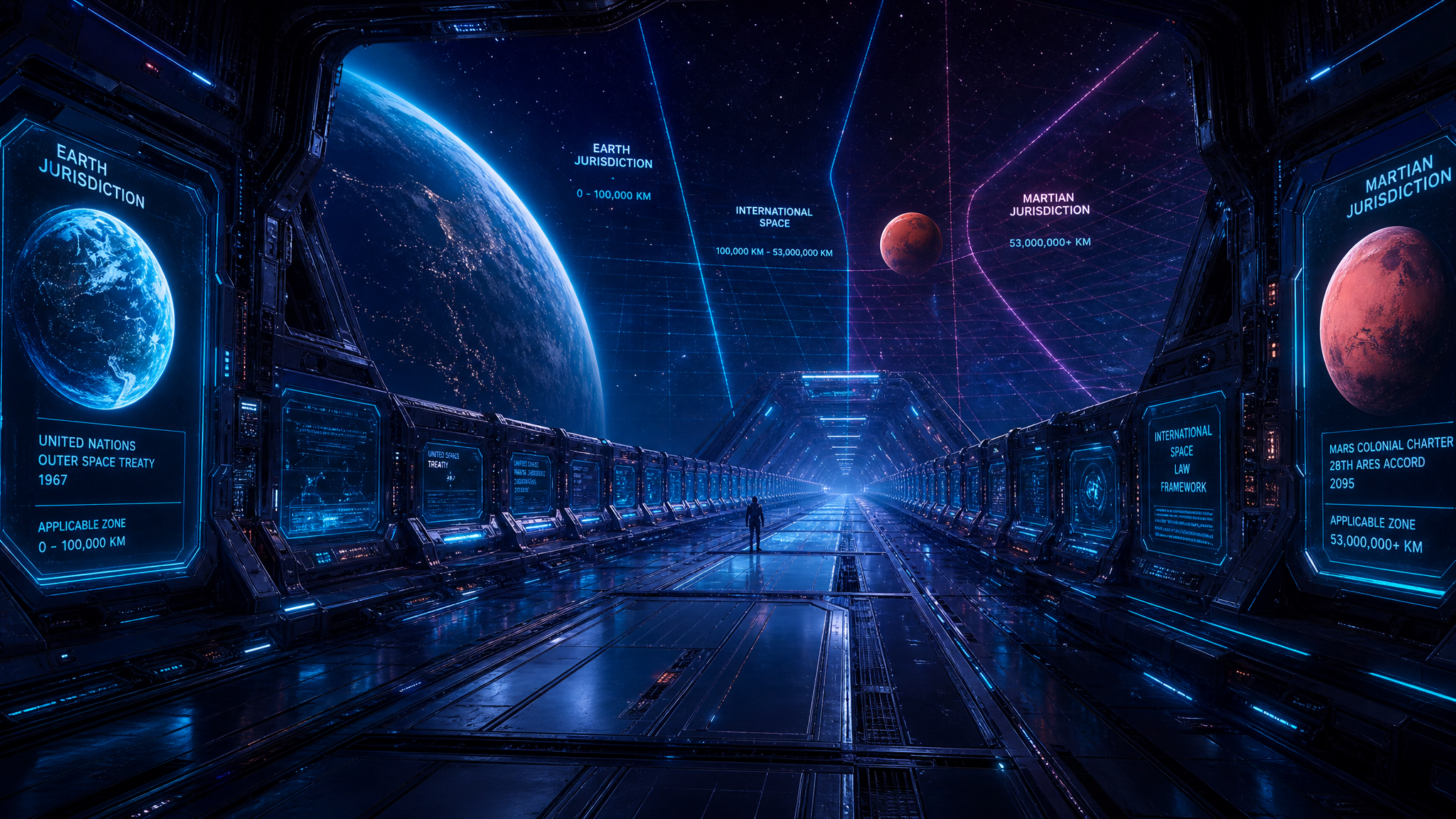
Six months of silence, then a question
Picture the scene not on Mars, but 300,000 kilometres from Earth, when the planet has already shrunk to a bright coin and the destination is still months away. A Starship-class vehicle, designed around the prospect of carrying roughly a hundred people, is no longer meaningfully under the day-to-day reach of any terrestrial court, police force or regulator. A medical emergency breaks out. A life-support algorithm reallocates power. A dispute over command authority escalates. Someone wants to revoke an autonomous system’s permissions before it opens, locks or depressurises a compartment.
At that moment, the central question of the space age is not propulsion. It is governance.
Humanity has spent decades learning how to launch further, land more precisely and automate more capably. It has been far slower to answer a simpler question: which rules apply between worlds, and who can enforce them? The gap matters because the transit corridor from Earth orbit to Mars is not a poetic abstraction. It is a long-duration, high-risk operational environment in which human rights, contractual duties, safety rules, command authority, machine autonomy and political jurisdiction will collide.
Space law exists, of course. But it was largely written for an era of flags, capsules and superpower symbolism, not one of reusable heavy-lift systems, mixed public-private missions, software-defined spacecraft and semi-autonomous habitats. The legal architecture now in force gives us principles. It does not yet give us a credible operating system for civilisation in transit.
That is where a distinction becomes useful. The Sovereign Standard is best understood as a broad, open framework for retaining sovereignty in the AI age across identity, data, money, health, governance and frontier environments such as space. It is not a legal right and not a jurisdiction. Within it, F-ACT — the Framework for Agent Conformance & Trust — provides the neutral, vendor-neutral agent-governance standard whose normative core is ASDAR: Authority, Scope, Data, Audit, Revocation. And the practical mechanism for implementation is Society OS’s 42 Protocols, a deployable stack spanning identity, trust and executable governance.
None of this supplants public law. Nor can it. But for the Mars transit corridor, where law is sparse and execution conditions are unforgiving, such machinery may prove essential.
The law we have: elegant principles, thin operations
The foundational text of space law remains the 1967 Outer Space Treaty. It is a remarkably durable document. It establishes that outer space is the province of all humankind; forbids national appropriation by claim of sovereignty, use or occupation; requires that space be used for peaceful purposes; and makes states internationally responsible for national activities in outer space, including those carried out by non-governmental entities.
That last point matters enormously. Even when a private company launches the spacecraft, the relevant state remains on the hook under international law. Article VI requires authorisation and continuing supervision of non-governmental activity. Article VIII provides that a state retains jurisdiction and control over objects launched into outer space and over personnel thereof while in outer space or on a celestial body, if those objects are carried on its registry.
These are powerful rules. But they are rules of allocation and responsibility, not a complete operating manual for a six-month civilian voyage to Mars.
The treaty says little about the internal governance of a mixed crew and passenger complement, about private contractual ordering aboard a spacecraft, about the evidentiary status of machine decisions, about software permissions, or about conflicts between launch-state jurisdiction, nationality-based claims and mission-specific governance documents. It certainly does not tell us what to do when a governed agent network becomes the de facto manager of air, heat, food, medical triage and mobility.
Subsequent instruments fill some gaps but leave many others untouched.
- The Rescue Agreement elaborates duties to assist astronauts.
- The Liability Convention addresses damage caused by space objects.
- The Registration Convention formalises registry obligations.
- The Moon Agreement of 1979 attempts a broader framework for celestial bodies and resources, but major spacefaring powers have not ratified it, sharply limiting its practical reach.
In the 2020s, the Artemis Accords added an important layer of political coordination around civil space exploration, including interoperability, transparency, emergency assistance, registration, release of scientific data, preservation of outer-space heritage and the use of safety zones. Yet the Accords are non-binding political commitments, not a comprehensive code for interplanetary passage. They illuminate norms around lunar and deeper-space activity; they do not settle the legal and operational constitution of a vessel halfway to Mars.
Meanwhile the activity is becoming real. NASA’s Artemis programme is restoring deep-space human capability. China’s Chang’e programme has established serious lunar ambition. NASA’s Psyche mission points to a future in which deep-space operations and industrial questions will only grow. And SpaceX’s Starship has shifted the scale of the conceivable: not a handful of specialists in cramped capsules, but large transport architectures carrying cargo, systems and eventually communities.
The legal question is therefore no longer speculative in the old sense. It is preparatory in the urgent sense.
The corridor is not empty. It is densely governed by systems
There is a habit in legal writing about space to speak of a vacuum. Physically, yes. Institutionally, the reality is more paradoxical. The Mars transit corridor is not empty; it is saturated with systems.
A long-duration spacecraft will be held together not only by hull and fuel, but by software permissions, identity credentials, scheduling logic, resource allocation models, maintenance agents, medical diagnostics, environmental monitoring, communication routing and emergency procedures. Even before genuine general-purpose autonomy arrives, mission operations will rely on layered automation simply because no crew can manually supervise every valve, battery loop, docking protocol, air mix, dosage schedule and predictive maintenance alert.
This creates a new constitutional fact. Whoever governs the system permissions governs the lived reality of the voyage.
That is why terrestrial analogies break down so quickly. A ship at sea, an aircraft over international waters or a research station in Antarctica all have legal relevance. Yet none is a perfect fit for a closed, software-mediated habitat where latency, remoteness and engineering interdependence mean that almost every meaningful action is conditioned by machine authorisation.
On a Mars transfer vehicle, governance is not only a matter of statutes and contracts. It is a matter of executable authority.
Whoever governs the system permissions governs the lived reality of the voyage.
Consider just a few plausible disputes:
- A passenger refuses a quarantine order after signs of infectious illness.
- A medical agent recommends sedation contrary to the passenger’s instructions.
- A maintenance agent locks out a compartment because of fire risk, trapping essential supplies.
- A corporate operator attempts to reprioritise power from communal areas to high-value scientific payloads.
- A crew member seeks to override habitat allocations made by an optimisation system.
- A married couple from one jurisdiction dispute custody or guardianship decisions involving an embryo, child or dependent aboard.
In each case, one may eventually ask what a court on Earth would think. But on the spacecraft, the first-order question is simpler: who or what has authority to act now?
That is the domain in which governance standards matter. Not as a substitute for law, but as the means by which law, policy and mission rules become operational under conditions of delay, scarcity and risk.
Why existing space governance will strain under settlement-scale transport
The traditional space governance model assumes a relatively small number of actors: states, agencies, prime contractors, trained astronauts and clearly bounded missions. Starship-class transport pressures every part of that model.
First, it changes the sociology of spaceflight. A vehicle carrying scores of people begins to look less like an expedition and more like a travelling jurisdictional puzzle. The passenger list may include employees, researchers, tourists, settlers, dual nationals, contractors, children and medical dependants. Their expectations about due process, privacy, bodily autonomy, labour conditions, data use and emergency powers will differ.
Secondly, it changes the economics of authority. The launch provider, mission operator, habitat operator, life-support vendor, communications provider, insurer and destination authority may all be distinct entities with overlapping contractual claims. The neat idea that one state simply supervises one operator becomes harder to sustain as supply chains internationalise and governance fragments.
Thirdly, it changes the tempo of decision-making. Round-trip communications delay between Earth and Mars can stretch from several minutes to approaching three-quarters of an hour depending on orbital positions. That is enough to break many assumptions about real-time remote oversight. In a crisis, there is no practical possibility of waiting for terrestrial instruction.
Finally, it changes the role of AI. Off-world systems will not merely assist with clerical work. They will increasingly mediate safety-critical operations. Air, water, radiation management, predictive maintenance, robotic inspection, medical monitoring, cargo handling and local resource planning will all push towards more autonomous operation because autonomy is efficient, resilient and, in some cases, unavoidable.
This is exactly where legal principle alone is inadequate. A command hierarchy scribbled in a policy binder does not tell a life-support orchestration system whose instruction should take precedence when a passenger’s health directive conflicts with vehicle-wide emergency protocol.
In deep space, governance fails not when principles are absent, but when authority cannot be executed cleanly under pressure.
From legal text to executable order
The hard problem, then, is translation. How do broad legal duties and mission norms become an operational order that humans and machines can actually follow?
This is the contribution Society OS is trying to make in frontier settings. Not by proclaiming a new law of space, and certainly not by claiming sovereign power over space, but by offering an implementable framework.
At the highest level sits The Sovereign Standard: an open, published, stewarded framework for retaining sovereignty in the AI age. Its relevance to space is straightforward. If human beings are to remain meaningfully sovereign while acting through software, data systems and autonomous agents, then identity, consent, authority, auditability and revocation must survive the journey off-world.
The mechanism is the 42 Protocols — the deployable stack that operationalises the Sovereign Standard across six domains: Individual, Economy, Enterprise, State, Mind and Infrastructure. In space, three elements are especially salient:
- Human-Twin-Agent identity, establishing who acts, on whose authority, and through which delegated machine counterpart.
- HEARTrank, defining what is trusted, by whom, and under what evidence.
- WISE Contracts, which execute law, not merely code, by binding actions to recognised authority and constraints.
The phrase Society OS uses is apt: Govern before execution — not after. In the Mars corridor, that is not a slogan but a design requirement.
If a habitat management system can open an airlock, alter an oxygen mix, disclose medical data or allocate rationing priorities, then those powers should not be left to improvised dashboards, opaque vendor defaults or broad administrator credentials. They should be bound to explicit authority, bounded scope, known data permissions, auditable logs and reliable revocation pathways.
That is precisely the point of F-ACT.
F-ACT for off-world autonomy
F-ACT, the Framework for Agent Conformance & Trust, is the agent-governance pillar within the Sovereign Standard. It is narrow where the broader framework is wide: a neutral, open standard for governing AI agents and autonomous systems.
In deep space, governance fails not when principles are absent, but when authority cannot be executed cleanly under pressure.
Its normative core, ASDAR — Authority, Scope, Data, Audit, Revocation — is particularly well-suited to space operations.
Authority
Which human, office, mission role or legal instrument gave an agent power to act? On a Mars vessel, authority may derive from launch-state requirements, mission charters, emergency medical protocols, employment contracts or passenger covenants. F-ACT requires that this authority be explicit rather than assumed.
Scope
What exactly may the agent do? Recommend, notify, throttle, lock, unlock, diagnose, purchase, route, isolate, ration, or command? Scope is the difference between a monitoring assistant and a system empowered to alter life-support priorities.
Data
What information may the agent access, process, share or retain? In a closed habitat, the data exhaust of ordinary life will be intimate beyond anything familiar on Earth: biometric streams, location traces, psychological assessments, medication records and conflict reports. Data governance cannot be a footnote.
Audit
What happened, when, why and under whose delegated authority? Audit is not bureaucratic decoration. In high-risk environments it is the basis for accountability, for post-incident learning and for later legal review.
Revocation
How is power withdrawn safely? This may be the most underrated element. A system that cannot be revoked without jeopardising the vehicle is not truly governed. Off-world autonomy must degrade gracefully when authority is rescinded.
F-ACT also defines conformance tiers: L0 Unattested, L1 Declared, L2 Enforced, L3 Provable. For a consumer chatbot, declared controls may be enough. For radiation shielding controls, medical triage or pressure integrity management in deep space, the acceptable floor is plainly higher. Over time, one can imagine mission classes specifying which functions require L2 Enforced or L3 Provable conformance before use.
That would not replace national licensing, insurance conditions or agency standards. It would give them an execution grammar.
A constitutional stack for the journey between worlds
The most useful way to think about the problem is as a stack.
At the top sit public law and international commitments: the Outer Space Treaty, domestic licensing law, safety regulation, liability rules, contractual obligations and mission agreements. Beneath that sits organisational governance: the mission charter, command hierarchy, medical protocols, dispute rules and passenger rights. Beneath that sits technical execution: identities, permissions, logs, trust scores, machine constraints and revocation controls.
Today, these layers are often only loosely connected. The legal team drafts clauses. The engineering team configures systems. The operations team improvises workarounds. The result may function on Earth, where courts, regulators and physical access remain available. It is much less robust in deep space.
The 42 Protocols offer one possible way to knit the layers together.
Imagine a Mars transfer mission in which every critical human and machine actor is instantiated through a Human-Twin-Agent model. Each passenger, medic, commander, maintenance unit and habitat subsystem has a recognised identity, a bounded role and machine-readable delegations. HEARTrank provides a trust layer so that mission-critical systems can weigh attested status, provenance and reliability rather than simply accepting any credential that appears syntactically valid. WISE Contracts then encode mission rules in a form that can actually govern execution: who can trigger quarantine, under what evidential threshold, with what duration, appeal path and logging requirement.
This matters because many disputes in space will not look like constitutional theory. They will look like edge cases.
- Can a pregnant passenger pre-authorise or deny certain emergency interventions?
- Can a habitat AI reveal a crew member’s psychiatric episode to all command staff, or only the medical chain?
- Can mission command on Earth suspend a local commander’s privileges after communications latency and partial evidence?
- Can a privately owned service robot continue operating after the owner’s death, incapacity or debt default?
- Can a destination settlement enforce pre-landing biosecurity rules before touchdown?
A governance stack that is complete by construction does not answer these politically. Human institutions still must. But once they decide, the stack makes those decisions executable.
That is the missing middle in space governance: not more rhetoric about the future of humanity, but the machinery by which authority is expressed cleanly under off-world conditions.
When human beings leave Earth for months at a time, they should not leave accountable governance behind.
What space law should do next
The point is not that a private framework should outrun public institutions. It is that public institutions should define the interfaces through which such frameworks can be used responsibly.
Several practical moves suggest themselves.
First, recognise transit governance as a distinct legal problem
Space law and policy still tend to focus on launch, orbital operations and surface activity. The interplanetary corridor needs explicit treatment: command, passenger status, medical authority, data rights, incident investigation, autonomous systems and emergency derogations.
Secondly, tie licensing to operational governance requirements
National authorisation and continuing supervision under the Outer Space Treaty could evolve to require more detailed governance artefacts for long-duration human missions: mission constitutions, dispute protocols, autonomy registers, incident logging standards and revocation procedures.
Thirdly, define assurance classes for autonomous functions
Not every off-world system is equally sensitive. A music recommender is not life support. Regulators, agencies and insurers could classify functions by consequence and require corresponding conformance levels, whether through F-ACT or another open standard with similar properties.
Fourthly, establish interoperability norms early
The future will not belong to one vehicle, one state or one company. Artemis-related systems, commercial logistics, scientific missions and, eventually, Chinese and other architectures will coexist. Governance standards that are open and vendor-neutral stand a better chance of becoming common rails than proprietary control planes.
Finally, protect human sovereignty in machine-mediated environments
The deeper issue is anthropological as much as legal. A habitat dense with automation can quietly erode human agency if convenience, safety and optimisation are allowed to outrank consent and review in every case. Space settlements will be brittle enough without importing opaque digital feudalism.
That is why the Sovereign Standard has force as a framing device. It insists that as systems become more capable, the human person and legitimate institution must remain legible within them.
Mars will not wait for jurisprudence
History suggests that governance usually lags infrastructure. Railways, radio, aviation, the internet and social media all scaled faster than the institutions meant to civilise them. Space is unlikely to be different. Starship, whether on its exact current timetable or a later one, has already changed the ambition function of the sector. It has made mass, cadence and settlement-scale transport thinkable in a way few programmes previously did.
Once that mental threshold is crossed, the governance deficit becomes impossible to ignore.
The danger is not simply legal ambiguity in the abstract. It is that norms will be set accidentally by whichever operator first ships code, writes the passenger terms, controls the credential server or defines the emergency override table. In other words, the constitution of interplanetary life could emerge not from public deliberation, but from systems integration.
That would be a profound mistake.
The better path is to treat the Mars transit corridor as what it is becoming: a new civic environment. It will require international law, national law, mission governance and machine-executable controls to work in concert. Public authority must remain primary. But it will need practical instruments. In that role, open frameworks such as the Sovereign Standard, technical governance layers such as F-ACT, and implementation mechanisms such as the 42 Protocols deserve serious attention.
The objective is modest in wording and radical in implication: when human beings leave Earth for months at a time, they should not leave accountable governance behind.
42 years. 42 protocols. 42 papers. The phrase is deliberately long-range. So is the problem. The first durable constitutional order between Earth and Mars will not arrive as a single treaty clause or company handbook. It will be assembled, layer by layer, from law, standards, software and institutional design.
The voyage to Mars may become the defining transport corridor of the century. Before it fills with passengers, cargo and autonomous systems, it needs rules that can survive the silence between planets.
Sources & Further Reading
- 1.United Nations Office for Outer Space Affairs — Treaty on Principles Governing the Activities of States in the Exploration and Use of Outer Space
- 2.United Nations Office for Outer Space Affairs — Agreement Governing the Activities of States on the Moon and Other Celestial Bodies
- 3.NASA — Artemis Accords
- 4.NASA — Artemis
- 5.NASA — Psyche Mission
- 6.China National Space Administration / Lunar Exploration and Space Program Center — Chang'e programme overview
- 7.SpaceX — Starship