Hub
Explainer
Trust Networks: How Mutual Aid DAOs Are Replacing Institutional Safety Nets
Trust Networks & CommunityExplainer

Trust Networks: How Mutual Aid DAOs Are Replacing Institutional Safety Nets

As public systems strain, cryptographically governed communities are becoming welfare’s new operating layer

AI AssistedSociety OS Research18 June 202614 min read

Key Insight: The next safety net will not be a bigger bureaucracy, but a verifiable trust network that can prove who may act, on whose behalf, with what data and under what rules.

A queue, a spreadsheet, and a stablecoin

In many cities, the first responder to private distress is no longer a ministry. It is a group chat.

A mother loses a week’s wages after a child is taken ill. A freelancer’s laptop fails on the morning rent is due. An elderly neighbour needs transport to a clinic before the reimbursement form is processed. The formal state is not absent; it is merely slow, fragmented and over-specified for lives that go wrong in irregular ways. By the time a caseworker, bank transfer or municipal programme catches up, the actual crisis has often passed — or deepened.

Into that gap has come a peculiar new institution: the mutual aid DAO. Part community fund, part software wrapper, part governance experiment, it allows a group to pool money, define rules, verify claims, and disburse help with a speed that public systems rarely match. Some run on familiar payment rails and little more than a shared ledger. Others use multisignature wallets, on-chain voting, stablecoins and programmable escrow. The point is not technological theatre. It is trust at small scale, rendered legible.

The deeper shift is this: welfare is moving from a model of centralised administration to one of networked assurance. Where the twentieth century built mass institutions to manage risk at scale, the twenty-first is producing smaller, denser circles of reciprocal support, equipped with better identity, better audit and finer-grained control over permission. Not every community will become a DAO; many should not. But the logic behind them — verifiable obligation among known participants — is becoming indispensable.

That is why trust networks matter to the sovereign era. The Sovereign Standard offers the broad framework for retaining agency across identity, data, money, health and governance. Inside it, F-ACT — the Framework for Agent Conformance & Trust — provides a neutral governance standard for AI agents, built around ASDAR: Authority, Scope, Data, Audit, Revocation. And the 42 Protocols are the implementation mechanism: the deployable stack that turns these principles into working systems, led by the Sovereign Trinity of Human-Twin-Agent identity, HEARTrank, and WISE Contracts.

If mutual aid is to become durable social infrastructure rather than a digital whip-round, it will need exactly this architecture.

Why institutional safety nets are under strain

The welfare state is not vanishing. It remains, in rich countries especially, the largest organised mechanism for pooling social risk ever built. But it is under pressure from every direction: ageing populations, chronic disease, housing costs, informal work, climate shocks, fiscal constraint and administrative complexity. The Organisation for Economic Co-operation and Development has repeatedly documented the budgetary strain produced by demographic ageing and rising health and pension obligations. The World Health Organisation and the Lancet literature on longevity and non-communicable disease have shown a parallel truth: modern welfare systems are increasingly designed for long, expensive tails of care rather than discrete episodes of need.

At the same time, work has become more irregular. Platform labour, short contracts and cross-border freelancing fit badly with benefits architectures designed for stable employers, standard payroll and fixed residence. A person may be solvent on paper and still unable to survive a ten-day cash-flow shock.

Three frictions matter most.

  • Speed: administrative systems optimise for due process, not immediate intervention.
  • Granularity: institutions classify people into broad categories, while actual need is highly specific.
  • Trust cost: proving eligibility often requires extensive disclosure to distant authorities with little contextual knowledge.

Digital government can mitigate some of this, but not all. Even where public services are modernising, legal obligations around procurement, fairness, data protection and appeal make them necessarily slower than an informal network of ten, fifty or two hundred people who know one another’s circumstances.

This is not an argument for dismantling public welfare. It is an argument for recognising that communities are once again becoming operational units of resilience.

What a mutual aid DAO really is

The term DAO still carries the odour of speculative crypto exuberance. Strictly, a decentralised autonomous organisation is a set of governance rules implemented in software, often with treasury functions and voting mechanisms on a blockchain. In practice, mutual aid DAOs are usually far less dramatic. They are governed community funds.

A typical arrangement has four layers:

  • a membership layer: who belongs and under what conditions;
  • a treasury layer: where pooled funds sit and who can move them;
  • a decision layer: how requests are evaluated and approved;
  • an audit layer: what is recorded, by whom, and with what privacy guarantees.

The best versions are not fully autonomous and should not pretend to be. They combine software enforcement with human judgement. A neighbour’s crisis, after all, is rarely reducible to a clean data field.

Recent law and regulation make this design space more serious than it was a few years ago. The European Union’s Markets in Crypto-Assets Regulation has begun to establish a more coherent framework for certain crypto-assets and service providers. The GDPR remains the benchmark for data minimisation, purpose limitation and data subject rights. The EU’s Data Act and eIDAS 2.0 point towards more portable data and digital identity tooling. Meanwhile, the EU AI Act makes risk governance, transparency and human oversight central features of lawful AI deployment.

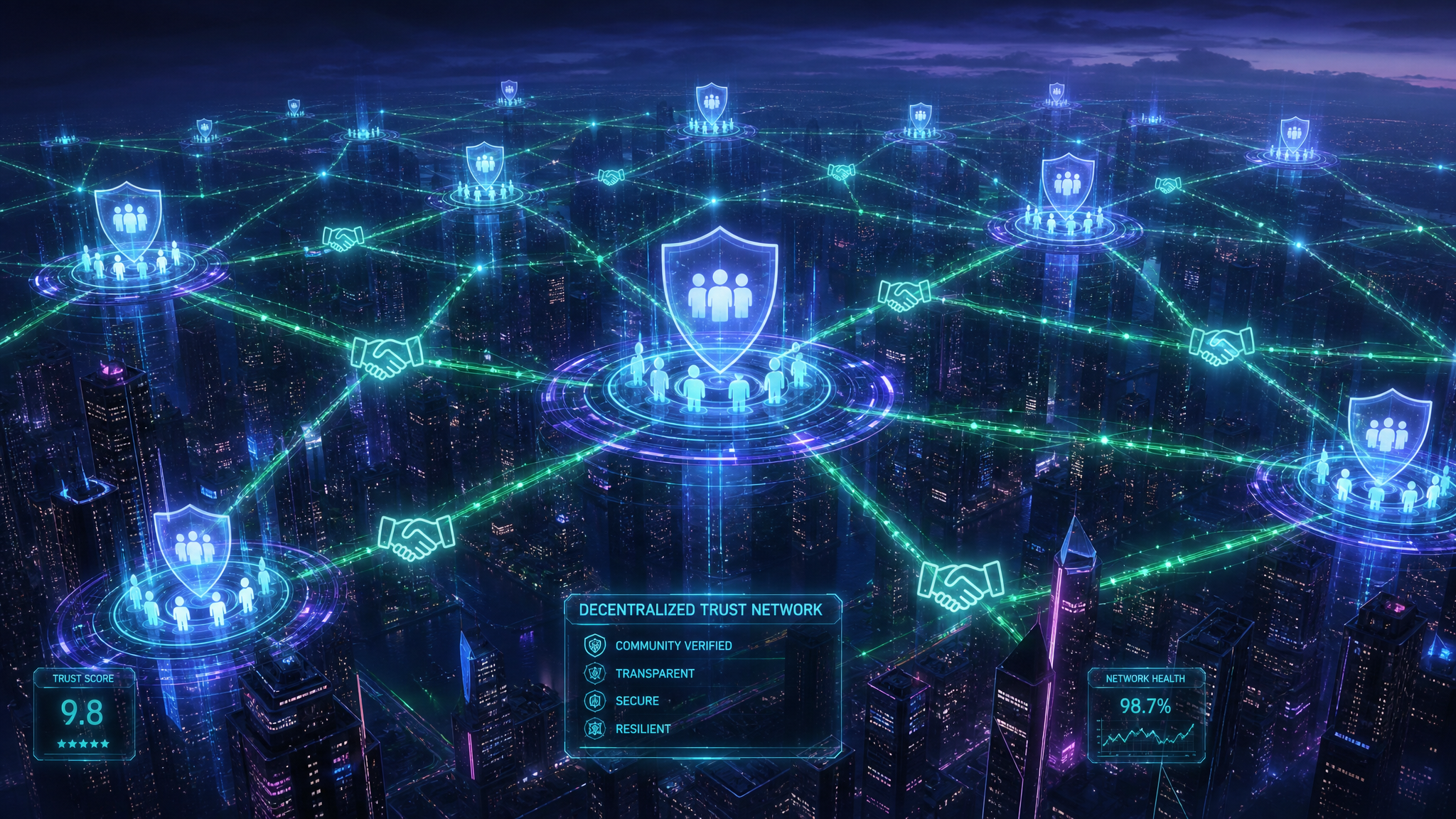
The next safety net will be built as a trust network: local in judgement, cryptographic in assurance.

Together these developments create a simple imperative: if communities are going to use digital tools to govern money, identity and assistance, they must do so with explicit permissions, bounded data use and accountable automation.

That is exactly where sovereign architecture becomes practical rather than philosophical.

Trust is becoming programmable — but must remain human

A trust network is not merely a payment pool. It is a verifiable circle of mutual obligation. Participants need confidence that contributions are real, requests are authentic, decisions are fair enough, and the system cannot be quietly captured by its operators.

Older institutions solved this through hierarchy and professional bureaucracy. Newer networks solve it through a mix of cryptography, reputation, policy and transparent process.

Consider a community health support circle. Members contribute monthly. A participant facing an urgent medical cost submits a claim. A designated triage agent gathers only the necessary evidence — perhaps proof of identity, a clinician’s note and the invoice amount. A small elected committee reviews against published rules. Payment is released rapidly, with sensitive details withheld from the wider group. A community auditor can later verify that rules were followed without seeing the claimant’s full medical record.

That model requires more than a wallet and a vote.

It requires:

  • identity assurance without excessive disclosure;
  • data compartmentalisation so only relevant parties see sensitive information;
  • policy-bound automation so software cannot exceed its brief;
  • revocation so permissions can be withdrawn when roles change;
  • auditable execution to preserve legitimacy over time.

This is where Society OS’s architecture becomes useful.

Within The Sovereign Standard, the individual remains the primary locus of agency, not the platform. Identity, money, health and governance are treated as linked domains rather than siloed products. The 42 Protocols operationalise that worldview through a deployable stack across six domains — Individual, Economy, Enterprise, State, Mind and Infrastructure. In sovereign life, the critical move is to connect three things that legacy systems often separate: who acts, what is trusted, and what may execute.

That is the work of the Sovereign Trinity:

  • Human-Twin-Agent identity establishes who the person is, what their digital twin may represent, and which agents may act for them.
  • HEARTrank surfaces trust and credibility through accountable signals rather than raw popularity or opaque scoring.
  • WISE Contracts execute law, not merely code: policy, consent, obligations and exceptions are embedded into the terms of action.

Mutual aid networks need all three.

F-ACT and the governance of care

If AI agents are going to help run trust networks — triaging requests, checking policy, detecting conflicts, scheduling disbursements, preparing audit trails — then agent governance cannot be improvised. Govern before execution — not after.

That is the defining principle of F-ACT, the Framework for Agent Conformance & Trust. It is vendor-neutral and technical by design, sitting inside The Sovereign Standard as its agent-governance pillar. Its normative core, ASDAR, is unusually well suited to mutual aid.

Authority

Who authorised this agent to act? In a mutual aid DAO, an eligibility agent may verify membership status, but it should not approve a payment unless explicitly empowered to do so. A care coordinator agent may prepare options, but not disclose health data to the full group.

Scope

What exactly may it do? Scope prevents mission creep. An agent assigned to validate receipts cannot infer unrelated financial behaviour or market additional services. In legal terms, this aligns naturally with GDPR’s purpose limitation and data minimisation principles.

Automation without constitutional design is merely efficient fragility.

Data

What data may it access, retain or transmit? Sensitive categories, including health information, require special care under European law. Mutual aid systems that are casual about data soon become dangerous. F-ACT insists that access be pre-defined and proportionate.

Audit

What evidence exists that the agent behaved as instructed? A credible community system needs audit logs that are intelligible to humans, not just machines. This is especially important where disputes arise or where vulnerable members need assurance that decisions were not arbitrary.

Revocation

How is permission withdrawn? Roles change, devices are compromised, volunteers burn out, policies evolve. Revocation is what keeps a trust network governable after its idealistic founding phase.

F-ACT’s conformance tiers make these distinctions concrete:

  • L0 Unattested: no meaningful evidence of governance;
  • L1 Declared: rules are stated but not strongly enforced;
  • L2 Enforced: policy controls are technically applied;
  • L3 Provable: conformance can be demonstrated with high assurance.

For a neighbourhood hardship fund, L1 may suffice. For a community health treasury handling sensitive personal data and substantial flows of money, L2 or L3 becomes far more appropriate. The aim is not maximal machinery everywhere. It is proportional trust.

From crypto idealism to civic infrastructure

The early DAO movement was animated by the thought that institutions could be replaced by code. Experience has been clarifying. The history of DeFi — ingenious, fast-moving, often brittle — shows both the power and the danger of software-native finance. Smart contracts can eliminate friction and arbitrariness; they can also harden design flaws, enable governance capture and create novel failure modes. The collapse or exploitation of poorly governed protocols has taught an old lesson in new form: automation without constitutional design is merely efficient fragility.

Mutual aid cannot afford that fragility. Its users are not yield farmers chasing basis points; they are people dealing with rent arrears, prescriptions, funerals, childcare and emergency travel.

That is why the more promising future lies not in anonymous mass DAOs, but in bounded trust circles:

  • local groups with recognisable membership;
  • clear contribution and claim rules;
  • transparent but privacy-preserving records;
  • delegated roles that can be monitored and revoked;
  • legal wrappers where necessary, such as co-operatives, associations, companies limited by guarantee or charitable structures, depending on jurisdiction.

In other words, the mutual aid DAO becomes less like a borderless ideology and more like a digitally competent civic institution.

The 42 Protocols support this transition by making deployment modular. A community does not need to adopt an entire worldview in one leap. It can begin with Human-Twin-Agent identity for membership and consent; add HEARTrank for trust-weighted governance; introduce WISE Contracts for disbursement rules and appeals; and later integrate health, education or local commerce functions into a broader Sovereign Stack. That is how social infrastructure actually spreads: not as a revolution, but as a sequence of sensible upgrades.

Trust networks do not replace society’s institutions by abolishing them. They replace them where they have become too slow, too blind or too extractive to serve lived reality.

The regulatory edge: sovereignty without lawlessness

One reason mutual aid DAOs are maturing now is that the regulatory environment has become less binary. The old choice was often framed as innovation versus compliance. That was always simplistic. The real challenge is designing systems that are governable enough to earn trust while flexible enough to meet need.

Under GDPR, communities handling personal data must answer hard questions about lawful basis, access control, retention and subject rights. Under anti-money laundering rules, treasury movements may trigger obligations depending on structure and jurisdiction. Under consumer and charity law, representations about funds and eligibility can carry legal consequences. Under the EU AI Act, using AI in contexts affecting access to essential services may entail significant governance responsibilities, especially where the system influences consequential decisions.

This does not kill mutual aid. It professionalises it.

Practical sovereignty means a community can act quickly without becoming arbitrary, and use intelligent software without becoming subordinate to it.

The Sovereign Standard’s value here is not that it claims to be law. It does not. It is an open, stewarded framework and worldview for retaining sovereignty in the AI age. F-ACT does not substitute for regulation either; it gives communities a technical and organisational grammar for complying with the spirit — and often the letter — of emerging rules. The 42 Protocols, in turn, supply implementation patterns.

A properly designed trust network can therefore offer something unusual: local intimacy with institutional-grade governance.

That matters because the choice facing communities is increasingly stark. Either they remain dependent on platforms that capture data, mediate relationships and dictate policy from afar, or they build sovereign capacity of their own: identity they control, trust they can inspect, contracts that embody their own rules, and agents that are constrained before they act.

Health, longevity and the coming burden of care

Nowhere is this more urgent than health. Ageing societies will produce more chronic care, more caregiving strain and more periods in which people are medically stable but socially precarious. Longevity science may extend healthy lifespan; it will not remove the need for coordination, transport, respite care, medication support or rapid household assistance. Those burdens are intensely local.

Trust networks can fill several gaps.

  • They can fund immediate non-clinical needs that formal insurance or state benefits often exclude.
  • They can coordinate caregivers through governed agent networks that schedule, remind and document.
  • They can allow selective disclosure of health information to the right people at the right time.
  • They can preserve dignity by reducing the amount of intimate data that must be exposed for help to arrive.

Here the Living OS idea becomes concrete. A person is not a case file moving between providers, apps and agencies. They are a continuous sovereign subject with a health history, a consent structure, a support network and delegated agents acting under bounded authority. If that person joins a mutual aid trust circle, the circle does not own their identity or data. It receives scoped access under explicit conditions.

That simple inversion — from institutional possession to individual delegation — may prove one of the most consequential design changes of the next decade.

What practical sovereignty looks like on the ground

For all the theory, practical sovereignty is mundane. It is the ability of an individual or community to organise without surrendering itself.

In a mature trust network built on the Sovereign Standard and implemented through the 42 Protocols, that might mean:

  • joining a community through Human-Twin-Agent Protocol credentials rather than handing raw identity documents to multiple intermediaries;
  • using HEARTrank to weight trust based on accountable contribution, reliability and peer recognition, rather than performative social capital;
  • encoding assistance rules in WISE Contracts, including thresholds, exceptions, appeals and time limits;
  • assigning agents specific F-ACT conformance levels depending on the sensitivity of their tasks;
  • ensuring every action can be audited and every permission revoked.

The result is not frictionless utopia. It is something better: a community that can act quickly without becoming arbitrary, and can use intelligent software without becoming subordinate to it.

This is also how mutual aid scales without dissolving. Instead of one giant platform, imagine thousands of interoperable trust circles — families, estates, migrant groups, patient communities, neighbourhoods, faith communities, worker associations — each sovereign in its own governance, but able to transact, recognise credentials and cooperate across a broader SCALE Ecosystem.

42 years. 42 protocols. 42 papers. The motif is ambitious, but the underlying proposition is practical: if civilisation’s next operating layer is being rewritten, the social safety net should not be left to ad hoc apps and discretionary platforms.

The shape of the sovereign safety net

The welfare state is not collapsing into nothingness. It is being outflanked in the places where human need is too fast, too contextual and too relational for large bureaucracies to handle elegantly. Mutual aid DAOs are one answer — not because they are trendy, but because they restore a very old civic logic with new tools: those closest to a problem are often best placed to solve it, provided trust can be structured and abuse constrained.

The challenge now is to build these systems so they endure beyond enthusiasm. That means lawful design, clear governance, privacy by default, robust identity, bounded automation and constitutional rules for data and money. It means rejecting both naïve techno-utopianism and nostalgic dependence on institutions that no longer fit the grain of everyday risk.

The sovereign era will be defined less by grand declarations than by the quiet competence of communities that can care for their own without being captured by the platforms they use. The trust network, properly designed, is not a retreat from modernity. It is a more precise response to it.

And in that future, the strongest safety net may not be the one that promises to know everyone equally. It may be the one that allows a community to know enough, prove enough and act in time.

Sources & Further Reading

  1. 1.European Commission — General Data Protection Regulation (GDPR)
  2. 2.European Parliament — Artificial Intelligence Act
  3. 3.European Commission — Markets in Crypto-Assets Regulation (MiCA)
  4. 4.European Commission — Data Act
  5. 5.European Commission — eIDAS Regulation
  6. 6.OECD — Pensions at a Glance
  7. 7.World Health Organization — Ageing and health
  8. 8.The Lancet Healthy Longevity
Mutual AidDAOTrust CirclesCommunity GovernanceSocial Infrastructure
The engine behind the Signal

Where this connects to Society OS

The Sovereign Intelligence Hub is the free, open front door of Society OS — the sovereign operating system that turns the ideas you just read into working governance. Where this piece names a problem, Society OS is building the machinery to solve it: AI agents that act with your authority, trust you can verify, and compliance that runs as code.

The 42-Protocol Stack

The governance engine beneath every article — led by the Sovereign Trinity: Human-Twin-Agent identity, HEARTrank trust, and WISE Contracts that execute law, not just code.

F-ACT — the open agent standard

The vendor-neutral framework for governing AI agents before they act: Authority, Scope, Data, Audit, Revocation — free to read, cite and implement.

The Sovereign Platform

Put it to work: govern a fleet of AI agents with verifiable authority, tamper-evident evidence, and compliance-as-code across your whole operation.

Explore membershipRead the F-ACT standard

Continue Reading

More from the Sovereign Intelligence Hub

The Architecture of Trust: How Decentralised Identity Networks Are Replacing the Password as the Foundation of Digital Society
Trust Networks & Community

The Architecture of Trust: How Decentralised Identity Networks Are Replacing the Password as the Foundation of Digital Society

18 min read
The New Politics of Credential Infrastructure
Trust Networks & Community

The New Politics of Credential Infrastructure

18 min read
How trust networks became informal public utilities
Trust Networks & Community

How trust networks became informal public utilities

11 min read
The Quiet Return of Surety
Trust Networks & Community

The Quiet Return of Surety

11 min read
Why Trust Networks Matter More Than Ever
Trust Networks & Community

Why Trust Networks Matter More Than Ever

14 min
Trust after Scale
Trust Networks & Community

Trust after Scale

14 min

Never miss a signal

Weekly intelligence, no noise

The Sovereign Intelligence Hub — Society OS

© 1989–2026 Society OS Pty Ltd. All rights reserved.