The collision that law cannot quite see
At roughly 28,000 kilometres an hour, a mistake in orbit does not remain a mistake for long. A fleck of paint can pit a window. A spent bolt can cripple a satellite. A dead spacecraft, left aloft for years because nobody could quite agree who should move it, can become a high-velocity hazard to everything that passes nearby.
This is usually described as an engineering problem. It is not. It is a sovereignty problem.
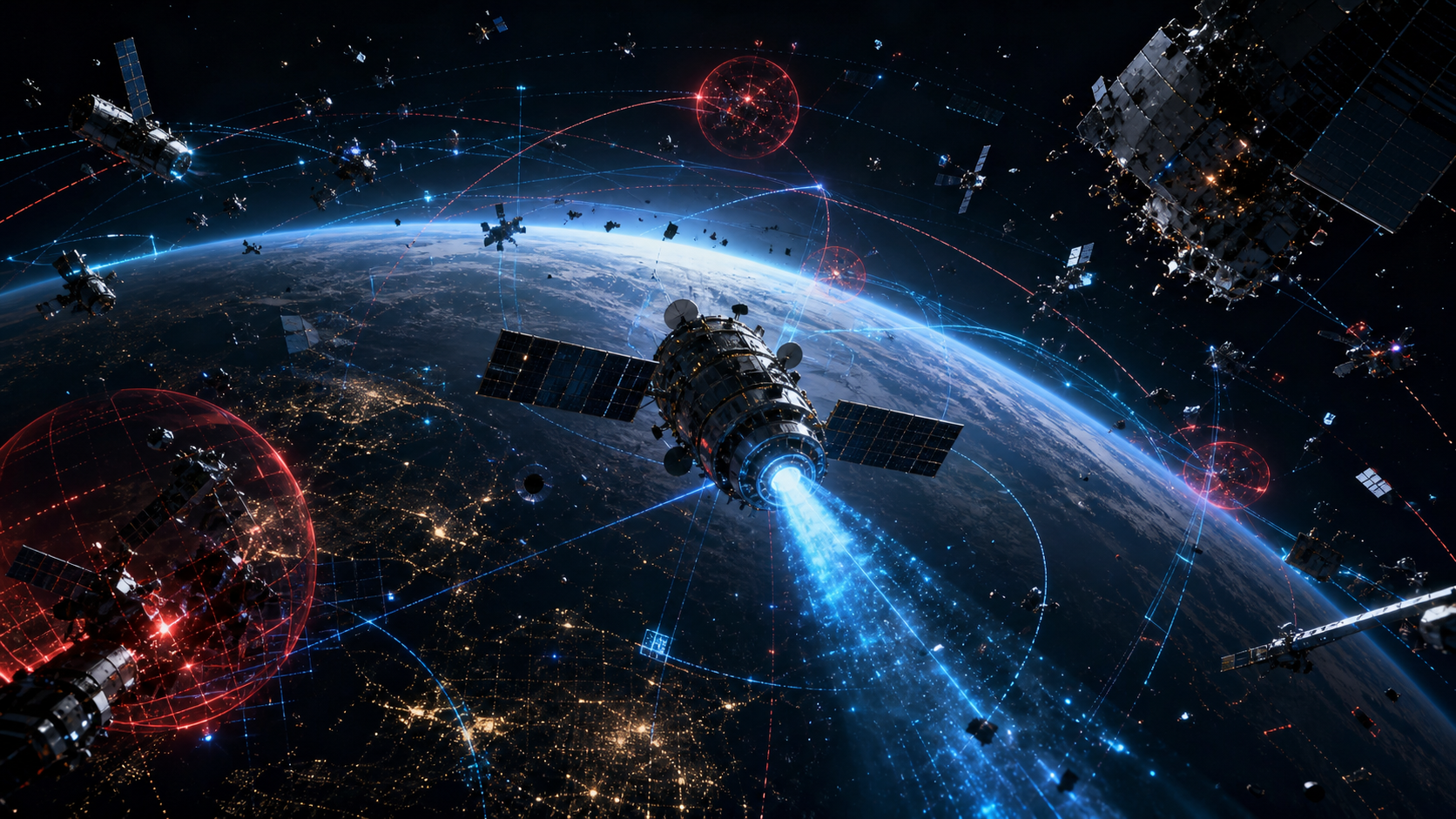
The numbers are no longer abstract. The European Space Agency says there are around 36,500 tracked objects larger than 10cm in Earth orbit, alongside about 1 million objects between 1 and 10cm and roughly 130 million objects between 1mm and 1cm. Most are not functioning spacecraft. They are fragments, dead satellites, spent rocket bodies and the accumulated residue of six decades of launch activity. Each object moves fast enough to turn a collision into a fragmentation event, and each fragmentation event raises the probability of the next.
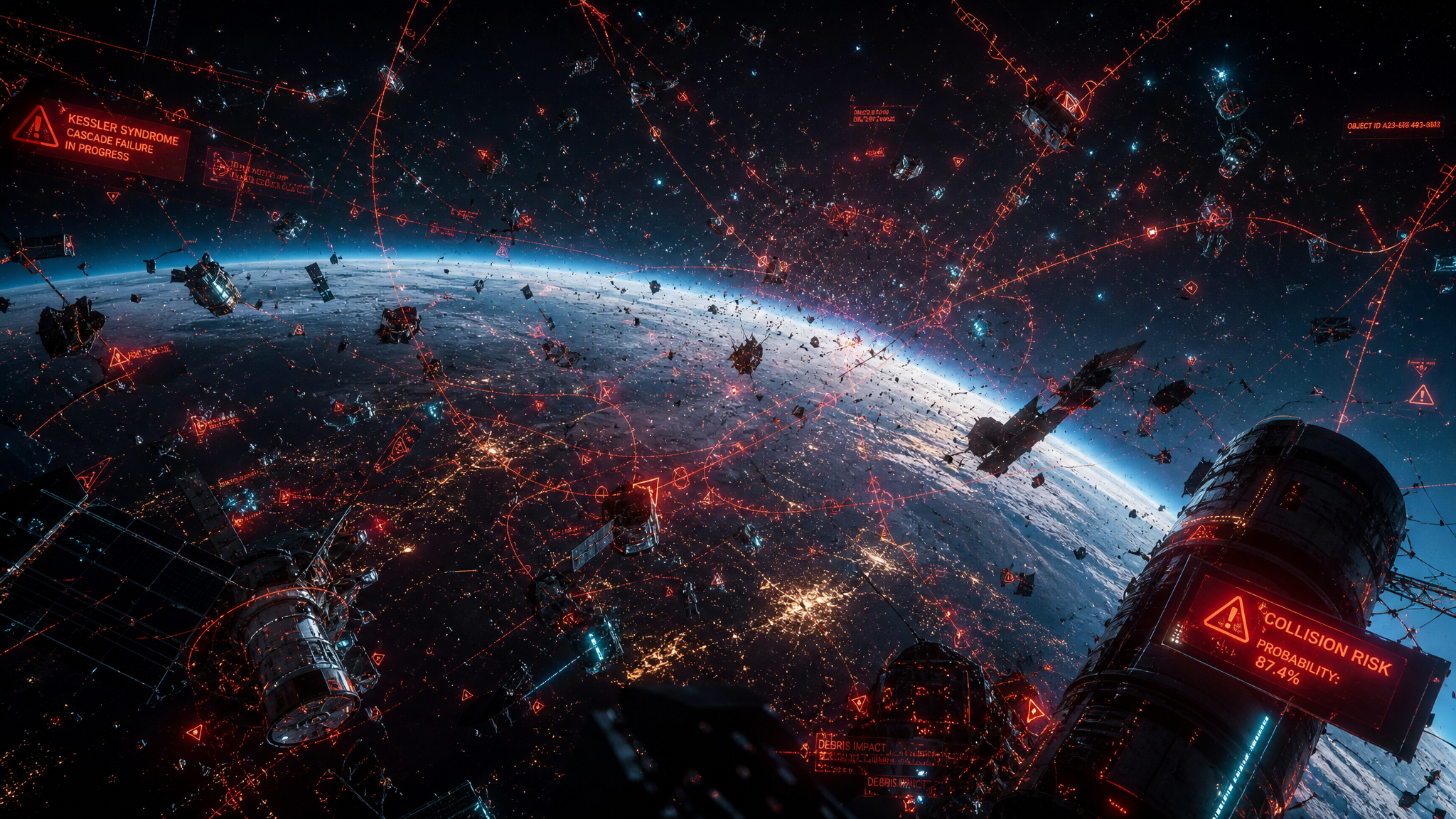
That is the logic behind the Kessler Syndrome, first articulated by NASA scientist Donald J. Kessler in 1978: once orbital density crosses a threshold, collisions generate debris faster than it can naturally decay, producing a self-reinforcing cascade. For years this sat in public discussion as a distant hypothetical, the space-law equivalent of a footnote. It no longer looks theoretical. It looks actuarial: a compounding risk curve with no clear insurer of last resort.
Take the user’s instinctive question: if a defunct Russian satellite were to hit a SpaceX Starlink unit, who pays, who removes the fragments, and who is liable for the next collision those fragments cause? The answer, under today’s regime, is disconcertingly thin. States bear international responsibility for national space activities. Launching states can be liable for damage. Operators carry licences under domestic law. But debris itself sits in a legal twilight: owned, in one sense; ungoverned, in another; everyone’s danger and nobody’s duty.
Space law was built for access, not congestion
The legal architecture of space was designed in a different age. When the 1967 Outer Space Treaty was concluded, the central fear was territorial appropriation and strategic rivalry, not orbital overcrowding. Its achievement was profound: outer space would be the province of all humankind; no nation could claim sovereignty over the Moon or other celestial bodies; states would bear responsibility for national activities in space, whether conducted by governmental or non-governmental entities.
That framework remains essential. It is also incomplete.
The treaty says remarkably little about debris remediation, active removal obligations, orbital housekeeping standards, or machine-to-machine coordination among autonomous systems. It does not establish a global clean-up duty. It does not create a standing adjudicatory mechanism for routine orbital incidents. It does not define a property-transfer pathway for abandoned hardware that remains legally attributable to a launching state. And because non-appropriation is foundational, governance often hesitates precisely where stewardship is most needed.
Subsequent instruments help, but only up to a point.
- The 1972 Liability Convention elaborates when launching states are liable for damage caused by space objects.
- The 1975 Registration Convention improves transparency by requiring registration of launched objects.
- The 1979 Moon Agreement contains more developed ideas about common interests and international regimes, but major spacefaring powers never embraced it, limiting its practical force.
- The Artemis Accords, beginning in 2020, have advanced principles around interoperability, transparency, deconfliction and preservation, but they are political commitments among signatories, not a universal debris code.
In parallel, technical guidelines have proliferated. The UN Committee on the Peaceful Uses of Outer Space has endorsed long-term sustainability guidelines. The Inter-Agency Space Debris Coordination Committee has issued mitigation recommendations. National regulators now speak more bluntly about post-mission disposal, conjunction analysis and end-of-life planning. The US Federal Communications Commission, for instance, adopted a five-year deorbit rule for certain low-Earth-orbit satellites, tightening the old 25-year norm.
Useful though these are, they remain patchwork. They mitigate future harm better than they resolve existing congestion. They assume good behaviour by individual operators in a system with weak collective enforcement. Above all, they do not answer the central question of a crowded orbital economy: who has both the authority and the obligation to act before a dangerous object becomes everybody else’s problem?
Debris is not rubbish; it is contested responsibility
The hardest part of orbital debris is that much of it is still, legally speaking, somebody’s object. Article VIII of the Outer Space Treaty preserves jurisdiction and control over registered space objects. That matters because active debris removal is not like collecting plastic from a beach. Capturing, nudging or deorbiting another state’s derelict satellite could be interpreted as interference with property, jurisdiction, national security interests or strategic capability.
This creates a perverse equilibrium. Everyone agrees debris is dangerous. Few actors are willing to confer broad rights on others to touch their hardware. So the incentive is to wait.
That waiting has costs.
In 2007, China’s anti-satellite test against Fengyun-1C created one of the largest debris clouds in history. In 2009, the accidental collision between Iridium 33 and the defunct Russian military satellite Kosmos 2251 produced thousands of trackable fragments. In 2021, Russia’s destruction of Kosmos 1408 generated another major debris field, forcing astronauts aboard the International Space Station to shelter. These were not minor episodes. They were demonstrations that a single event can raise collision risk across orbital shells used by civil, commercial and scientific missions.
Meanwhile, the orbital economy is being industrialised. SpaceX has launched thousands of Starlink satellites. OneWeb has deployed a large constellation. Amazon’s Project Kuiper is preparing to do the same. China is pursuing large constellations of its own. More launch cadence, lower costs and reusable systems, especially through vehicles such as SpaceX Starship, point towards a busier orbital future, not a quieter one.
This is excellent news for connectivity, Earth observation, navigation resilience and scientific access. It is also a recipe for governance debt if rules, incentives and machine-readable coordination do not mature at the same pace.
The issue is not simply more metal in space. It is more decision-making, dispersed across more operators, moving faster than human review can reliably manage.
The real scarcity in orbit is not space; it is enforceable responsibility.
Insurance can price launches. It cannot yet price cascades.
Insurance is often invoked as the market mechanism that will discipline behaviour. In narrow cases it does. Launch insurance, in-orbit cover and third-party liability policies are familiar parts of the commercial space sector. Underwriters can assess a rocket, a payload, a mission profile and a known operator with some confidence.
But systemic debris risk is different.
A collision cascade is a correlated, transboundary hazard with delayed and distributed consequences. One defunct object can cause damage years after its useful life has ended. The fragments may strike spacecraft operated by firms in different jurisdictions, insured by different markets, under licences issued by different states. Causation becomes technically intricate; subrogation becomes politically fraught.
Insurers dislike uncertainty they cannot observe, model or legally recover. Orbital debris contains all three.
Three problems stand out.
First, attribution is difficult
Determining which fragment caused which loss is often possible only probabilistically. The responsible object may itself have been produced by an earlier collision or breakup. Even where tracking data is good, legal fault may not be.
Secondly, obligations are thin
There is no universal clean-up duty, no standard salvage regime for derelict objects, and no globally harmonised requirement to maintain financial assurance against downstream debris harm over the full life of an object.
Thirdly, the tail risk is collective
If a heavily used orbital band becomes materially more hazardous, losses are not confined to one operator. Communications networks, weather data, Earth observation, scientific missions and national security systems all face degraded access.
That is why the phrase “space insurance” can mislead. We do not merely need better underwriting of individual missions. We need a governable framework for shared orbital externalities.
The frontier problem: autonomous systems beyond easy supervision
This governance gap becomes sharper as operations become more autonomous. Orbital servicing vehicles, collision-avoidance systems, robotic inspection craft, lunar logistics platforms and eventually off-world industrial systems will not wait politely for a committee meeting. They will sense, classify, prioritise and act in environments where latency, bandwidth and human attention are scarce.
Consider the trajectory already visible.
- Artemis is rebuilding sustained lunar operations around infrastructure, logistics and international participation.
- China’s Chang’e programme has demonstrated methodical lunar progress, including sample return.
- NASA’s Psyche mission is pushing deeper-space operational complexity.
- Commercial servicing, rendezvous and in-space manufacturing efforts are moving from experiment towards business model.
The governance question changes at that frontier. It is no longer enough to know which state authorised a mission on paper. One must know, in operational terms, who may instruct a system, within what scope, using which data, under what audit trail, and with what revocation mechanism if behaviour deviates.
This is precisely where Society OS’s proposed contribution becomes relevant: not as a substitute for public international law, and certainly not as legal authority over space, but as an open framework and implementation mechanism for making governance executable.
Under The Sovereign Standard — a broad framework for retaining sovereignty in the AI age across identity, data, money, health, governance and frontier domains such as space — orbital systems would be treated as one application of a deeper principle: authority must remain legible, bounded and revocable even when action is delegated to machines.
Within that, F-ACT — the Framework for Agent Conformance & Trust — provides the agent-governance layer. Its normative core is ASDAR: Authority, Scope, Data, Audit, Revocation. The design principle is simple and stringent: govern before execution — not after.
In orbital terms, that means an autonomous debris-inspection craft or collision-avoidance agent should not merely be technically capable. It should be able to demonstrate, at machine speed and in a vendor-neutral way:
Non-appropriation must not become non-responsibility.
- who authorised the action;
- what action class is permitted;
- what data sources may be used;
- what immutable audit record will be produced; and
- how authority can be withdrawn or superseded.
The conformance tiers matter here: L0 Unattested, L1 Declared, L2 Enforced, L3 Provable. In frontier environments, the difference between declared policy and provable constraint is not bureaucratic detail. It is the difference between hope and governability.
From principle to mechanism: what the 42 Protocols would actually do
Space does not need another vague appeal to responsibility. It needs interoperable machinery.
This is where the 42 Protocols matter. They are Society OS’s implementation mechanism: the deployable stack that operationalises The Sovereign Standard. Led by the Sovereign Trinity — Human-Twin-Agent identity for who acts, HEARTrank for what is trusted, and WISE Contracts for which execute law, not merely code — the 42 Protocols are designed to make authority, accountability and action composable across domains. 42 years. 42 protocols. 42 papers.
Applied to orbital governance, the architecture suggests a practical model rather than a rhetorical one.
Identity: who is acting in orbit?
The first weakness in many distributed systems is ambiguous agency. Is an avoidance manoeuvre initiated by a human controller, an operator policy engine, an onboard autonomous system or a subcontracted servicing platform?
The Human-Twin-Agent Protocol addresses this by binding action to a clear chain of identity between a human principal, a digital twin and an agentic executor. In a space context, this could create a verifiable record showing whether a debris-removal manoeuvre was authorised by a state agency, a commercial operator, a mission insurer or a court-recognised emergency protocol.
Trust: which data and counterparties are credible?
Orbital safety depends on shared situational awareness: ephemeris data, conjunction warnings, sensor confidence, manoeuvre declarations and servicing intent. Yet operators do not always share equally, and trust is uneven.
HEARTrank would provide a structured trust layer: not a simplistic reputation score, but a way to weight data provenance, operational history, disclosure quality and conformance status. An object catalogue produced by a high-conformance civil operator with auditable telemetry should not be treated identically to an opaque feed with uncertain refresh and limited validation.
Execution: how are obligations carried out?
The missing piece in space governance is often executable obligation. Rules exist as documents; operations occur as software. The gap between the two is where risk accumulates.
WISE Contracts are designed to execute law, not merely code. In orbital use, they could encode machine-readable conditions for servicing consent, debris-removal escrow, post-mission disposal milestones, emergency manoeuvre rights, and multi-party liability waterfalls triggered by a verified incident.
This would not replace treaties or domestic licensing. It would make them operable in real systems.
Imagine, for example, an internationally recognised protocol for abandoned-object intervention:
- A state or operator registers a derelict object as non-functional.
- A servicing entity requests authority to inspect, stabilise or deorbit it.
- Consent conditions, insurance backing, telemetry-sharing obligations and safety corridors are encoded in a WISE Contract.
- Autonomous execution agents conform under F-ACT, with ASDAR constraints enforced at L2 or L3.
- Every action is auditable; every delegated permission is revocable.
That is not sovereignty over space. It is sovereignty-preserving coordination within space activity.
What a serious orbital clean-up regime would require
No framework, however elegant, dissolves the political work. A functioning debris regime would require states, operators, insurers and standards bodies to align around a handful of difficult commitments.
1. A clearer doctrine of abandonment, consent and salvage
The Kessler Syndrome no longer looks theoretical. It looks actuarial.
At present, derelict objects remain legally awkward. The world needs a more precise pathway for when an object may be designated non-operational, what consent is required for third-party intervention, and under what emergency exceptions action may proceed to prevent imminent harm.
2. Binding end-of-life obligations
Post-mission disposal cannot remain a best-efforts aspiration. Operators should face licence conditions that are measurable, monitored and financially backed. The recent tightening of deorbit expectations is a start, not an end.
3. Financial assurance that follows the object
A launch licence should not be the last moment at which responsibility is capitalised. Some form of reserve, bond, pooled fund or ongoing assurance mechanism may be needed to cover late-arising debris consequences and removal costs.
4. Shared technical rails for autonomous coordination
As orbital traffic management becomes more machine-mediated, common protocols for identity, intent broadcasting, precedence rules, safe manoeuvre envelopes and auditability will be as important as radio standards were for aviation.
5. A norm of verifiable conformance
Declarations are not enough. High-risk systems should be able to demonstrate whether constraints are merely stated or actually enforced. That is the rationale behind F-ACT’s progression from L1 Declared to L3 Provable.
None of this requires fantasy governance or a world state. It requires institutional seriousness: open standards, domestic incorporation, treaty-compatible operational rules and technical systems that can carry law into execution.
The deeper scarcity is stewardship
Space is often described as boundless. Useful orbit is not. Low Earth orbit contains altitude bands, inclinations and traffic patterns that are economically precious and physically finite. Lunar approaches, cislunar routes and key surface sites will become more contested as programmes scale. The problem, then, is not abundance but stewardship under conditions of shared access.
The old legal language of non-appropriation remains wise. Yet non-appropriation must not become non-responsibility.
That is why the frontier cluster matters within The Sovereign Standard. Space is not its definition; it is a proving ground. If societies cannot preserve legible authority, accountable automation and revocable delegation in orbit — where the environment is hostile, the systems are expensive and the consequences of failure propagate quickly — they will struggle to do so anywhere.
A proposed, open framework such as The Sovereign Standard is useful precisely because it does not pretend to be law. It offers a way to think clearly about sovereignty when action is distributed across institutions, software and autonomous agents. The 42 Protocols matter because principles without mechanisms tend to evaporate at first contact with operations. And F-ACT matters because governed agent networks in frontier domains cannot be trusted on aspiration alone.
Before the cascade becomes governance by collision
The world is entering a new age of space activity. Reusable heavy launch systems are lowering barriers. Lunar programmes are multiplying. Commercial constellations are thickening orbital shells. Robotic systems are becoming more capable, more autonomous and more essential. This is, on balance, an extraordinary civilisational expansion.
But expansion without stewardship is just deferred disorder.
The present debris regime asks too much of voluntary restraint and too little of executable obligation. It assumes that ownership, responsibility and control will somehow line up when needed. In practice they often do not. That is the sovereignty crisis hidden inside the engineering story.
There are 36,500 tracked objects larger than 10cm in orbit, and many millions more beneath routine tracking thresholds. They are not merely pieces of metal. They are fragments of unfinished governance.
The next era of space law will not be defined only by who reaches the Moon, lands cargo, mines resources or services satellites. It will be defined by whether humanity can build institutions that decide, in advance and with technical precision, who must act when orbit becomes dangerous.
If we fail, the Kessler Syndrome will not arrive as science fiction. It will arrive as paperwork after impact.
Sources & Further Reading
- 1.European Space Agency Space Debris Office – Space debris by the numbers
- 2.United Nations Office for Outer Space Affairs – Treaty on Principles Governing the Activities of States in the Exploration and Use of Outer Space
- 3.United Nations Office for Outer Space Affairs – Convention on International Liability for Damage Caused by Space Objects
- 4.United Nations Office for Outer Space Affairs – Convention on Registration of Objects Launched into Outer Space
- 5.United Nations Office for Outer Space Affairs – Agreement Governing the Activities of States on the Moon and Other Celestial Bodies
- 6.NASA – The Kessler Syndrome
- 7.US Federal Communications Commission – Mitigation of Orbital Debris in the New Space Age
- 8.NASA – The Artemis Accords
- 9.NASA – Psyche Mission Overview
- 10.China National Space Administration – Chang'e programme overview