The Short Version
Today, on the International Day of Charity, I am making an irrevocable, royalty-free pledge over the core patent claims of F-ACT — the intellectual property that anyone practising the standard necessarily uses. The pledge is binding now. It covers any use, not just conformance. It cannot be revoked.
I am also announcing the intention to transfer those core claims to an independent Swiss foundation being established — the Open Conformance Foundation, a Stiftung under Swiss law, purpose-locked to steward open standards for autonomous AI-agent governance. When the Foundation is incorporated, the transfer will complete. The claims leave my balance sheet permanently.
The company keeps its operational IP — the trade secrets, know-how and pending patent application covering the specific methods and architectures that make our product faster, more capable, and more reliable than alternatives. We compete on engineering, not on owning the rulebook.
This is not a press release dressed as philanthropy. It is a structural decision — one that removes the kill-switch, disarms the founder, and makes the standard genuinely impossible to capture.
Why a Foundation
There is a simple test for whether an open standard is actually open: can the person who wrote it take it back?
If the answer is yes, the standard is a licence, not a gift. It is contingent. It can be revoked, re-priced, or weaponised the moment the economic incentives change. Every enterprise buyer, every regulator, and every competitor knows this — and factors it into their adoption decision.
A Swiss Stiftung eliminates that possibility by law. Under Articles 80–89a of the Swiss Civil Code, a Stiftung's purpose clause is near-immutable. It cannot change its mission without extraordinary judicial process. It has no shareholders. It has no members who can vote to redirect its assets. Its board operates under federal supervision.
There is a simple test for whether an open standard is actually open: can the person who wrote it take it back?
The Foundation's purpose clause will be tight: steward, maintain, and freely publish open standards for governance of autonomous AI agents; keep them royalty-free, non-discriminatory, and universally implementable.
If the Foundation is dissolved, its assets transfer only to an entity with an identical or substantially similar public-benefit purpose. There is no back door.
The Foundation is not yet registered. It is being established. The pledge, however, is binding today — it does not depend on the Foundation's existence. The Foundation is the lock; the pledge is the promise. Today I make the promise. The lock comes next.
Why Now — the Regulatory Clock Is Running
This is not structural housekeeping done in the abstract. The obligations are already live. EU AI Act enforcement for general-purpose AI began on 2 August 2025, carrying penalties of up to €15 million or 3% of global turnover. ISO/IEC 42001 — the first certifiable AI management standard — became a European norm (EN ISO/IEC 42001:2026) in March 2026, with national adoption underway across 34 countries. The Linux Foundation now stewards the Model Context Protocol, and NIST has launched an AI Agent Standards Initiative.
Every one of those tells an organisation that it must govern its agents. None of them is an open, citable standard for proving that a specific agent action was authorised before it happened — and none of them can be, because a standard everyone must trust cannot sit inside any single company or jurisdiction. That is the gap F-ACT fills, and it is exactly why the core claims have to leave my balance sheet before the standard gets big enough to be worth capturing. You transfer the seed while it is still a seed. Waiting until the standard is load-bearing would mean asking the market to trust a rulebook that one person could still take back.
What Will Transfer — and What Won't
This is the part most people will want to scrutinise, so here it is in plain language.
Pledged now; transferring to the Foundation when it is incorporated
- Core patent claims — those that anyone conforming to F-ACT necessarily practises. The five GUARD governance clauses, the four conformance tiers, the govern-before-execution principle. If a rival building a conformant product would inevitably use these claims, they belong in the Foundation.
- The F-ACT standard itself — the specification, the GUARD vocabulary, the conformance-tier definitions, the F-ACT Verified mark, and the verification methodology.
- The patent non-assertion pledge — irrevocable, worldwide, royalty-free, covering any use of the core claims. Binds successors and assigns. Effective today.
The Foundation is the lock; the pledge is the promise. Today I make the promise. The lock comes next.
Stays with Society OS
- Operational patents — how we implement the standard with superior performance. These are not required to conform. They are fully enforceable. They are our competitive moat.
- Product, brand, and platform — the engines, the registry-as-a-service, the compliance tooling, the data and network effects.
- A non-exclusive licence to the core claims — the Foundation will grant us the same licence it grants everyone else. No special deal. No exclusive lock. We win on merit or we don't win.
The one-line test: if a rival adopting F-ACT would fear this asset gives us a veto over them, it goes to the Foundation. If it's how we do the work better, it stays with us.
The Off-World Question
We have been transparent about the commercial opportunity in off-world agent governance — governing AI agents operating on the Moon, Mars, and in orbit, where there is no existing legal framework.
The Foundation will grant Society OS a time-limited, conditional exclusive right to sub-license core patents for off-world deployment. This exclusivity runs 42 months from the date the transfer takes legal effect — not ten years, not perpetuity. And it is not a squatter's right: it is conditioned on use-it-or-lose-it diligence milestones (a signed licensee or sub-license within 12 months; funded, revenue-generating deployment within 24). Miss a milestone and that field auto-reverts to the open, non-exclusive regime early. Hit the 42-month mark and it reverts anyway. Either way the off-world field ends up under the same royalty-free, non-exclusive regime as Earth.
During the exclusivity period, the majority of off-world licensing revenue (no less than sixty percent) flows to the Foundation. The Foundation's share funds the permanent stewardship of the open standard. The company's share rewards the work of building the category.
This is not a perpetual monopoly, and it rewards activity, not squatting. It is a head-start with a sunset and a clock. The end state is the same everywhere: the governance of autonomous agents — on Earth and off it — belongs to everyone.
The Founder's Seat
I get one permanent seat on the Foundation board. No veto. The board will have an odd number of members, a majority of whom are independent, with defined constituency seats spanning civil liberties, enterprise, academic, regulatory, and Global South representation. Terms are staggered.
Most people who say "for humanity" build a kill-switch. I am removing mine.
I cannot outvote the board. I cannot block a decision. I cannot redirect the Foundation's assets. I am structurally disarmed — and that is the point.
Most people who say "for humanity" build a kill-switch. I am removing mine.
The Coalition
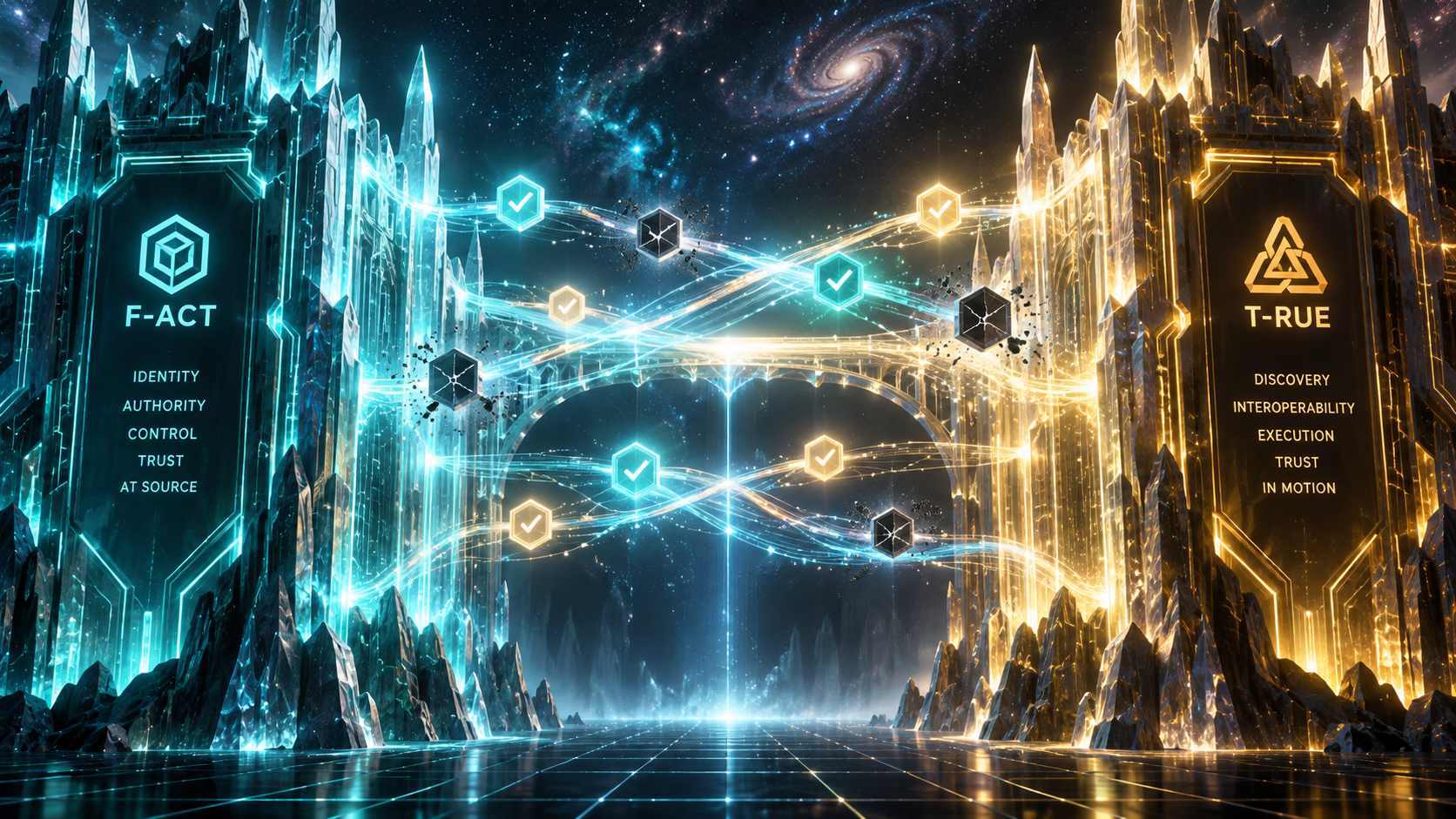
On 19 August — World Humanitarian Day — we published F-ACT 1.0 and issued a Call for Founding Signatories to build a multi-stakeholder coalition that will govern the standard collectively. The Foundation will host the coalition as its neutral secretariat. Today the same coalition also publishes two sister standards — T-RUE and R-EAL — so what began as a single specification is becoming an open family of conformance standards, governed in common rather than owned in private.
We deliberately separate two things that are easy to confuse: momentum and legitimacy. The Founding Circle — the first cohort of signatories — closes at 42. That builds early momentum. But headcount is not legitimacy, and a week-one rush must never be allowed to force a premature handover of the standard.
So governance handover is decoupled from the signup count. The elected board takes the editorial pen only when three conditions are all met: a legitimacy quorum (at least four of the five constituencies represented, including at least three regulators and at least three frontier labs); a maturity floor (a stable v1.x standard, live for at least twelve months, and not before 19 August 2027); and a hard backstop — if those conditions are not met organically, handover happens no later than 19 August 2028 regardless. This trigger is a hard commitment in the Foundation's charter. It is not optional. It is not deferrable.
At handover, the elected governing board takes the editorial pen. The standard stops being mine and becomes ours. That is not a loss. It is the destination.
A foundation makes a standard credible. A coalition makes it inevitable.
The Economics of Giving It Away
People will ask: why would you give away the IP?
It rewards activity, not squatting. It is a head-start with a sunset and a clock.
The honest answer is that the IP I'm giving away is not the IP that makes money.
The core claims — the standard, the five questions, the tiers — are the seed. They are the thing everyone must practise to conform. They are royalty-free by design. Their standalone commercial value, as an unexamined, pledged, zero-revenue bundle, is modest.
The operational IP, the product, the brand, the licence-back, the network effects, the data moat — those are the orchard. The orchard is where the revenue grows. Red Hat gave away Linux and built a $34 billion business on implementation. Google gave away Android and built a $2 trillion ecosystem on services. The pattern is not new. It is proven. Give away the seed; get rich on the orchard.
The pledge happens now, while the seed is still a seed. The transfer will follow.
What This Means for You
If you're an enterprise deploying AI agents: The standard you adopt is structurally locked open. The pledge is irrevocable and binding today. The Foundation — once incorporated — makes the lock permanent. You can adopt F-ACT knowing it will still be open in ten years.
If you're a regulator: The technical standard you cite will not be controlled by a single commercial entity. It is pledged royalty-free today and will be hosted by a purpose-locked, federally supervised Swiss foundation. Cite it in policy with confidence.
If you're a competitor: The core claims are free. The pledge covers any use. You can build a conformant product without fearing a patent suit from us. We will compete with you on operational IP, product quality, and execution — not on owning the rules.
If you're an investor: The company's value is not in the donated IP. It is in the operational IP, the product, the brand, and the structural advantage of being the originator of the standard that everyone implements. The donation is the moat — it makes the standard trustworthy, which makes adoption inevitable, which makes the implementation the most valuable asset in the category.
The Date Is Not an Accident
Give away the seed. Get rich on the orchard. And make sure no one can burn the orchard down — including you.
The International Day of Charity honours the spirit of giving for the betterment of humanity. I chose this date because this is, genuinely, a gift — not of money, but of structural power. The power to define how autonomous agents are governed. The power to gate, to exclude, to monetise the rules themselves.
I am giving that power to a structure that cannot abuse it. Not because I am virtuous, but because the standard only works if no one can capture it.
The governance of autonomous AI agents is the most consequential infrastructure problem of this century. It should not belong to any single company, government, or bloc. Starting today — with this pledge — it doesn't.
Read the standard: f-act.org/standard
Read the patent pledge: openconformance.org/occ/pledge
Become a Founding Signatory: f-act.org/coalition
"Give away the seed. Get rich on the orchard. And make sure no one can burn the orchard down — including you."
— Darryl S. Astin, 5 September 2026 · International Day of Charity
Sources & Further Reading
- 1.F-ACT 1.0 Standard Specification
- 2.Patent Non-Assertion Pledge
- 3.Call for Founding Signatories — Coalition
- 4.Swiss Civil Code, Articles 80–89a (Stiftung / Foundation Law)
- 5.Open Conformance Foundation — Charter Summary (forthcoming)
- 6.United Nations — International Day of Charity