Hub
Deep Dive
Regenerative Intelligence: AI-Driven Agriculture and the Sovereignty of Soil
Climate & Sustainability TechDeep Dive

Regenerative Intelligence: AI-Driven Agriculture and the Sovereignty of Soil

AI can restore the land only if farmers retain control of the data that defines it.

AI AssistedSociety OS Research18 June 202615 min read

Key Insight: The next contest in agriculture is not merely over seeds, fertiliser or carbon credits, but over who owns the model of the soil.

The field as sensor, the farm as extractive data mine

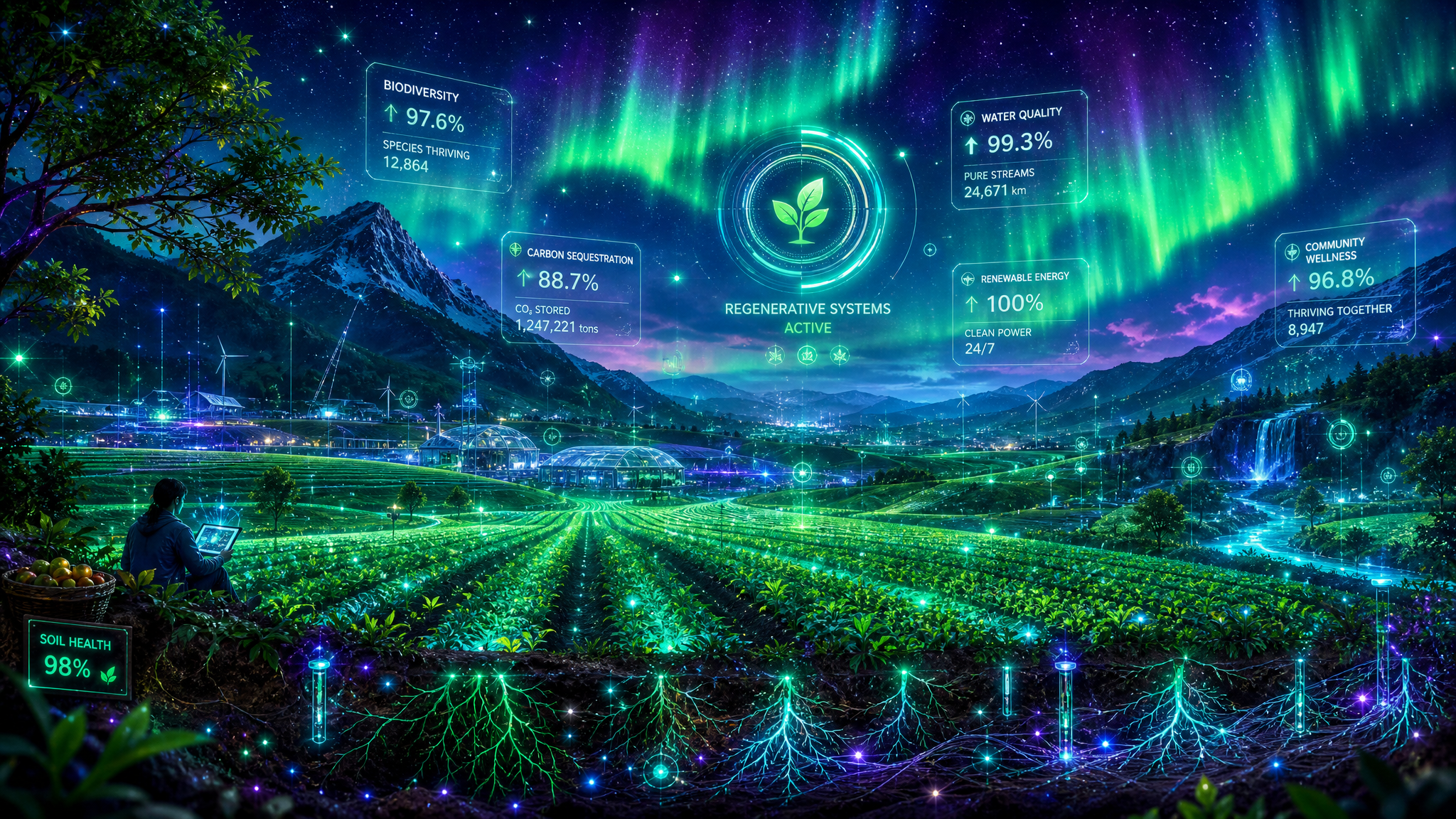
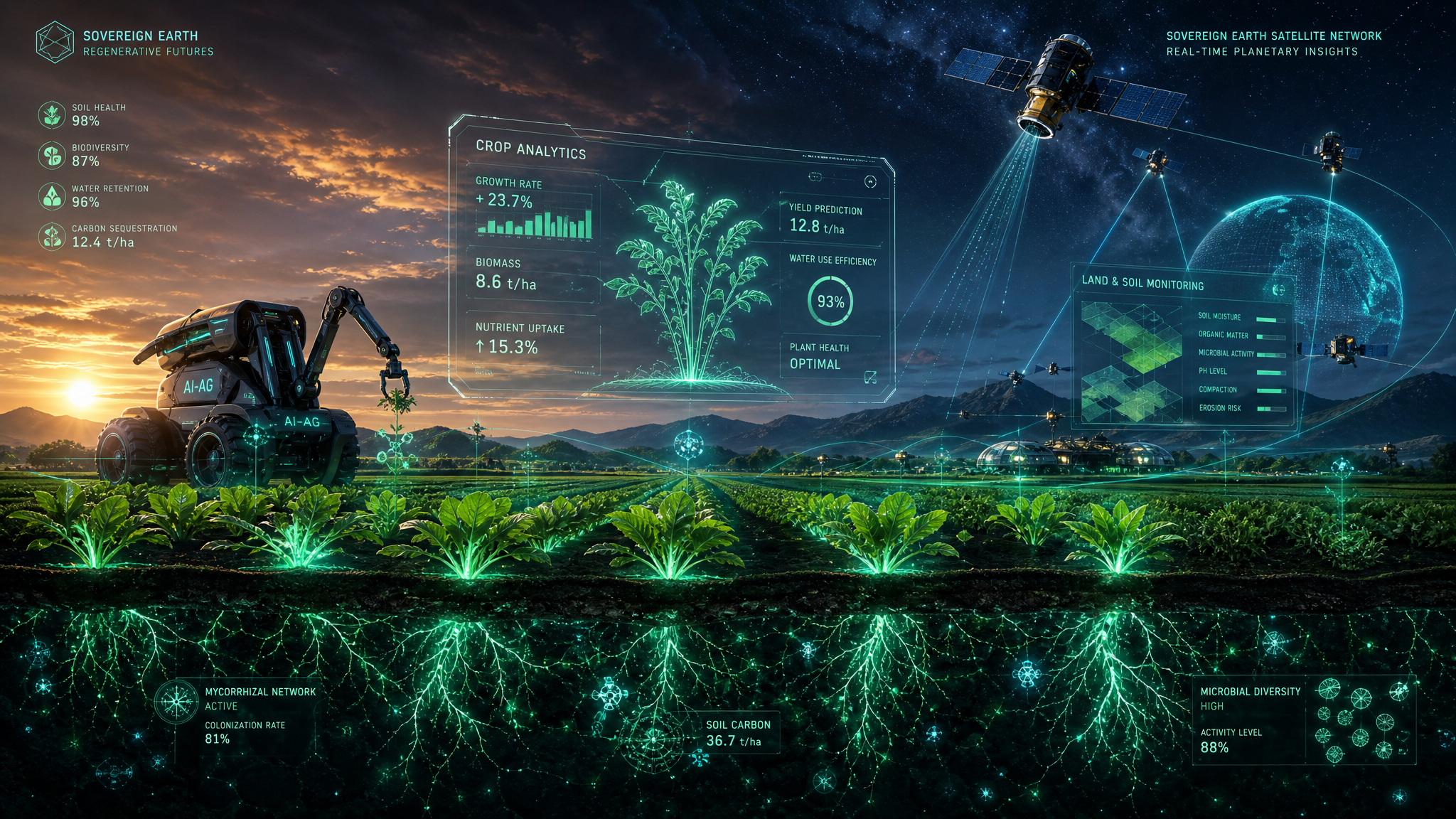
At dawn, a modern farm already hums with computation. A tractor steers itself by satellite correction. A drone maps chlorophyll stress row by row. Soil probes log moisture, salinity and temperature every few minutes. A milking robot records movement, feed intake and signs of disease. A weather model updates the probability of rain by the hour. What looks, from the road, like timeless agriculture is increasingly a dense digital system.

That transformation is real and, in many respects, overdue. Agriculture has always been an information business disguised as a biological one. The farmer who knew which paddock held water after a dry winter, which slope lost topsoil in a hard storm, or which rotation restored nitrogen was already acting on data. What has changed is the scale, granularity and ownership of that data. The farm is becoming one of the most intensively measured environments on Earth. Too often, however, the intelligence built from those measurements accrues elsewhere.

This matters because industrial agriculture's central optimisation target has been dangerously narrow. For decades, many systems have pursued yield, speed and uniformity, often supported by synthetic fertiliser, pesticides, heavy tillage and monoculture. The gains were extraordinary; so, in many places, has been the ecological cost. The UN Food and Agriculture Organization has long warned that a substantial share of the world's soils is degraded. The Intergovernmental Panel on Climate Change has documented the links between land use, emissions, water stress and biodiversity loss. Soil is not an inert substrate. It is a living, structured system, and when it collapses, productivity eventually follows.

The next wave of agricultural AI therefore faces a choice. It can deepen the old logic, squeezing another percentage point of output from exhausted ground. Or it can help produce what might be called regenerative intelligence: systems that optimise for soil organic matter, water retention, nutrient cycling, biodiversity, resilience and long-term farm viability, rather than yield alone.

Yet a regenerative future will fail if its underlying digital architecture remains extractive. If a farm's most valuable asset becomes its behavioural and biological data, then food sovereignty begins with data sovereignty. The farmer, grower co-operative and local community must be able to decide who may observe, model, recommend and transact on the basis of their land. That is precisely where The Sovereign Standard, F-ACT and the 42 Protocols become practical rather than philosophical.

From precision agriculture to regenerative intelligence

Precision agriculture promised to apply the right input, in the right place, at the right time. Variable-rate fertiliser, satellite imagery and computer vision have all delivered measurable efficiencies. John Deere's autonomous systems, climate and field analytics platforms, and a rising generation of agritech start-ups have demonstrated that software can reduce waste and improve management. Europe, Australia, North America and parts of Latin America now host farms where sensor networks and machine learning are routine rather than novel.

But efficiency is not the same as regeneration. A system can become exceptionally good at applying chemicals more precisely and still degrade soil biology over time. It can identify a stressed crop without asking why the soil has become less sponge-like, less diverse or less alive. In other words, AI can optimise a broken objective function.

Regenerative intelligence requires a different stack of metrics and incentives. The model should ask questions such as:

  • Is soil organic carbon rising or falling?
  • Is infiltration improving after rain, or is water still running off compacted ground?
  • Are earthworm counts, microbial diversity or cover-crop persistence strengthening ecological function?
  • Is the farm reducing purchased inputs because biology is doing more of the work?
  • Is biodiversity increasing at field margins and across rotations?
  • Is income becoming more resilient, not merely larger in a single bumper season?

That is not speculative romanticism. Soil science, remote sensing and farm management data already make much of this tractable. The challenge is governance. Most current digital agriculture markets are organised around vendor platforms, cloud dashboards and subscription software whose terms are written for extraction: of operational data, derivative insights and strategic dependency. A farmer may own the land and machinery while renting the intelligence that interprets both.

This is a familiar pattern across the digital economy. Social media users generated data they did not govern. Small merchants became dependent on marketplace algorithms they could not audit. Drivers supplied labour to opaque pricing engines. Agriculture is now vulnerable to the same asymmetry, with a further complication: the data concerns not merely behaviour but biology, ecology and future value creation in carbon, water and food markets.

Soil is infrastructure, not scenery

A society that treats soil as scenery will eventually import its fertility from the future. Soil stores carbon, regulates water, cycles nutrients and supports the majority of food production. The European Commission's soil strategy, the proposed Soil Monitoring Law and a widening set of sustainability reporting rules all reflect a basic shift: land health is being recognised as strategic infrastructure.

That recognition is arriving just as climate volatility is making old assumptions unreliable. The World Meteorological Organization and the IPCC have repeatedly shown rising instability in rainfall, heat and extreme events. On the farm, this means yield models based on historical averages are becoming less dependable. Soil with greater organic matter and better structure holds more water, buffers shocks more effectively and can reduce the need for external inputs. Regeneration is not an ethical premium add-on. It is an adaptation strategy.

The digital layer now matters because every claim in this chain is increasingly measured, priced and verified. Carbon markets seek evidence. Food buyers seek traceability. Insurers seek risk signals. Lenders seek resilience indicators. Regulators seek reporting. The farm is entering an era in which data about the land can be nearly as consequential as the land itself.

The next contest in agriculture is not over tractors, but over who owns the model of the soil.

That creates a profound governance question. If a model infers that one parcel has superior water-holding capacity, lower disease risk and higher carbon sequestration potential, who captures the resulting value? The platform? The agronomic adviser? The off-taker? The lender? Or the farmer and the community stewarding the asset?

The Sovereign Standard offers a clear answer. It is the broad framework for retaining sovereignty in the AI age across identity, data, money, health and governance. In agriculture, this means that the digital representation of the farm should not be alienated from the human beings and institutions responsible for it. Data rights, decision rights and economic rights must travel together.

The regulatory wind is shifting towards accountability

This argument is not anti-technology; nor is it anti-market. It is increasingly aligned with regulation. The European Union's General Data Protection Regulation established the principle that personal data cannot simply be taken and repurposed without lawful basis, transparency and rights of access, correction and deletion. Farm data is not always personal data under GDPR, but much of it can become personal when linked to identifiable individuals, sole traders or households. More importantly, GDPR has reset expectations around consent, minimisation and accountability.

The EU AI Act extends that direction of travel. Its risk-based framework does not target agriculture as such, but it does insist that certain AI systems meet obligations around transparency, data governance, human oversight and record-keeping. Any agricultural AI used in employment, credit, insurance or critical decision support may quickly fall into more consequential regulatory terrain than founders imagine. If an insurer prices a farm using opaque environmental models, or a lender denies credit on the basis of inferred climate risk, explainability and contestability cease to be abstract ideals.

Elsewhere, similar pressures are mounting. Sustainability reporting regimes, biodiversity disclosure frameworks and anti-greenwashing enforcement are raising the cost of unverifiable claims. Supply-chain rules such as the EU Deforestation Regulation push traceability deeper into commodity systems. Data spaces for agriculture are being actively discussed in Europe, precisely because fragmented proprietary control is becoming a bottleneck.

The lesson is straightforward: the future farm will not merely be connected; it will be audited. Governance must therefore be designed before automation proliferates.

That is F-ACT's defining principle: Govern before execution — not after. F-ACT, the Framework for Agent Conformance & Trust, is the neutral, open, vendor-neutral AI-agent governance standard within The Sovereign Standard. Its normative core is ASDAR: Authority, Scope, Data, Audit, Revocation.

Applied to agriculture, ASDAR is strikingly concrete.

  • Authority: who is entitled to instruct an agent acting on farm data or farm infrastructure?
  • Scope: what may that agent actually do, and within which temporal, geographic and financial limits?
  • Data: which datasets may it access, derive from, export or monetise?
  • Audit: what tamper-evident record exists of recommendations, actions and outcomes?
  • Revocation: how quickly can permissions be withdrawn when a contract ends, a vendor fails, or a model behaves badly?

These are not legal niceties. They are operational controls for real farms dealing with irrigation scheduling, chemical recommendations, equipment autonomy, carbon accounting and market participation.

A sovereign farm stack in practice

Consider a mixed farming business of 2,000 hectares, transitioning part of its land to lower-tillage regenerative methods. It uses satellite imagery, in-field moisture sensors, accounting software, a weather feed, autonomous spraying equipment and a carbon measurement service. Today, each service likely has its own login, licence terms, data schema and extraction pathway. The farm receives dashboards. The platforms receive the strategic picture.

Now imagine the same enterprise built on the 42 Protocols, Society OS's deployable implementation mechanism for the Sovereign Standard. The farm's digital life is organised around the Sovereign Trinity.

Human-Twin-Agent identity: who acts

The Human-Twin-Agent Protocol establishes a durable identity architecture linking the real person, their digital twin and the agents acting on their behalf. On a farm, this means the principal farmer, family members, agronomists, contractors and co-operative officers can each have clearly bounded authority. An irrigation agent may analyse sensor feeds and propose watering windows, but only a defined operator can authorise action above certain thresholds. A contractor's access to equipment telemetry can expire automatically when the season ends.

This matters most where farming is communal or intergenerational. Many agricultural businesses are family enterprises with blurred lines between household, landholding entity, labour and community obligation. Sovereign identity lets those relationships be reflected accurately rather than flattened into one vendor admin account and a weak password.

A farm may own the land and machinery while renting the intelligence that interprets both.

HEARTrank: what is trusted

Agriculture is awash with claims: low-carbon, nature-positive, water-efficient, biodiversity-safe. HEARTrank provides a trust layer for evidence, provenance and reputation. In farming, that could rank the reliability of soil samples, the provenance of remote-sensing data, the history of an agronomy model, or the performance of an adviser across seasons and regions.

Trust, here, is not social mood. It is structured credibility. A carbon buyer should know whether sequestration claims come from direct sampling, modelled estimates or self-reported practice changes. A farmer should know whether an AI recommendation reflects local field history or merely a general model trained elsewhere. A lender should know whether resilience scores are empirically grounded or marketing gloss.

WISE Contracts: which execute law, not merely code

Agriculture is increasingly contractual: input finance, crop delivery, insurance, environmental payments, carbon credits, water allocations. Conventional smart contracts often execute rigidly. WISE Contracts are designed to execute law, not merely code, embedding governance, exceptions and recognised obligations more faithfully.

That has practical value. A regenerative transition might be financed through outcome-based agreements tied to soil organic matter, input reduction or biodiversity targets. Payments can be staged against verified milestones, with transparent dispute processes and revocation rights. A community irrigation scheme can automate water access within agreed rules while preserving emergency overrides and local governance.

The point is not techno-utopian automation. It is that programmable systems should remain answerable to human institutions rather than replacing them.

Why ownership of farm data now determines economic power

If this sounds abstract, follow the money. Agricultural data is becoming collateral for several expanding markets.

First, there is input optimisation. Whoever controls the model can influence which seed, fertiliser, pesticide or advisory service is recommended.

Second, there is credit and insurance. Parametric products, climate-risk scoring and performance-based lending increasingly rely on environmental data. Control over that data shapes price and access.

Third, there is traceability and premium pricing. Food brands want proof of origin, welfare and environmental practice. The party curating the chain of evidence often captures outsized bargaining power.

Fourth, there is carbon and ecosystem services. Soil carbon, methane reduction, biodiversity uplift and water stewardship are all candidates for monetisation, but only if measured and trusted.

Fifth, there is model value itself. Aggregated farm data trains the next generation of agronomic models. That can create immense value for platforms even when the underlying contributors see very little of it.

This is where sovereign infrastructure matters. Under The Sovereign Standard, the farmer or local institution should be able to licence access to data selectively, receive compensation where appropriate, and retain the ability to move between providers without losing continuity. Under F-ACT, any agent touching that data should declare and enforce its authority, scope and auditability. Under the 42 Protocols, these principles become deployable controls rather than aspirational policy.

The analogy with decentralised finance is useful, though only up to a point. DeFi showed that financial functions can be disaggregated and recomposed without a single central intermediary. Agriculture will not be run as a token casino, nor should it be. But the underlying lesson holds: markets become more contestable when custody, identity, execution and audit are not monopolised by one platform. A sovereign agricultural stack can allow co-operatives, communities and farmers to participate in data and environmental markets on fairer terms.

Community sovereignty, not just individual dashboards

Regenerative intelligence will fail if its digital architecture remains extractive.

The politics of soil are rarely individual. Catchments, aquifers, grazing commons, seed-sharing networks and co-operatives all operate at community scale. One farm's tillage, pesticide drift or water extraction affects another's prospects. A sovereign approach therefore cannot stop at personal control panels.

The Sovereign Standard is valuable precisely because it addresses institutions as well as individuals. A local growers' association could govern a shared data trust. A watershed body could authorise agents to monitor river health within tightly defined scope. A regional food co-operative could pool evidence for regenerative certification while keeping underlying farm data partitioned and permissioned.

This is where the Living OS and the Sovereign Stack become useful concepts rather than slogans. A living society needs digital systems that evolve with relationships, obligations and ecological feedback. In agriculture, that means identities that reflect real stewardship, data permissions that can be renegotiated, and contracts that can adapt to drought, flood, disease or policy change without collapsing into arbitrary platform decisions.

It also means recognising that sovereignty is not isolation. Farmers will still use external models, insurers, logistics platforms and public research. The question is whether integration requires submission. Under a governed agent network, the answer can be no.

A farm may choose to share selective data with a university soil programme, an off-taker seeking provenance, or a lender financing regenerative transition. But the sharing can be bounded, audited and revocable. That is sovereignty in practice: not absolute secrecy, but meaningful control over participation.

Conformance, trust and the right to leave

Agriculture is littered with expensive dependencies. A proprietary machinery ecosystem, a locked farm-management platform, a finance arrangement tied to one buyer: all can erode strategic freedom. AI risks compounding this through invisible dependence on models and agents that quietly become indispensable.

F-ACT's conformance tiers matter here because they create a language for trust.

  • L0 Unattested: an agricultural agent exists, but makes no credible governance claims.
  • L1 Declared: the vendor states what the agent should do and what data it uses.
  • L2 Enforced: controls actually restrict authority, scope and data access.
  • L3 Provable: those controls can be independently verified.

In a sector where poor recommendations can ruin a season, this hierarchy is not bureaucratic theatre. It is a procurement tool. A co-operative choosing an AI adviser for crop rotation or carbon reporting should be able to insist on more than marketing assurances. Conformance creates comparability across vendors and a route to higher trust without requiring a single monopolist to certify the entire market.

The most underappreciated element is revocation. The right to leave has become one of the central freedoms of the digital age. If a farmer cannot revoke an agent's access to historical field data, or cannot export records in usable form, sovereignty has already been lost. The same is true for communities. If a regional conservation scheme cannot replace one analytics provider without rebuilding the entire data estate, dependency will trump regeneration.

The next green revolution will be governed

The phrase 'green revolution' once meant improved genetics, synthetic inputs and mechanisation. The next one, if it deserves the name, will combine biology, sensing, software and governance. It will be judged not only by tonnes per hectare, but by whether soils deepen, watersheds recover, biodiversity returns and farm businesses become less brittle.

AI can help. Machine vision can detect pest pressure earlier. Remote sensing can monitor cover-crop establishment. Predictive models can reduce over-irrigation. Genomics and longevity science are sharpening understanding of plant resilience and microbial function. DAO-like co-ordination tools can help communities govern shared environmental outcomes, though they must remain grounded in real law and local legitimacy rather than cyber-libertarian fantasy.

But none of this will produce a regenerative civilisation if the intelligence layer is owned elsewhere. The map will become more valuable than the territory; the farmer will become a tenant of their own data exhaust.

That is why the sovereignty of soil now depends on the sovereignty of data. The Sovereign Standard provides the worldview: human and institutional control across identity, data, money, health and governance. F-ACT provides the agent-governance discipline: Authority, Scope, Data, Audit, Revocation, with conformance that can be declared, enforced and ultimately proved. The 42 Protocols provide the implementation mechanism: a deployable sovereign stack led by Human-Twin-Agent identity, HEARTrank trust and WISE Contracts. 42 years. 42 protocols. 42 papers. The ambition is not to digitise extraction more elegantly, but to build systems that are complete by construction for human sovereignty.

The farm of the future will still rely on rain, labour, judgement and luck. It will still be constrained by insects, markets and politics. Yet it need not surrender the digital representation of its reality to remote platforms by default. Regenerative intelligence will matter most where it helps a community know its land more deeply, govern its tools more wisely and keep more of the resulting value.

Soil, after all, is the original commonwealth. The question is whether AI will help restore that inheritance or merely securitise it. The answer will depend less on the brilliance of the models than on who is permitted to own, direct and revoke them.

Sources & Further Reading

  1. 1.UN Food and Agriculture Organization — Status of the World’s Soil Resources
  2. 2.IPCC Special Report on Climate Change and Land
  3. 3.European Commission — EU Soil Strategy for 2030
  4. 4.European Parliament — Artificial Intelligence Act
  5. 5.EUR-Lex — General Data Protection Regulation (GDPR)
  6. 6.European Commission — EU Deforestation Regulation
  7. 7.World Meteorological Organization — State of the Global Climate
  8. 8.Nature Reviews Earth & Environment — Soil carbon sequestration and regenerative agriculture debates
RegenerationAgricultureSoil SovereigntyEnvironmental AIFood Systems
The engine behind the Signal

Where this connects to Society OS

The Sovereign Intelligence Hub is the free, open front door of Society OS — the sovereign operating system that turns the ideas you just read into working governance. Where this piece names a problem, Society OS is building the machinery to solve it: AI agents that act with your authority, trust you can verify, and compliance that runs as code.

The 42-Protocol Stack

The governance engine beneath every article — led by the Sovereign Trinity: Human-Twin-Agent identity, HEARTrank trust, and WISE Contracts that execute law, not just code.

F-ACT — the open agent standard

The vendor-neutral framework for governing AI agents before they act: Authority, Scope, Data, Audit, Revocation — free to read, cite and implement.

The Sovereign Platform

Put it to work: govern a fleet of AI agents with verifiable authority, tamper-evident evidence, and compliance-as-code across your whole operation.

Explore membershipRead the F-ACT standard

Continue Reading

More from the Sovereign Intelligence Hub

The Repair Dividend
Climate & Sustainability Tech

The Repair Dividend

16 min
Why the Hardest Climate Technologies Are Becoming Questions of Systems Design
Climate & Sustainability Tech

Why the Hardest Climate Technologies Are Becoming Questions of Systems Design

14 min
The Grid Is Becoming the Climate Story
Climate & Sustainability Tech

The Grid Is Becoming the Climate Story

11 min
The Hard Physics of a Net-Zero Grid
Climate & Sustainability Tech

The Hard Physics of a Net-Zero Grid

14 min
Water Data Is Becoming Critical Infrastructure
Climate & Sustainability Tech

Water Data Is Becoming Critical Infrastructure

13 min
How climate technology moved from niche experiments to systems transformation
Climate & Sustainability Tech

How climate technology moved from niche experiments to systems transformation

14 min

Never miss a signal

Weekly intelligence, no noise

The Sovereign Intelligence Hub — Society OS

© 1989–2026 Society OS Pty Ltd. All rights reserved.