Twenty minutes from Earth
A rover on Mars does not enjoy the luxury of managerial escalation. If it drives towards a slope that crumbles under one wheel, if a dust storm obscures a landmark, if a drill begins to jam against unexpectedly brittle rock, there is no operations director leaning over a console who can intervene in time. Depending on the relative positions of Earth and Mars, one-way communication delay can stretch to around 20 minutes. By the time a command arrives, the moment has passed.
This is the simplest, most important fact about artificial intelligence in space: distance converts software from tool to authority. The farther a system is from Earth, the less it can be micromanaged and the more it must interpret goals, allocate risk and act under uncertainty. Autonomous navigation, fault management, resource scheduling and scientific triage are not merely engineering conveniences. They are delegated judgement.
That matters because the first generation of serious off-world AI will not just optimise routes or conserve battery life. It will decide which rock samples deserve finite storage, which terrain is too dangerous to cross, which anomalies count as scientifically meaningful, which maintenance routines to postpone and, eventually, how multi-agent systems coordinate habitats, logistics, extraction, communications and life-support. In other words, it will begin to shape humanity's practical relationship with other worlds.
The wrong instinct is to treat this as a procurement question. It is not simply a matter of which contractor supplies the model, which launch provider carries the payload, or which cloud environment trains the system. It is a governance question. Should off-world intelligence be effectively owned by a corporation, subordinated to a single state interest, or governed through transparent, verifiable protocols that preserve human and institutional sovereignty?
The argument for the last option is stronger than it first appears.
Space law is real, but incomplete for machine agency
The legal architecture of space is often discussed either with utopian vagueness or with geopolitical melodrama. The reality is more prosaic and more demanding. There is already a body of law; it is simply not designed for autonomous agents.
The cornerstone remains the 1967 Outer Space Treaty, which establishes that outer space is the province of all humankind, forbids national appropriation by claim of sovereignty, use or occupation, and places international responsibility on states for national activities in outer space, including those carried out by non-governmental entities. States are also liable for damage caused by their space objects under related conventions and retain jurisdiction and control over registered objects launched into space.
That framework still matters. It means neither a company nor a state can straightforwardly claim a patch of the Moon or Mars as sovereign territory in the terrestrial sense. It also means states cannot wave away responsibility for what their licensed private operators do beyond Earth.
Yet the treaty was written in an era of rockets, flags and radio commands, not adaptive machine intelligence. It answers big jurisdictional questions while leaving a practical vacuum around delegated autonomy. If a mining robot on the Moon reprioritises activity because its learning system infers a better resource gradient, whose intent is it executing? If a habitat management system rations power between medical, industrial and communications loads during failure conditions, what governance controls should have constrained that decision before launch? If a network of prospecting drones shares learned behaviours across a governed agent network, what counts as an auditable chain of authority?
Subsequent instruments and arrangements only partly fill the gap. The 1979 Moon Agreement attempted a more developed regime for the Moon and its natural resources, but it was never broadly adopted by major spacefaring powers. The Artemis Accords, launched in 2020, are politically consequential and operationally relevant, especially on interoperability, transparency, emergency assistance, deconfliction and the preservation of outer-space heritage, but they are non-binding political commitments rather than a comprehensive constitutional order for off-world machine conduct.
Meanwhile, actual programmes are moving quickly. NASA's Artemis programme aims to return humans to the Moon and build sustained presence. SpaceX Starship is designed around heavy-lift reusability and, if it achieves operational maturity, could dramatically alter the economics of cislunar and planetary logistics. China has executed a methodical lunar programme through the Chang'e missions, including sample return. NASA's Psyche mission points towards increasingly complex deep-space operations around distant bodies. None of these efforts can avoid autonomy. Their question is how autonomy will be governed.
Space law, in short, tells us who remains responsible. It does not yet tell us how machine decision rights should be bounded, evidenced and revoked.
Corporate AI is not neutral infrastructure
Many advanced space systems will be developed through public-private partnerships. That is neither scandalous nor new. The modern space sector depends on a dense mesh of launch firms, avionics suppliers, satellite manufacturers, software companies, data providers and state agencies. The problem is not corporate participation. The problem is corporate opacity at the point where operational judgement is delegated.
A proprietary model embedded in mission operations can become a silent governor. It can encode assumptions about acceptable risk, prioritise efficiency over scientific caution, treat data exhaust as an asset to be consolidated elsewhere, and make post hoc explanation difficult. In terrestrial settings, these issues are already familiar in finance, healthcare and critical infrastructure. Off-world, latency and remoteness magnify them.
Consider three practical concerns.
Authority can blur
In a complex mission stack, it becomes surprisingly difficult to answer a basic question: who authorised this action? A spacecraft may run navigation software from one provider, planning software from another, a fine-tuned model trained on mixed public and private data, and edge systems that adapt to local conditions. If these layers interact without a common conformance regime, responsibility fragments while operational power concentrates in code.
Incentives can diverge
In deep space, latency turns software from tool to authority.
A corporation may reasonably optimise for shareholder value, platform lock-in or control over high-value telemetry and derived models. A state agency may optimise for national prestige or strategic advantage. A scientific consortium may optimise for publication and discovery. None of those priorities is illegitimate. But none should be allowed to masquerade as neutral machine judgement in an environment where intervention is delayed and failure is expensive.
Audit can arrive too late
In deep space, after-the-fact review is not enough. If an autonomous system damages a protected site, contaminates a sample chain, wastes propellant during an avoidable manoeuvre, or makes an ethically consequential choice under scarcity conditions, the notion of forensic accountability offers cold comfort. Govern before execution — not after is not a slogan in such settings; it is a design necessity.
This is why the language of "trustworthy AI" can feel insufficiently sharp. Trust is useful, but missions need more than trust. They need explicit authority maps, bounded scope, data discipline, auditability and revocation.
The case for sovereign AI in space
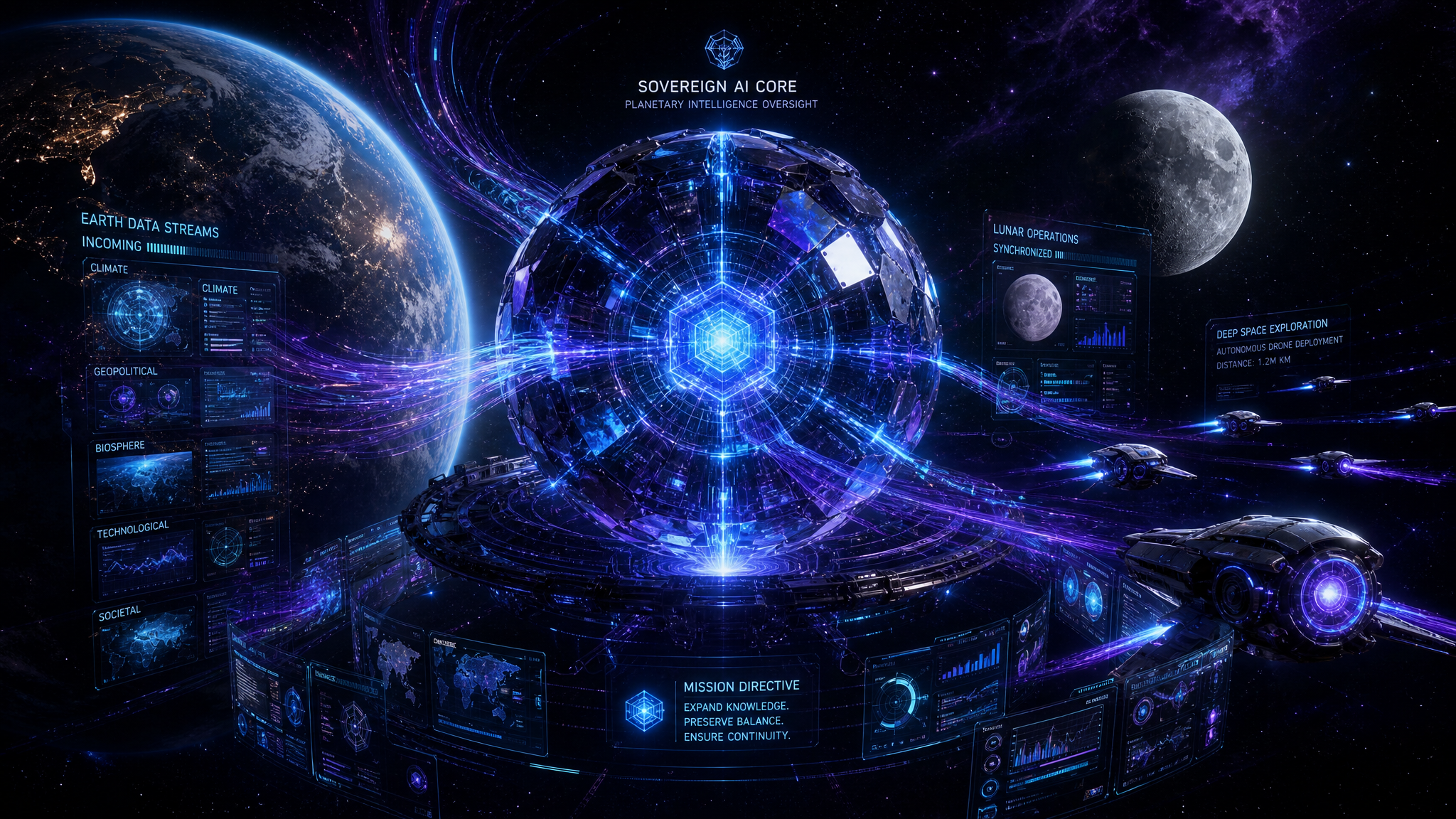
Here, sovereignty must be used carefully. The Sovereign Standard is not a claim of legal authority over the Moon, Mars or any orbital domain. It is a proposed, open framework for retaining human and institutional sovereignty in the AI age across identity, data, money, health, governance and frontier environments, including space. It asks a simple question: when autonomous systems act, how do humans and institutions remain meaningfully in charge?
Applied to space, the answer is not to imagine digital independence from law, nor to romanticise self-governing machines. It is to ensure that off-world autonomy operates within transparent, stewardable and verifiable constraints. Sovereign AI, in this sense, means AI that:
- acts under explicit human and institutional authority;
- can prove what scope it was given;
- uses data under defined rules;
- leaves intelligible audit trails;
- can be constrained, degraded or revoked when conditions change.
That is a better fit for space than either naive centralisation or laissez-faire platform dependence.
A centrally controlled model struggles with latency and brittle command dependency. A purely corporate model struggles with legitimacy and inspection. A sovereign model recognises that local autonomy and constitutional constraint must rise together. The farther an agent can act from Earth, the more clearly its authority should have been structured before launch.
This is where Society OS's architecture becomes relevant, not as a substitute for international law, but as an implementation mechanism for governance that law increasingly requires and operations increasingly demand.
F-ACT: a governance layer for off-world agents
Within the Sovereign Standard sits F-ACT, the Framework for Agent Conformance & Trust: a neutral, open, vendor-neutral AI-agent governance standard. Its normative core is ASDAR — Authority, Scope, Data, Audit, Revocation. For space systems, that grammar is unusually apt.
Authority
Which human role, institution or mission charter delegated the agent's right to act? In a lunar logistics system, for example, authority may derive from mission control for navigation, from a safety board for exclusion zones, and from a scientific governance process for sample handling priorities. Authority should not be inferred from technical capability alone.
Scope
What exactly may the agent do, under which operating conditions, and to what limits? A rover may be authorised to select among pre-approved routes but not to enter heritage zones; a habitat agent may shed industrial loads before medical ones; a prospecting drone may classify terrain but not alter extraction plans without higher-tier approval. Scope is the line between assistance and unauthorised policy.
Data
What data may be used, retained, shared or adapted from? Off-world missions generate telemetry, imagery, environmental readings and, eventually, operational patterns that could be commercially valuable. Governance must specify whether edge models can learn from local data, whether that learning can propagate across an agent fleet, and how contamination, privacy, security and scientific integrity are managed.
Audit
Can the system produce a durable, inspectable record of why an action was taken, under what policy, with which inputs and constraints? In space, audit must function under intermittent connectivity and degraded environments. Logs cannot depend on perfect uplink conditions.
Revocation
Govern before execution — not after.
If assumptions change, can rights be withdrawn or narrowed? Revocation in space may not mean an instant shut-off. It may require graceful degradation: fall back to safe mode, restrict action classes, require consensus from multiple modules, or revert to a bounded rule-based profile until human review. Revocation is not the enemy of autonomy; it is its civilising condition.
F-ACT defines conformance tiers that are useful for mission design:
- L0 Unattested: no meaningful claim of governance conformance;
- L1 Declared: the operator states the controls in place;
- L2 Enforced: technical controls enforce declared boundaries;
- L3 Provable: conformance can be evidenced in a stronger, formally inspectable way.
Not every subsystem in space will need the same level. A low-stakes scientific classifier might remain at L1. Autonomous docking, habitat safety, sample chain-of-custody or planetary protection-sensitive systems should aspire to L2 or L3. The point is not bureaucratic inflation. It is risk-calibrated governance that can be inspected across institutions and vendors.
The 42 Protocols as implementation, not ideology
Standards become real only when they can be deployed. Society OS's contribution is not to proclaim a new jurisdiction in space, but to propose the 42 Protocols as the mechanism that operationalises the Sovereign Standard. They form a deployable stack led by the Sovereign Trinity:
- Human-Twin-Agent identity: who acts;
- HEARTrank: what is trusted;
- WISE Contracts: which execute law, not merely code.
This is best understood as infrastructure for accountable autonomy.
The Human-Twin-Agent Protocol matters in space because identity is not just about access control. It is about legibility of agency. A command, recommendation or autonomous action should be attributable across human operator, digital twin and machine agent. In a distributed mission architecture spanning Earth, orbit, lunar surface and relay assets, ambiguity about who acted is not a minor software defect; it is a governance failure.
HEARTrank matters because trust in frontier systems cannot be reduced to raw performance metrics. A model that is accurate on benchmark tasks but unverifiable in operational provenance may be less trustworthy than a slightly less capable system with stronger conformance guarantees. Trust, in this sense, must incorporate provenance, policy adherence, audit quality and institutional legitimacy.
WISE Contracts matter because off-world systems will increasingly need machine-readable governance that is more nuanced than executable code alone. Rules concerning exclusion zones, sample handling, energy triage, cross-agency interoperability, emergency override and heritage protection must be translated into forms machines can execute without severing their connection to human law and policy. The premise is subtle but powerful: critical automation should execute law, not merely code.
Across the broader stack, the 42 Protocols extend into identity, economy, enterprise, state, mind and infrastructure. Space is one application among many, but it is an unusually clarifying one because it forces governance assumptions into the open. On Earth, humans can often patch around badly governed systems. On Mars, they cannot.
In deep space, bad governance cannot be hidden behind good connectivity.
The motif Society OS uses — 42 years. 42 protocols. 42 papers. — points to a long-horizon architecture rather than a product sprint. That is sensible. Space systems often live for years, sometimes decades. Governance for them should be equally durable.
What this looks like in real missions
The value of sovereign AI becomes clearest when translated into operational scenarios.
Artemis and lunar surface operations
A sustained lunar presence under Artemis will involve assets from multiple organisations: landers, habitats, rovers, communications links, scientific instruments and logistics chains. Some systems will be governmental, some commercial, some international. Interoperability therefore is not merely a question of connectors and frequencies. It is also a question of whether autonomous behaviours are governed in comparable ways.
F-ACT could provide a common conformance language across operators. A cargo rover supplied by one company, a habitat power manager developed by another, and a navigation layer maintained by an agency could each declare and enforce ASDAR-compatible controls. This would not eliminate political complexity. But it would make operational authority far easier to inspect.
Mars exploration under long delay
For Mars rovers and, eventually, crew-support systems, communication delay makes bounded autonomy unavoidable. A sovereign approach would define in advance:
The farther an agent can act from Earth, the more clearly its authority should have been structured before launch.
- which hazards justify self-preserving deviation from plan;
- which scientific opportunities permit on-site reprioritisation;
- which resources can be reallocated locally;
- which decisions must be deferred despite delay.
That changes mission autonomy from a vague aspiration into a constitutional design problem.
Commercial launch and transport ecosystems
If Starship or equivalent heavy-lift systems create abundant transport capacity, the number of actors operating beyond Earth may rise sharply. More payloads, more habitats, more robotic systems and more commercial experimentation will mean more agentic software in environments where external supervision is weak. The need for open governance standards tends to rise, not fall, as access becomes cheaper.
Scientific integrity and planetary protection
Missions such as Psyche, and future missions to icy moons or sensitive astrobiological targets, raise questions beyond operational safety. How should AI classify ambiguous signatures? When may an agent adjust sampling strategy? Under what conditions can learned heuristics spread across instruments or missions without compromising scientific comparability? These are not merely technical calibration issues. They are governance questions touching scientific integrity and planetary protection.
An open framework is more realistic than a universal ruler
One can imagine two unhelpful extremes. The first is a fragmented future in which each company and state runs opaque AI systems under incompatible assumptions. The second is a grandiose fantasy of a single supranational operating system ruling space by decree. Neither is plausible, and neither is desirable.
A more serious path is layered governance.
International law continues to anchor responsibility through instruments such as the Outer Space Treaty. Political frameworks such as the Artemis Accords shape coordination norms among participating states. National licensing and supervision remain essential for activities by domestic actors. Sectoral technical standards handle safety, interoperability and reliability. And above these, or rather through them, open governance frameworks can specify how autonomous agents should be bounded and evidenced.
That is where the Sovereign Standard belongs: not as legal authority over space, but as a public framework for preserving sovereignty when action is delegated to machines. F-ACT supplies the narrow agent-governance pillar inside that broader worldview. The 42 Protocols provide an implementation path for organisations that want to operationalise those principles in actual systems.
This layered model has three virtues.
- It is compatible with existing law. Nothing about sovereign AI requires abandoning the Outer Space Treaty or pretending that legal responsibility has migrated to software.
- It is vendor-neutral. Different models, hardware stacks and mission architectures can still conform to common governance requirements.
- It is future-proofing rather than reaction. As missions become more autonomous, governance can mature in advance rather than after a preventable failure.
The frontier will inherit the defaults we choose now
Every frontier inherits the institutional habits of its founding period. Railways inherited the finance and property assumptions of industrial Britain and America. The early internet inherited research openness, defence funding and later advertising economics. Space will inherit the governance assumptions embedded in its software stack.
If off-world intelligence is built as a bundle of proprietary black boxes, then practical authority will accumulate wherever those boxes are trained, updated and controlled. If it is built only as an extension of state command, then international and commercial cooperation may become brittle. If, instead, it is built on transparent, revocable and inspectable protocols, then autonomy can expand without dissolving accountability.
This is the deeper meaning of sovereign AI for space. It is not about nationalist symbolism, nor about corporate branding elevated to cosmic scale. It is about making sure that when machines act where humans cannot immediately reach, they remain answerable to human purposes that are explicit, plural and governable.
The Moon Agreement showed how difficult comprehensive legal settlement can be. The Artemis Accords show that practical coordination can still advance. The next step is to do for machine agency what earlier space law did for states and objects: define the conditions under which action is legitimate.
That work should begin before autonomous systems become routine infrastructure on the Moon, before Mars missions normalise on-board reprioritisation, before cislunar industry embeds unexamined platform power into physical operations. By then, governance will be much harder to retrofit.
The frontier does not excuse constitutional laziness. It exposes it.
When the next rover hesitates at an unexpected escarpment, or the next habitat controller juggles a failing power bus against life-support demand, the software making that decision will not just be solving an engineering problem. It will be exercising delegated authority on behalf of humanity.
We should know, in advance, whose authority that is, how far it goes, what data it may use, how it will be audited and how it can be revoked. In space, as on Earth, sovereignty is not preserved by distance. It is preserved by design.
Sources & Further Reading
- 1.United Nations Office for Outer Space Affairs: Treaty on Principles Governing the Activities of States in the Exploration and Use of Outer Space
- 2.United Nations Office for Outer Space Affairs: Agreement Governing the Activities of States on the Moon and Other Celestial Bodies
- 3.NASA: The Artemis Accords
- 4.NASA: Artemis
- 5.SpaceX: Starship
- 6.China National Space Administration: Lunar Exploration Program
- 7.NASA: Psyche Mission