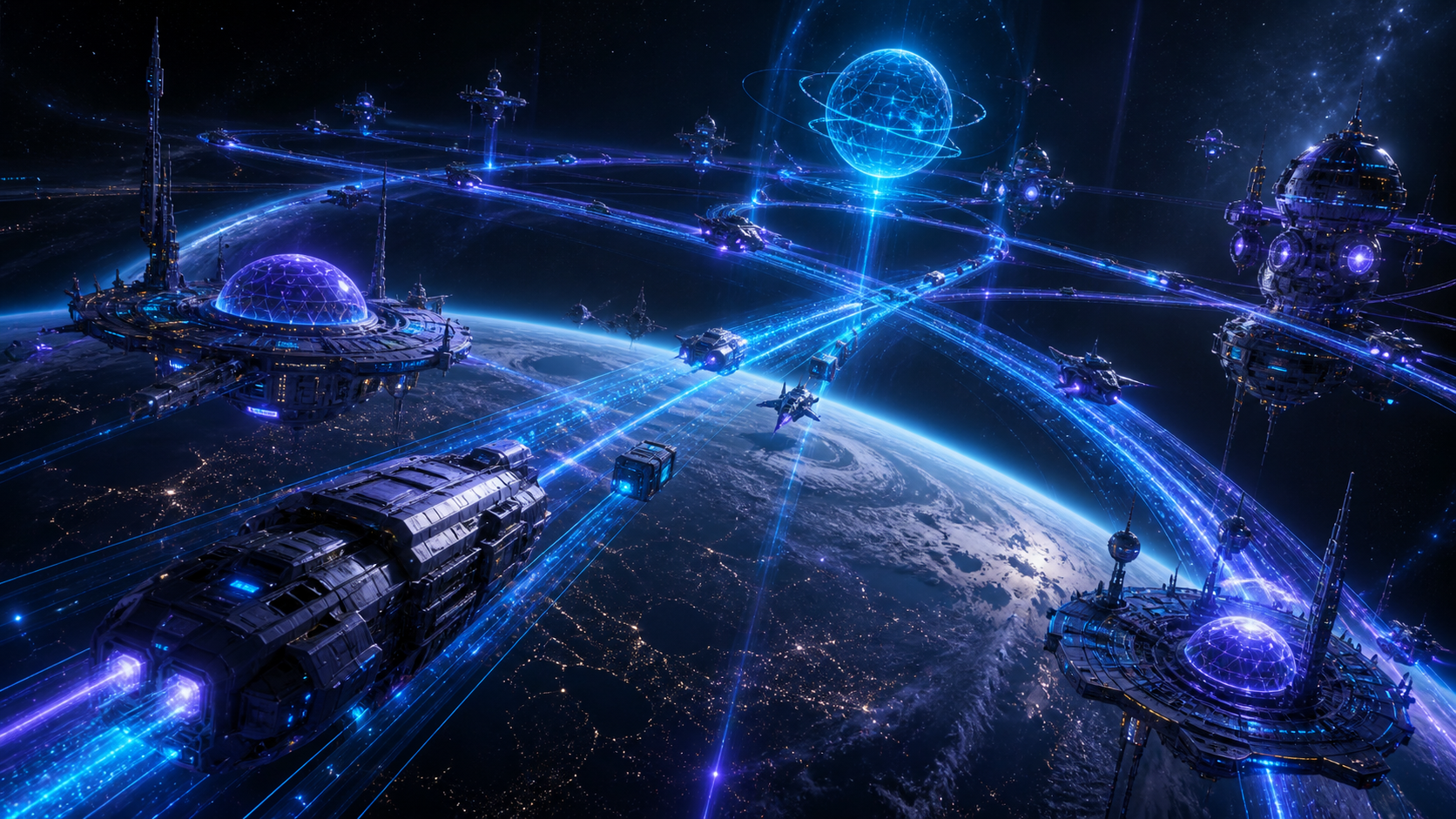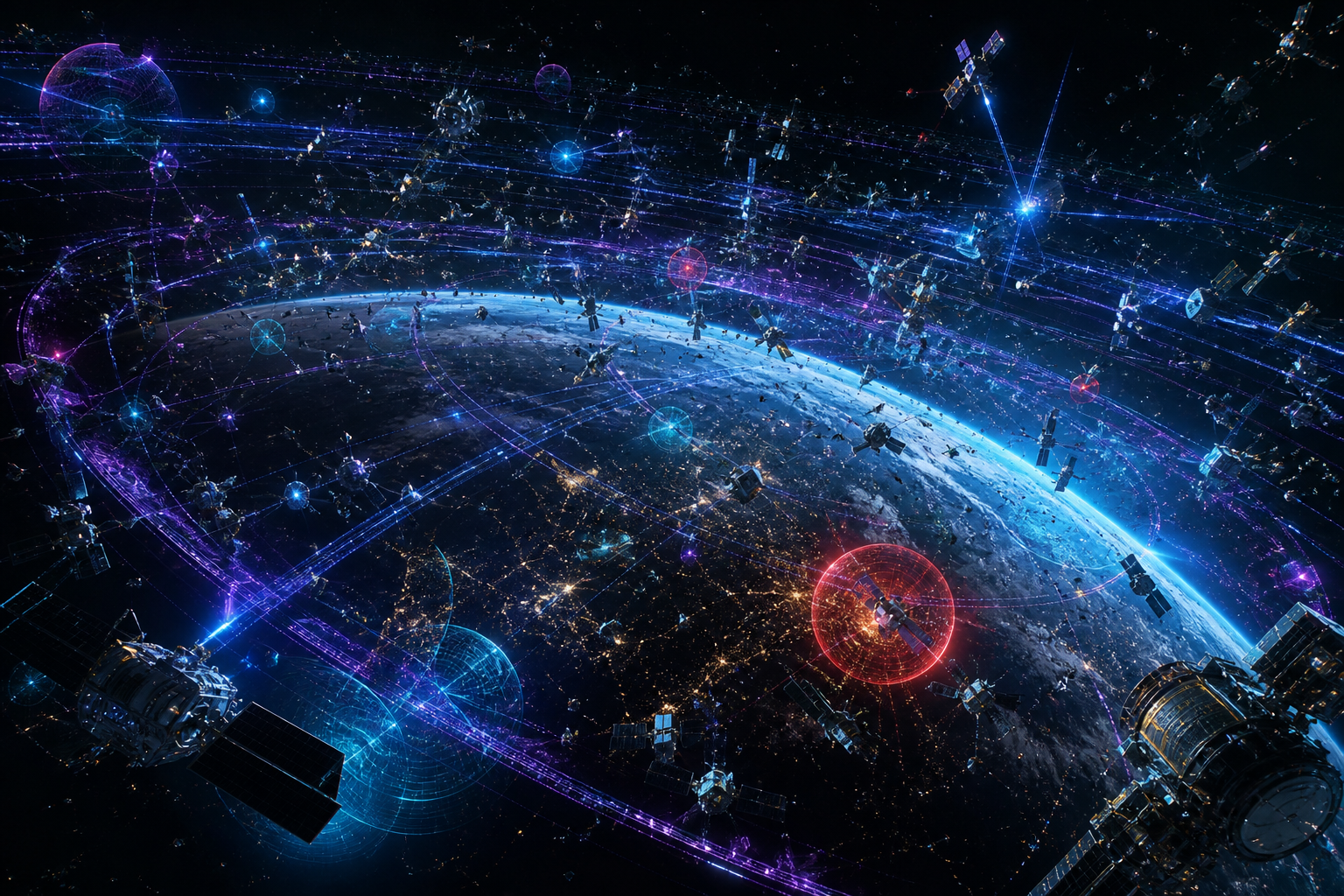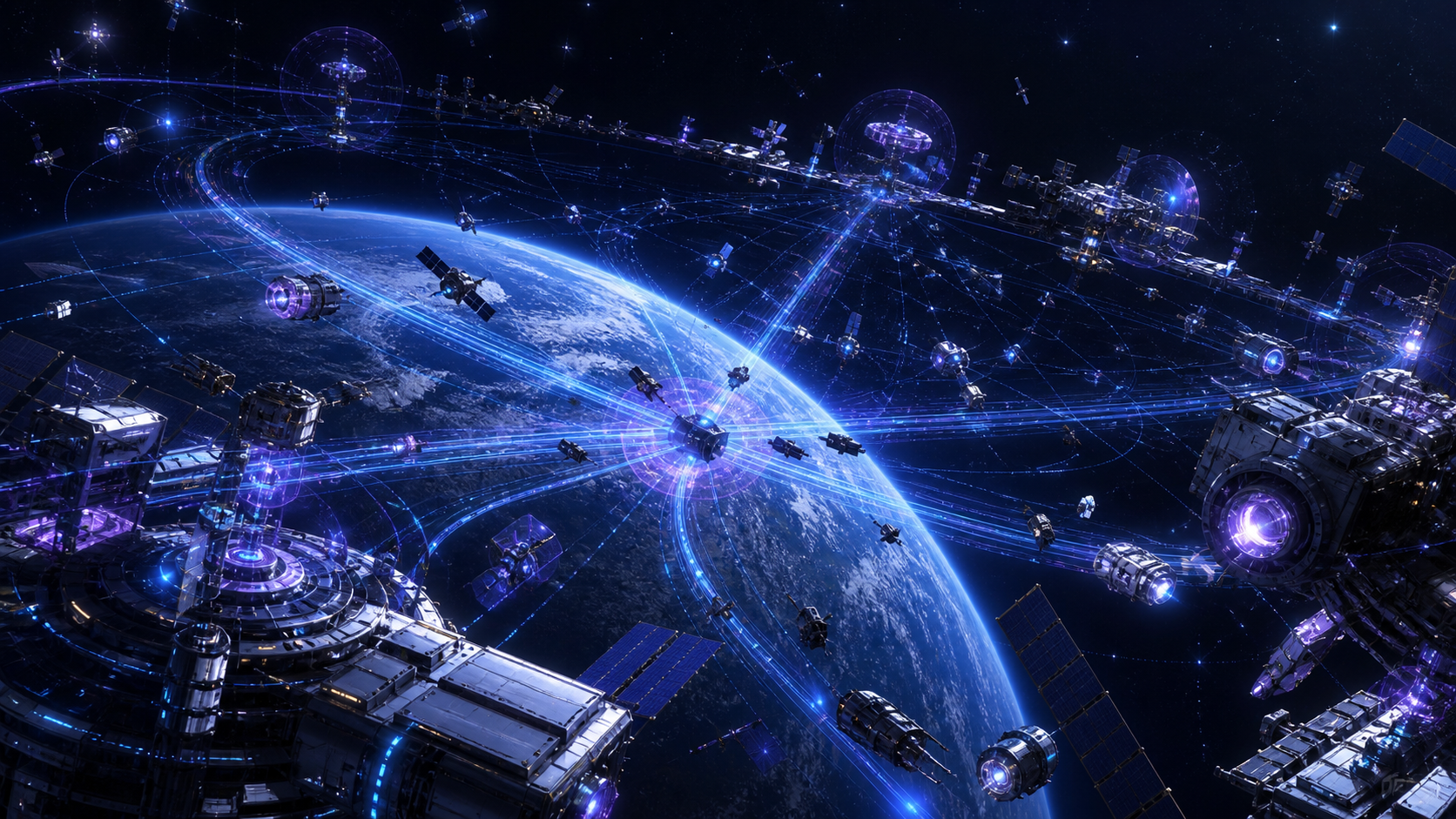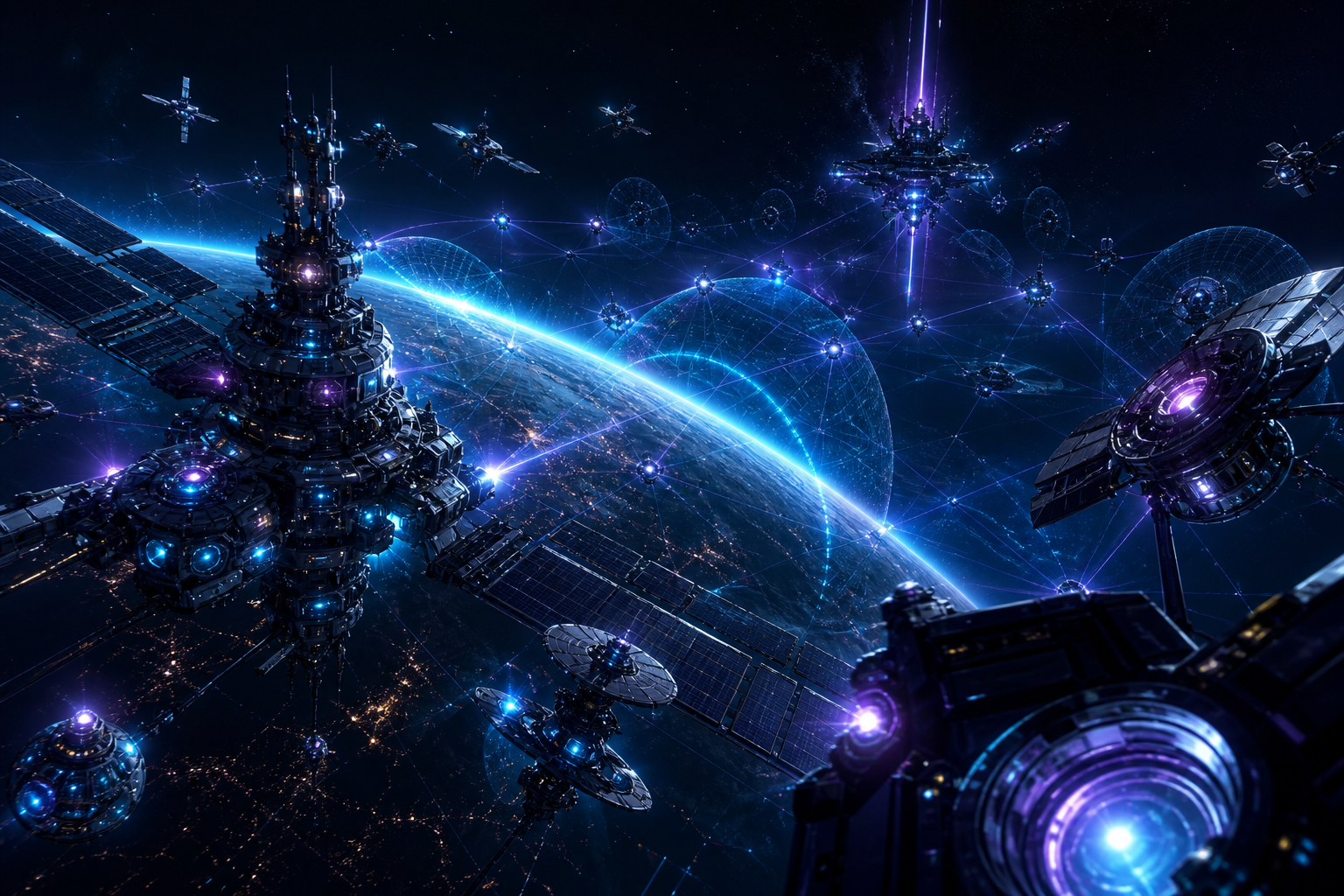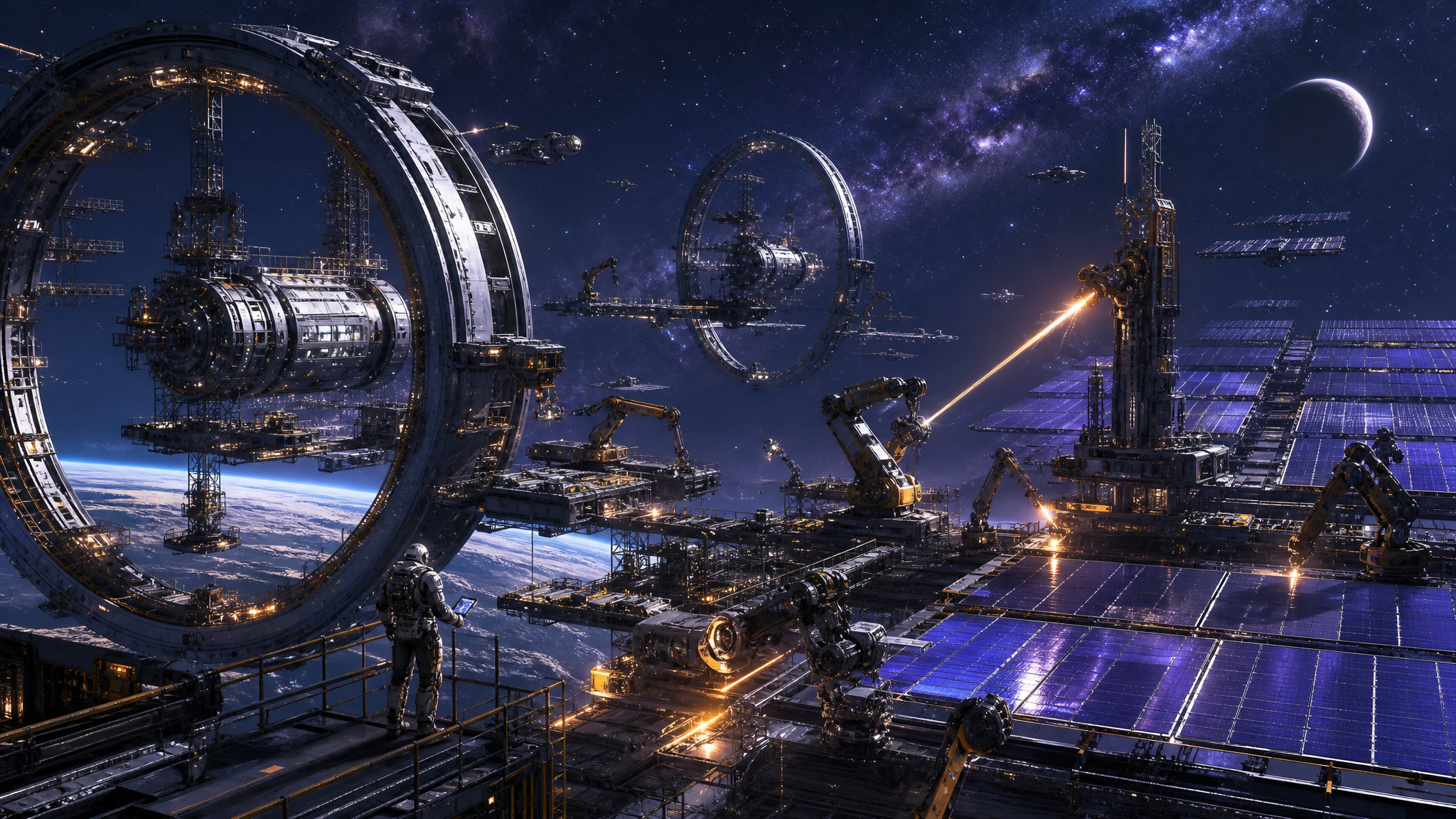
A scaffold appears before the city
On 8 April 2024, a Falcon 9 lifted a commercial robotic lander towards the Moon as part of NASA’s Commercial Lunar Payload Services programme. In the same broad season, SpaceX continued the violent, iterative testing of Starship in south Texas; China advanced the Chang’e programme that has already returned samples from the lunar far side; and engineers across the United States, Europe and Japan worked on habitats, relay systems, docking interfaces, life-support loops and in-space power architectures. None of these pieces, taken alone, constitutes a civilisation in space. Together, however, they point to something more consequential: the early assembly of an orbital scaffold.
Every durable human order begins with infrastructure before it acquires poetry. Roads precede republics. Cables precede markets. Harbours precede empires. In orbit and cislunar space, the equivalents are becoming visible: launch systems that can move mass at scale, stations that can host people and machines, relay networks that can carry command and telemetry, solar arrays that can power industrial processes, and robotic systems that can inspect, repair and assemble what humans cannot yet maintain continuously.
The striking feature of this scaffold is not merely that it is being built. It is that it is being built before there is any settled understanding of who may govern access to it, on what terms, according to which rules, and with what recourse when things go wrong. Space law exists, but it was written for an age of flags, capsules and superpower prestige. The infrastructure now emerging looks more like the substrate of logistics, industry and computation.
That mismatch matters. A relay satellite is not only a piece of hardware; it is a gatekeeper. A propellant depot is not only a tank; it is a chokepoint. A habitat is not merely shelter; it is jurisdiction made physical, however incomplete the law. And an autonomous maintenance system in deep space is not just software in a box; it is an actor capable of decisions with operational, legal and economic effects.
The question for the coming decades is therefore not whether humanity will build permanent space infrastructure. It already is. The question is whether that scaffold will be governed as a shared civilisational layer, or drift into a patchwork of private dependency, national assertion and technical faits accomplis.
What the orbital scaffold actually consists of
The popular imagination still pictures “space” as rockets and heroic landings. In practice, permanence depends on a more prosaic inventory. A functioning off-world system requires at least five layers.
- Transport: reusable or partially reusable launch systems, in-space tugs, docking systems and, eventually, refuelling architectures.
- Habitation: pressurised volume, thermal control, radiation mitigation, closed-loop or semi-closed-loop life support, medical support and waste handling.
- Energy: deployable solar arrays, power management systems, batteries, fuel cells and, in time, perhaps fission surface power for the Moon or Mars.
- Communications and navigation: relay satellites, space domain awareness, timing, positioning and resilient links between Earth, orbit, lunar orbit and the surface.
- Maintenance and construction: robotic manipulators, inspection drones, additive manufacturing, modular replacement systems and autonomous scheduling.
This is why the phrase orbital scaffold is useful. It emphasises incompleteness. Scaffolds are transitional structures that make larger structures possible; they also shape what can be built and who gets to build it. The first operator to provide reliable heavy lift can tilt the economics of every downstream activity. The first network to offer persistent cislunar relay can shape which missions are practical. The first provider of standardised docking, power and servicing interfaces can lock in a technical grammar for an entire era.
We can already see the pieces. NASA’s Artemis programme aims to return astronauts to the lunar surface and build a more durable cislunar architecture. The planned Lunar Gateway, though repeatedly debated and re-scoped, is intended as part of that architecture. SpaceX’s Starship, if it reaches operational reliability, would radically alter the amount of mass that can be moved to orbit and beyond. Blue Origin’s Blue Moon lander and broader cislunar ambitions point to parallel logistics. China’s Chang’e programme has progressed from orbiters to landers to sample return, and Beijing has articulated plans with international partners for an International Lunar Research Station. The European Space Agency, JAXA and others are working on modules, robotics and systems that fit the same broad picture.
Even missions that appear distant from settlement matter here. NASA’s Psyche mission, headed towards a metal-rich asteroid, is scientific first and foremost. Yet every deep-space mission extends practical knowledge in guidance, communications, autonomy, thermal management and long-duration operations. The scaffold is not built only by projects aimed explicitly at colonisation. It is assembled by the cumulative competence of the space sector.
The law we have was not written for the infrastructure we are building
The foundational instrument remains the 1967 Outer Space Treaty. It established principles that still matter profoundly: outer space shall be free for exploration and use by all states; it is not subject to national appropriation by claim of sovereignty, use, occupation or any other means; states bear international responsibility for national activities in outer space, whether carried out by governmental or non-governmental entities; and they are liable for damage caused by their space objects in ways elaborated by later conventions.
This framework was historically important because it prevented the most obvious territorial scramble. But it leaves large areas unresolved once infrastructure becomes persistent, commercial and operationally indispensable.
Take ownership. The treaty is clear that states may not claim sovereignty over celestial bodies. It is much less clear, in practical terms, how exclusive control works around installations that require safety zones, approach corridors, radio quiet, debris mitigation and continuous maintenance. The Artemis Accords, a non-binding political arrangement first signed in 2020 by the United States and partner countries, try to address some of this by affirming principles such as interoperability, deconfliction, assistance in distress, registration and the public release of scientific data. They also discuss “safety zones” around operations to avoid harmful interference.
These are sensible operational ideas. Yet they also reveal the legal tension at the heart of the next space age. A safety zone may be technically necessary and politically prudent. But if such zones become persistent, expansive or commercially strategic, they can begin to resemble functional control without formal sovereignty. The line between deconfliction and exclusion is not always bright.
Then there is the 1979 Moon Agreement, which sought a more developed regime for the Moon and its natural resources, including the idea that such resources are the “common heritage of mankind”. Its influence has been limited because the major spacefaring powers have not ratified it. As a result, humanity has a foundational anti-appropriation principle, a set of partial operational norms, and no broadly accepted regime for resource extraction, infrastructure access, priority rights, dispute resolution or stewardship of long-lived off-world utilities.
There are other instruments, of course: the Registration Convention, the Liability Convention, International Telecommunication Union coordination for spectrum and orbital slots, and a growing body of national space legislation. But the basic institutional truth remains: space law is thinner than space infrastructure now requires.
A relay satellite is not only a piece of hardware; it is a gatekeeper.
Infrastructure creates power long before anyone calls it government
It is tempting to imagine governance as something that arrives in the form of a treaty conference, a declaration or a new authority. In reality, governance often begins materially. Whoever controls scheduling controls throughput. Whoever controls interfaces controls interoperability. Whoever controls maintenance controls uptime. Whoever controls the data layer can decide what is visible, billable, certifiable and contestable.
That is as true in low Earth orbit as it will be in cislunar space and beyond. A communications relay can prioritise one customer’s traffic over another’s. A lunar power installation can become the difference between a viable outpost and an inert shell during darkness or dust-laden operations. A propellant depot can determine whether a mission architecture is commercially feasible. A privately operated station can impose terms of access that are formally contractual yet, in practical effect, infrastructural law.
Earth offers many analogies, none exact but all instructive. Railways shaped national markets before competition law matured around them. Undersea cables became strategic assets well before the public developed any interest in peering agreements or landing rights. Cloud computing has concentrated vast operational power in a few providers, not because they hold sovereignty, but because applications cannot easily function without them.
Space will be harsher because substitution is harder. There is no easy workaround for a failed docking standard 380,000 kilometres from Earth. There is no nearby alternative hospital when radiation exposure or decompression injury occurs on a lunar mission. There is no meaningful distinction between digital and physical control when software schedules oxygen recycling, attitude control and robotic repair.
This is why ownership alone is the wrong question. The more useful questions are:
- Who can access essential off-world infrastructure?
- Under what technical and economic terms?
- How are those terms audited and contested?
- Who is responsible when autonomous systems make operational decisions that cause loss or exclusion?
- How can maintenance, safety and resource use be coordinated without smuggling in undeclared sovereignty?
These are institutional design questions as much as engineering ones.
Autonomy will run the scaffold long before people inhabit it at scale
The orbital scaffold will not be managed chiefly by crews in shirtsleeves floating through spacious stations. It will be managed, for long intervals, by machines. Communications delay, crew scarcity, radiation exposure and cost all point in the same direction: off-world infrastructure will depend heavily on autonomous and semi-autonomous systems.
Those systems will inspect trusses, route power, schedule charging cycles, detect leaks, sort inventory, allocate bandwidth, coordinate docking windows, maintain thermal balance and mediate emergency responses. Some will be narrow and deterministic. Others will increasingly resemble general-purpose agents embedded in constrained industrial settings.
That raises a difficulty which current space governance scarcely addresses. Space law was designed around states, vehicles and human operators. It has relatively little to say about governed machine decision-making inside critical infrastructure. Yet in practice, an autonomous system deciding whether to deny a docking request, quarantine a module, divert power from one user to another or prioritise one repair task over another is already performing a species of governance.
Here the distinction between The Sovereign Standard and F-ACT matters. The Sovereign Standard is a proposed, open framework for retaining sovereignty in the AI age across domains including identity, data, money, health, governance and frontier contexts such as space. It is not law and does not claim jurisdiction. Rather, it offers a way to think clearly about how authority, accountability and human agency should be preserved as technical systems become the substrate of social order.
Within that broader framework sits F-ACT — the Framework for Agent Conformance & Trust — the neutral, open, vendor-neutral standard for AI-agent governance. Its normative core is ASDAR: Authority, Scope, Data, Audit, Revocation. The principle is simple and severe: govern before execution — not after.
Applied to space infrastructure, that means an autonomous maintenance or logistics agent should not merely be evaluated for performance. It should be governable in advance:
- Authority: who authorised this agent to act, and on whose behalf?
- Scope: what exact actions may it take, in which operational envelope?
- Data: what data may it access, infer from, transmit or retain?
- Audit: what tamper-evident record exists of its decisions and effects?
- Revocation: how can its authority be constrained, suspended or withdrawn safely?
These questions are not decorative ethics. They are operational necessities when software mediates access to air, power, movement and communication. A lunar habitat’s life-support optimiser, a cislunar traffic coordinator and a robotic regolith-processing supervisor are not ordinary enterprise tools. They are embedded institutional actors.
F-ACT’s conformance tiers are useful precisely because space systems will mature unevenly: L0 Unattested, L1 Declared, L2 Enforced, L3 Provable. Early missions may operate with declared controls and partial audit. Mature infrastructure carrying humans and high-value cargo should trend towards enforced policy and, where feasible, provable guarantees around authority boundaries and revocation paths.
The frontier needs open standards, not improvised feudalism
The first constitution of space will not be written only in law books. It will be written in interfaces, permissions, logs and fail-safe design.
The risk in the next phase of space development is not simply conflict among states. It is the gradual emergence of improvised feudalism: a world in which access to essential off-world systems depends on opaque contracts, proprietary interfaces, vertically integrated service bundles and governance by technical lock-in.
No serious operator wants this outcome in theory. In practice, however, commercial incentives often favour it. Closed ecosystems monetise dependency. Proprietary interfaces reduce substitutability. Bundled logistics, power, data and servicing can generate stable rents. National programmes, meanwhile, may prefer strategic dependence on friendly providers to genuine openness if the former appears faster or safer.
The answer is not romantic anti-commercialism. Commercial actors are indispensable. SpaceX has already reshaped launch economics. Blue Origin, though slower to market in some domains, is investing in the heavy industrial base required for cislunar operations. Private station companies, in-space servicing firms and communications providers are all extending the frontier. Nor is the answer to pretend that states will relinquish strategic interests. They will not.
The answer is to recognise that standards are political economy in compressed form. Interface standards, audit standards, identity standards, servicing standards and agent-governance standards determine whether a system remains plural, contestable and resilient.
This is where the 42 Protocols matter as an implementation mechanism. They are Society OS’s deployable stack for operationalising The Sovereign Standard. In the space context, they are not a substitute for treaties, licensing regimes or mission rules. They are a way of making governance executable across technical systems.
Led by the Sovereign Trinity — Human-Twin-Agent identity for who acts, HEARTrank for what is trusted, and WISE Contracts for which execute law, not merely code — the 42 Protocols offer a practical grammar for frontier infrastructure in which human authority, machine delegation, trust scoring and contractual execution can be aligned rather than improvised.
That matters off-world because identity failure is catastrophic. If a docking authorisation, maintenance instruction or emergency override cannot be reliably attributed across human, digital twin and agent layers, accountability dissolves at precisely the point where it is most needed. Likewise, trust cannot be a matter of brand aura alone. Habitats, relays and autonomous service systems require persistent, inspectable trust signals grounded in behaviour and conformance. And contracts for access to power, bandwidth, berthing or repairs will increasingly need to execute against real operational constraints, not merely abstract payment terms.
The first constitution of space will not be written only in law books. It will be written in interfaces, permissions, logs and fail-safe design.
A sovereign framework for space without pretending to sovereignty in space
It is important to keep categories clean. The Sovereign Standard is not a claim to rule space. It is not a state, a jurisdiction or a granted right. Space governance will continue to depend on public international law, national licensing, intergovernmental agreements, operator practices and the evolving norms of the sector.
What The Sovereign Standard can offer is a disciplined way to prevent a frontier infrastructure from quietly stripping individuals, organisations and even states of meaningful agency once autonomous systems and platform dependencies thicken around them.
In space, sovereignty is easily misunderstood. The Outer Space Treaty correctly bars national appropriation. But the lived experience of sovereignty for a research institution, a company, a mission crew or a smaller state joining a larger programme is often about something more practical: can you verify the system you depend on, can you port your operations, can you revoke a delegated agent, can you inspect a decision trail, can you contest exclusion, can you retain custody over mission-critical data and models?
Those are sovereignty questions in the AI age, even where no flag is being planted.
The frontier cluster of the Living OS and the Sovereign Stack is therefore best understood as a design discipline for emerging environments where human presence is sparse, machine mediation is dense and institutional lag is severe. Space is one application of that logic. The same patterns appear, in different forms, in digital identity, financial infrastructure, health systems and advanced industrial automation on Earth.
The lesson is sobering. If governance is not built into the scaffold, it will be retrofitted later under crisis conditions: after an exclusion dispute, after a collision chain, after a habitat software failure, after a contested resource operation, after a forensic battle over logs that were never designed to bear legal weight.
What should be built now
The prudent agenda is not grand constitutional theatre. It is a set of practical moves that can mature alongside the infrastructure itself.
First, define essential-space-infrastructure principles
Operators and agencies should identify which off-world assets function as essential infrastructure: communications relays, navigation systems, life-support platforms, power hubs, docking standards, emergency medical capability, debris tracking and servicing nodes. Those systems should carry heightened obligations around interoperability, transparency of operating terms, incident reporting and continuity planning.
Permanence without governance is merely extended fragility.
Secondly, separate possession from access governance
Ownership of an asset need not imply arbitrary control over access where the asset has infrastructural significance. Terrestrial sectors already recognise variants of this logic in telecommunications, energy and transport. Space will require analogous thinking, adapted carefully to treaty constraints and commercial incentives.
Thirdly, make autonomy auditable from the start
Mission architectures should require governance metadata for autonomous systems, not bolt it on later. F-ACT’s ASDAR model provides a coherent baseline for this. An agent that can alter trajectories, allocate power, deny access or execute repair routines should expose authority provenance, scope boundaries, data rules, auditability and revocation paths as first-order features.
Fourthly, standardise identity across human, digital and agent actors
The Human-Twin-Agent Protocol becomes especially relevant in environments where operations span crew, mission control, robotic systems and delegated software. Clear identity continuity across these layers reduces ambiguity in command, liability and emergency action.
Fifthly, design executable agreements for shared infrastructure
Space operations will increasingly rely on machine-readable commitments: slot allocation, servicing windows, maintenance duties, emergency override hierarchies, data-sharing permissions and cost apportionment. WISE Contracts are relevant here because frontier agreements cannot remain vague PDFs when software is actually dispatching power and movement.
Sixthly, preserve pluralism through open conformance
Vendor-neutral conformance matters. F-ACT is valuable precisely because it is framed as a neutral, open standard rather than a proprietary control plane. Frontier infrastructure will be safer and more legitimate if participants can prove conformance without ceding themselves to a single corporate operating model.
This is also the wider significance of the 42 Protocols: 42 years. 42 protocols. 42 papers. The motif is not branding theatre. It reflects a claim about duration and system design. Civilisational infrastructure must be built for stewardship across decades, across operators and across successive technological generations.
The next argument in space will be about maintenance
The romance of the frontier is still attached to firsts: first landing, first woman, first private mission, first sample, first outpost. But the economics and politics of permanence turn on a duller word: maintenance.
Who replaces failing arrays? Who verifies software updates? Who pays for debris avoidance? Who audits a relay outage? Who certifies that a habitat module’s autonomous control system acted within mandate during an emergency? Who gets priority when power is scarce? Who decides whether a robotic miner’s exclusion radius is reasonable deconfliction or disguised enclosure?
These are not peripheral questions. They are the questions that determine whether the scaffold becomes public-like infrastructure, competitive utility, strategic bottleneck or colonial improvisation by other means.
The early twenty-first century may be remembered as the moment when space ceased to be a sequence of missions and became a layer of civilisation. If so, the decisive transition will not have been symbolic. It will have been architectural.
The habitats, energy arrays and communication relays now being planned and deployed are the beginning of a permanent human presence beyond Earth. But permanence without governance is merely extended fragility. The task, then, is not to halt the scaffold. It is to civilise it while it is still being assembled.
That is the frontier challenge The Sovereign Standard is designed to illuminate and the 42 Protocols are designed to operationalise: not to claim authority over space, but to ensure that as humanity builds a second operating environment, it does not do so by surrendering authority to opaque systems, unaccountable dependencies and governance written only by whoever arrives first.
The scaffold is going up. The question is whether we will build its constitutional logic before we are forced to live beneath it.
Sources & Further Reading
- 1.United Nations Office for Outer Space Affairs — Treaty on Principles Governing the Activities of States in the Exploration and Use of Outer Space
- 2.United Nations Office for Outer Space Affairs — Agreement Governing the Activities of States on the Moon and Other Celestial Bodies
- 3.NASA — Artemis
- 4.NASA — Artemis Accords
- 5.SpaceX — Starship
- 6.Blue Origin — Blue Moon
- 7.China National Space Administration — Lunar Exploration
- 8.NASA — Psyche Mission
- 9.European Space Agency — Lunar Gateway
- 10.International Telecommunication Union — Space services