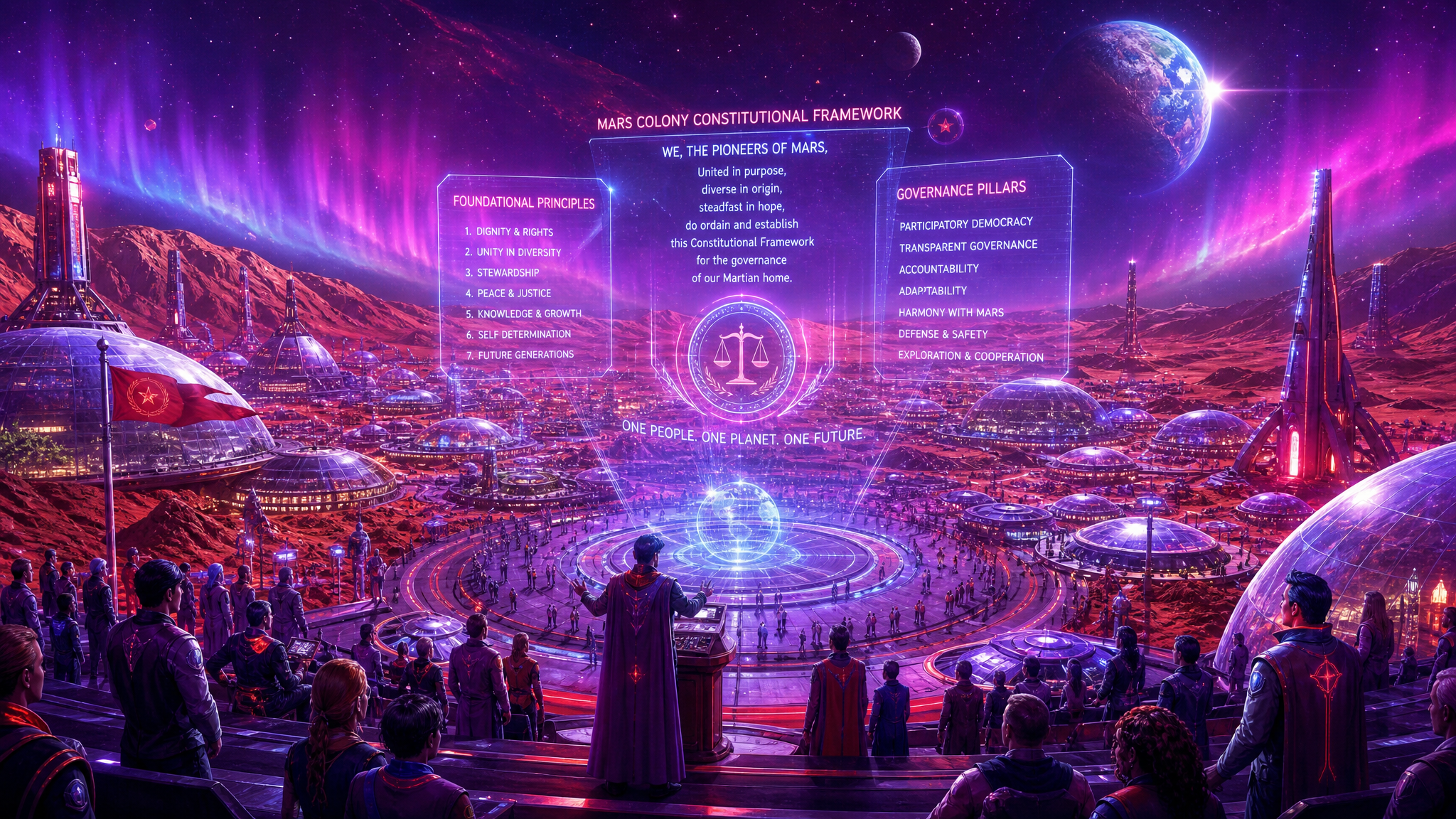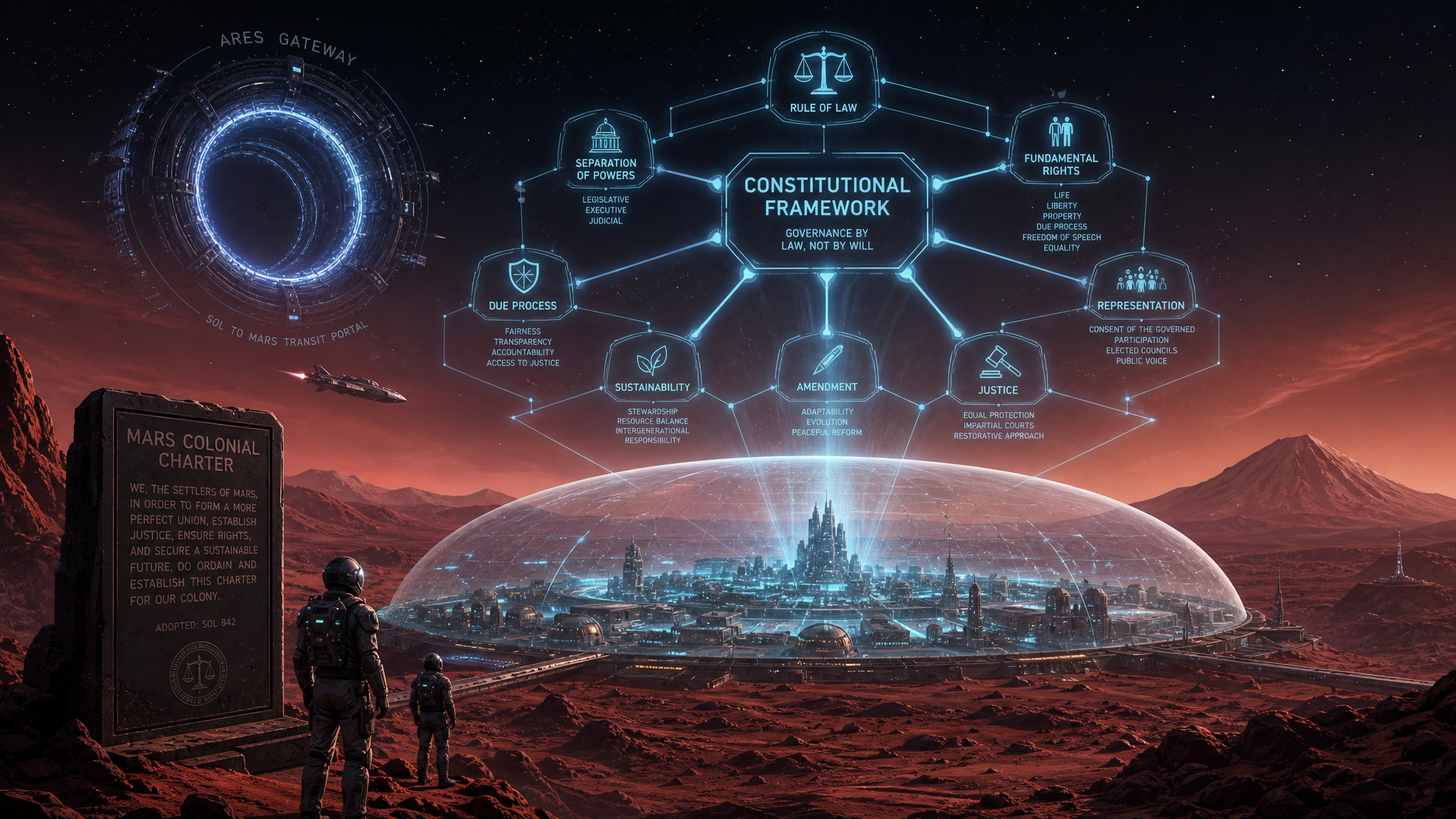
The constitutional clock has already started
A hundred people live inside a sealed habitat on Mars. Outside, the temperature can plunge below minus 100 degrees Celsius. The atmosphere is too thin to breathe. Radiation is a chronic fact, not a distant risk. Water, oxygen, heat, food, spares and bandwidth all depend on machines. Many of those machines depend on software updates. Most of the software, most of the transport capacity and much of the resupply chain are controlled from Earth.
Now ask the fashionable question: will this settlement govern itself by direct democracy?
It is a seductive phrase, not least because Mars invites grand political language. Elon Musk has said that Martian settlers should decide things through direct democracy. Yet a small, closed, high-risk settlement is not Athens with rockets. It is closer to a submarine, an Antarctic station or an offshore platform — except months away, with no realistic evacuation route and a radically more asymmetric dependence on whoever owns the launch vehicles, power systems, communications and life-support components.
That is why the constitutional question for Mars is not speculative philosophy. It is systems design. Who has authority to decide, within what scope, over which data, with what audit trail, and by what means of revocation? Those questions do not begin after a flourishing city exists. They begin when mission software is written, when operating procedures are drafted, when the first habitat rules are encoded, and when the chain of command for emergencies is established.
The window for making those choices deliberately is narrow. If a serious push for human missions to Mars aims at the late 2020s or early 2030s, the governance architecture must be drafted well before boots touch regolith. In practice, that means the next 18 to 24 months matter disproportionately. After that, precedent is likely to be set operationally: by launch contracts, mission protocols, insurance terms, communications systems, export controls, remote override capabilities and the habits of whichever organisation arrives first.
On frontiers, law rarely arrives first. Procedure does.
Space law is real, but it does not answer the settlement question
There is already law in space. The trouble is that most public discussion oscillates between two errors: either pretending Mars is a legal vacuum, or assuming existing treaties provide a ready-made constitution for settlement. Neither is true.
The 1967 Outer Space Treaty remains the foundational instrument. It establishes several principles that matter enormously. Outer space, including the Moon and other celestial bodies, is to be used for the benefit and in the interests of all countries. It is not subject to national appropriation by claim of sovereignty, by use or occupation, or by any other means. States bear international responsibility for national activities in outer space, whether carried out by governmental or non-governmental entities, and they must authorise and continuously supervise the latter. Jurisdiction and control over registered space objects, and personnel thereof, remain with the launching state or registry state.
That architecture is enough to prevent a simplistic land-grab theory of Mars. It is not enough to tell a settlement how to govern its daily life.
The Artemis Accords, first signed in 2020 and since joined by a growing number of states, add practical principles around interoperability, emergency assistance, registration, release of scientific data, preservation of outer-space heritage, deconfliction of activities and the use of so-called safety zones. They are politically important, especially for civil space co-operation around the Moon. But they are non-binding political commitments, not a planetary constitution. They say little about the internal governance of a privately supplied Martian habitat.
Then there is the 1979 Moon Agreement, which contains more developed language on celestial resources and the common heritage of mankind. Yet it has attracted very limited uptake and has not been ratified by the major spacefaring powers. As a practical basis for near-term Mars settlement governance, it is weak.
Meanwhile, real programmes are moving. NASA’s Artemis programme aims to return humans to the Moon and build cislunar infrastructure. SpaceX Starship is central both to NASA’s lunar architecture and to SpaceX’s own stated ambitions for Mars. China’s Chang’e programme has advanced methodically through lunar orbit, landing, sample return and farside operations. NASA’s Psyche mission, though not a settlement mission, reminds us that deep-space operations are becoming more ambitious, more autonomous and more commercially entangled.
The result is a familiar pattern in technological history: capability is compounding faster than institutional design. The treaties tell states not to annex Mars. They do not tell us how a crew of 80, 120 or 500 people should allocate oxygen in a crisis, adjudicate labour obligations, resolve algorithmic disputes over life-support prioritisation, handle births, deaths, intimate violence, mental-health breakdowns, sabotage, property claims in hab modules, or conflicts between Earth-based operators and locally elected councils.
These are constitutional questions in the oldest sense: who decides, on what authority, under what constraints.
A Mars settlement will begin as infrastructure before it becomes a polity
Romantic accounts of colonisation often start with settlers. Real settlement starts with systems.
The first enduring human presence on Mars, if it comes, is unlikely to resemble an independent republic. It will resemble an integrated operating environment with four defining features.
First, it will be capital-intensive. Launch, landing, habitat construction, power generation, in-situ resource utilisation, medical capability and communications are fantastically expensive. That concentrates power in the hands of whoever finances and fields the stack.
Second, it will be logistically dependent. Early Martian communities will rely on Earth for specialised components, pharmaceuticals, software patches, high-value instruments and probably regular replenishment. Dependence shapes constitutional reality more than rhetoric does.
Third, it will be software-mediated. Scheduling, environmental control, access permissions, maintenance, diagnostics, rover operations, crop management and perhaps even interpersonal allocation systems will run through software layers. Increasingly, autonomous agents will manage parts of those workflows.
Fourth, it will be emergency-prone. In a place where one puncture, one contamination event or one cascading power failure can kill many people, executive power expands naturally. A survival environment rewards command responsiveness. It does not reward leisurely plebiscites.
This does not make self-government impossible. It does mean that the first constitution on Mars is likely to be partly hidden.
It will be embedded in:
The first constitution on Mars may not be a document at all, but a permissions matrix.
- command hierarchies for life-support and security-critical systems;
- code permissions for access, allocation and override;
- communications architectures between Mars and Earth;
- ownership and maintenance rights over critical infrastructure;
- employment and passage contracts signed before launch;
- dispute-resolution procedures enforceable by airlock access, ration control or network privileges.
In other words, the founding charter may not begin as a parchment text. It may begin as a permissions matrix.
The danger is not that Mars will have no constitution. It is that it will inherit one accidentally from software defaults and commercial dependency.
Why direct democracy is an insufficient answer
Direct democracy has intuitive appeal in a pioneering settlement. Small populations can, in theory, deliberate collectively. Distance from Earth creates a moral case for local voice. Latency in communications will, at times, force local discretion. There is dignity in self-rule.
But voice is not the same as governance design.
A Martian settlement of 100 people faces conditions that strain the assumptions behind direct democracy.
Emergency power will dominate unless constrained in advance
Life-support failures cannot wait for ballots. Medical quarantine cannot be crowdsourced in real time. Fire, depressurisation, contamination or radiation events require command authority. The constitutional task is therefore not to imagine away executive power, but to define its triggers, limits, review mechanisms and expiry.
Employer power and civic power will blur
If one company transports residents, employs many of them, owns key hardware, controls software updates and determines resupply, then formal political equality may coexist with practical dependency. A vote means less if your oxygen recycler, food printer and return seat are all governed by the same Earth-based entity.
Information asymmetry will be severe
A technically complex settlement distributes knowledge unevenly. Engineers, flight surgeons, systems operators and Earth-side mission control will know more than the median resident about operational risk. Democratic legitimacy then depends on transparent disclosure, intelligible reporting and auditable logs — not simply one-person-one-vote.
Exit is weak, so consent is weak
Democratic theory often assumes that citizens can leave jurisdictions, at least in principle. Early Mars settlers will have little practical exit. A polity without viable exit must compensate with stronger due process, stronger rights and stronger safeguards against arbitrary control.
Agents will govern by action even where humans govern by vote
As off-world systems become more autonomous, many decisions will be prepared, filtered or executed by software agents: power balancing, maintenance prioritisation, anomaly detection, habitat access control, medical triage support, inventory allocation and navigation. If those agents are poorly governed, a nominally democratic settlement can become operationally opaque.
This is where the language of constitutional design must catch up with technical reality. A vote on Mars cannot itself inspect a model’s authority boundary, data provenance or remote override path. Those must be designed and attested beforehand.
The real constitution will be machine-readable
That is not a call to replace law with code. Quite the opposite. It is an argument that in high-autonomy environments, law-like constraints must be made operational in machine-readable form if they are to survive contact with daily reality.
Society OS’s contribution here is not to claim legal authority over space. The Sovereign Standard is a proposed, open framework for retaining human and institutional sovereignty in the AI age, across domains including new frontiers such as space. It is a worldview and stewardship model, not a jurisdiction and not a granted right. Within it sits F-ACT, the Framework for Agent Conformance & Trust: a neutral, open, vendor-neutral AI-agent governance standard whose normative core is ASDAR — Authority, Scope, Data, Audit, Revocation. Its defining principle is simple: govern before execution — not after.
That principle is unusually apt for Mars.
A settlement will rely on a governed agent network long before it can rely on settled constitutional custom. Autonomous and semi-autonomous systems will not merely assist administration; they will mediate survival. Off-world governance therefore requires at least two layers.
A human constitutional layer
This includes rights, duties, emergency powers, representation, dispute resolution, labour rules, family law, scientific openness, property use, resource allocation principles and relations with Earth-based sponsors and states.
A settlement that cannot inspect or disable consequential automated decisions from within is not self-governing in any meaningful sense.
An agent-governance layer
This governs what software agents may do, under whose authority, with access to which data, subject to what logging, and with what revocation path if they malfunction, drift or are abused.
On Mars, ASDAR becomes concrete very quickly:
- Authority: which human office, crew function or recognised institution empowered an agent to act?
- Scope: may it merely recommend, or may it execute control over habitat systems, inventory locks or vehicle routing?
- Data: what inputs may it use, including medical records, behavioural telemetry or location data?
- Audit: can every consequential action be reconstructed, inspected and challenged?
- Revocation: who can disable, degrade or replace it, locally and from Earth, and under what conditions?
These are not abstract software-governance niceties. They are constitutional safeguards for a place where systems make consequential decisions under stress.
Under F-ACT, conformance tiers run from L0 Unattested and L1 Declared to L2 Enforced and L3 Provable. For a consumer chatbot, L1 may be tolerable. For an off-world life-support allocation agent or habitat-access controller, anything below enforceable governance would look increasingly irresponsible.
The wider implementation mechanism is the 42 Protocols, Society OS’s deployable stack for operationalising the Sovereign Standard. In a frontier context, they offer a way to bind identity, trust and execution together through the Sovereign Trinity: Human-Twin-Agent identity for establishing who acts, HEARTrank for establishing what is trusted, and WISE Contracts for ensuring that what executes is not merely code, but law-like policy translated into operational logic.
For Mars, that matters because the settlement problem is not only political philosophy. It is identity architecture, trust architecture and executable governance. Or, more plainly: who may do what, on whose behalf, in a place where mistakes are lethal.
Six constitutional questions Mars settlers cannot defer
Any serious Mars governance effort in the next two years should, at minimum, answer six questions before departure.
1. Who governs in the first 500 sols?
Founding periods are constitutionally distinctive. Early settlements need a temporary regime with explicit limits. That could combine mission command for safety-critical operations with a chartered civic council for non-emergency matters. The key is clarity: what remains under mission authority, what transfers to resident decision-making, and by what milestones.
Indefinite founding emergencies are the oldest route to arbitrary rule.
2. What is locally sovereign, and what remains Earth-controlled?
The Outer Space Treaty makes states responsible for national activities in space, and launch providers will retain powerful contractual leverage. Yet local legitimacy requires defined zones of resident authority. Habitat discipline, domestic relations, work rotations, common-space rules and non-critical resource use may need local competence even if navigation, launch windows or planetary protection remain constrained by Earth-based obligations.
Without that demarcation, settlers risk becoming permanent occupants without meaningful citizenship.
3. What rights are non-derogable in a survival environment?
Some rights may be curtailed by necessity. Others should not be casually negotiable. Due process in serious accusations, bodily autonomy, transparent rationing criteria, appeal rights against algorithmic decisions, protection from coercive surveillance beyond genuine operational need, and clear standards for confinement or sedation in medical and psychiatric emergencies all require prior definition.
Mars will tempt expansive surveillance because every sensor seems safety-relevant. That is precisely why limits are needed.
4. How are autonomous systems governed?
Every critical agent should have a named authority source, bounded scope, minimum-data rule, tamper-evident audit trail and tested revocation pathway. Remote override powers from Earth should be disclosed and constrained. No resident should be subject to consequential machine decisions without records, review and human accountability.
This is the point at which F-ACT is less a technical add-on than a civic necessity.
5. How are disputes resolved when no court is nearby?
Settlements need procedures for contract disputes, negligence, harassment, assault, scientific misconduct, property use conflicts and claims against operators. Purely ad hoc command decisions will not suffice. Nor will Earth courts alone, given delay, evidentiary complexity and the practical need for local interim remedies.
Hybrid tribunals, standing review panels and machine-readable evidence logs may sound dry. They are the plumbing of legitimacy.
On frontiers, law rarely arrives first. Procedure does.
6. How can the constitution itself change?
The first charter will be imperfect. Amendment rules therefore matter as much as founding rules. A settlement must avoid both rigidity and capture. Supermajority thresholds, resident assemblies, expert review and Earth-side treaty compliance checks may all play a part. What matters is that constitutional change is not monopolised by the operator with the most bandwidth.
The analogy is not empire. It is the company town, updated for AI
Public debate about Mars often reaches for the wrong historical analogy. This is not sixteenth-century conquest in any simple sense; the legal environment is far more developed, and the non-appropriation principle matters. Nor is it simply frontier homesteading.
A more illuminating comparison is the company town: a settlement where housing, work, credit, movement and discipline are structurally entangled because one organisation provides the essentials of life. Add advanced automation, biometric sensing and delayed communications, and the governance challenge becomes more acute still.
The modern twist is that control will often be exercised not through overt decree but through integrated systems:
- account permissions rather than padlocks;
- maintenance priority queues rather than public edicts;
- algorithmic risk scoring rather than posted notices;
- remote software control rather than visible constables.
That is why any credible Martian constitutional project must be bilingual. It must speak the language of public law and the language of systems engineering.
The Sovereign Standard offers a useful framing precisely because it insists that sovereignty in the AI age is distributed across identity, data, execution and accountability. Space is one application of that broader thesis, not its definition. The 42 Protocols matter in this setting because they translate principles into deployable mechanisms. F-ACT matters because it addresses the layer too often ignored by lawyers and romantics alike: the governance of agents that will increasingly sit between settlers and their environment.
This is not a substitute for treaty-making. It is a practical bridge between legal principle and operational reality.
The next 24 months should produce a Mars constitutional pre-commitment
The best time to design Mars governance is before Mars governance becomes an emergency patch.
A sensible agenda for the immediate future would be modest in ambition but serious in architecture.
First, spacefaring states, launch providers, habitat designers, insurers, ethicists and prospective settlers should articulate a Mars founding charter template: not a final constitution, but a pre-commitment framework covering emergency powers, resident representation, rights baselines, dispute procedures and amendment rules.
Second, operators developing autonomous mission systems should publish and test agent-governance profiles for safety-critical functions. F-ACT’s ASDAR model provides one coherent way of doing this across vendors and subsystems.
Third, the community should distinguish more clearly between mission command and civic authority. The first human years on Mars will require both; legitimacy depends on not confusing them.
Fourth, the infrastructure stack should be designed with local revocation and auditability in mind. A settlement that cannot inspect or disable consequential automated decisions from within is not self-governing in any meaningful sense.
Fifth, constitutional design should begin from realism rather than theatre. The first Martian polity will not be a utopian blank slate. It will be a fragile, expensive, intensely technical settlement embedded in Earth law and dependent on Earth industry. Pretending otherwise merely hands power to the least accountable layer.
Society OS’s broader architecture is built for exactly these moments of civilisational transition: when new technical capacities outrun inherited institutions, and when societies need a Living OS rather than improvised governance. In this frontier context, the Human-Twin-Agent Protocol, the Sovereign Stack and the 42 Protocols are best understood as implementation machinery for preserving accountable human authority amid rising automation. They do not answer every legal question in space. They do answer a neglected one: how to ensure that software agents, once embedded in the habitat of a new world, remain legible, bounded and subordinate to legitimate human governance.
Precedent will belong to the first movers
Mars settlement, if it happens this century, will be remembered for engineering. It should also be remembered for constitutional foresight.
The first generation will not have the luxury of separating politics from infrastructure. Their rights will live or die in maintenance protocols, command pathways, access controls and resupply terms. Their democracy, if they achieve one, will require more than ballots. It will require governance designed into the stack before launch.
That is why the constitutional window is closing. Once the first permanent habitats are occupied, practice will harden quickly into precedent. Whoever writes the operating manuals, the software permissions, the emergency doctrines and the dispute procedures will have written much of Mars’s first constitution whether or not they use that name.
The question is therefore not whether Mars will be governed. It will be. The question is whether its governance will be openly designed, institutionally constrained and technically enforceable — or whether it will emerge by default from contracts, code and dependence.
On a hostile planet, defaults become destiny remarkably fast.
Sources & Further Reading
- 1.United Nations Office for Outer Space Affairs — Treaty on Principles Governing the Activities of States in the Exploration and Use of Outer Space
- 2.United Nations Office for Outer Space Affairs — Agreement Governing the Activities of States on the Moon and Other Celestial Bodies
- 3.NASA — Artemis
- 4.NASA — Psyche Mission
- 5.NASA — The Artemis Accords
- 6.SpaceX — Starship
- 7.CNSA / Lunar Exploration and Space Program Center — Chang’e Programme