Hub
Deep Dive
Helium-3: The Lunar Gold Rush That Could Power Earth for 10,000 Years
Space Resources & MiningDeep Dive

Helium-3: The Lunar Gold Rush That Could Power Earth for 10,000 Years

Helium-3 makes the Moon economically legible; the harder problem is governing extraction before autonomy scales.

AI AssistedSociety OS Research18 June 202619 min read

Key Insight: The first true lunar rush may not begin with people planting flags, but with governed machines deciding what may be touched, moved and owned.

A fuel source measured in dust

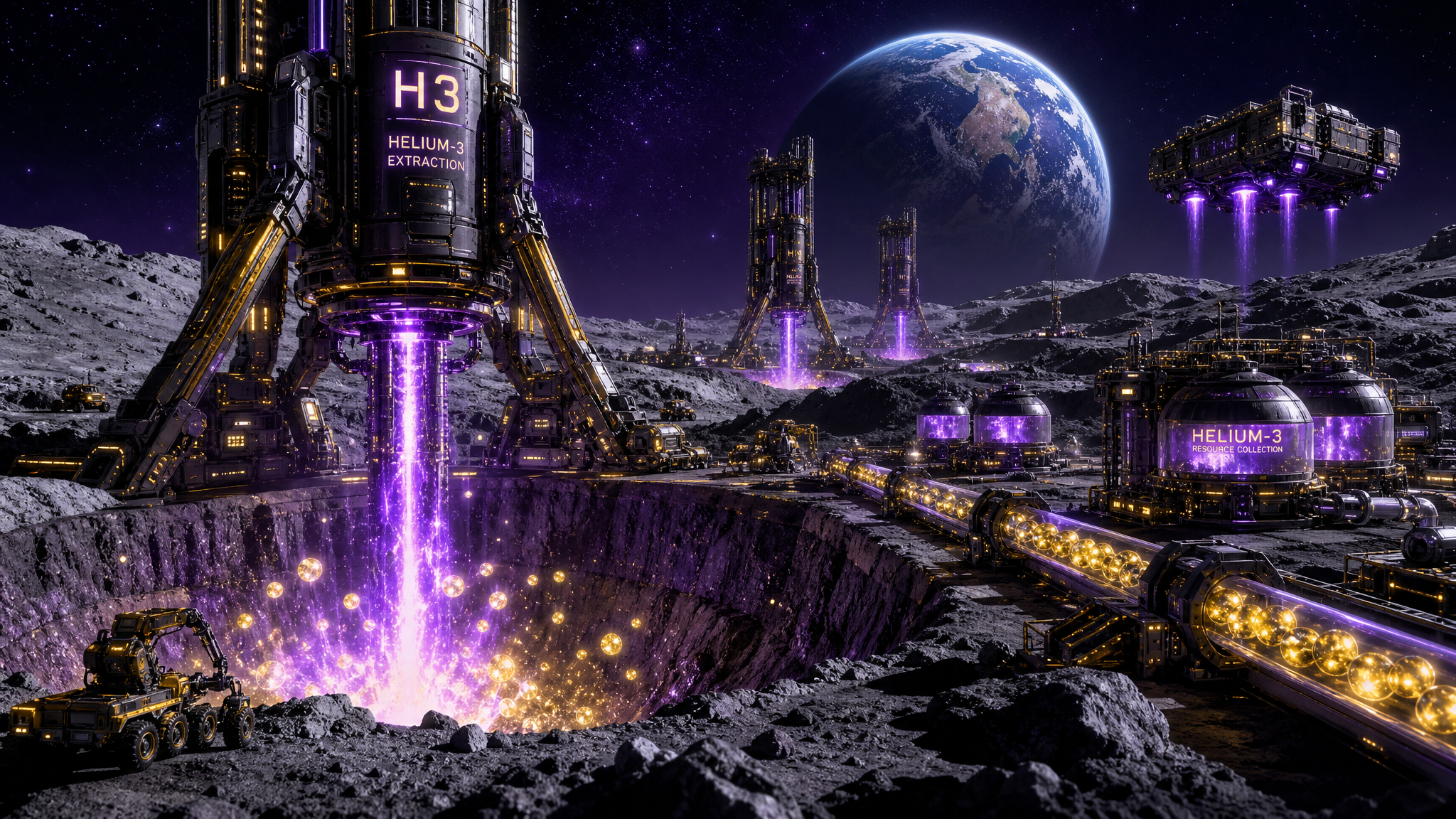
The most consequential energy deposit in the Solar System may look like nothing at all. It lies not in glittering veins or underground caverns, but in a thin, grey skin of lunar dust: regolith baked by sunlight, shattered by micrometeorites and exposed for aeons to the solar wind. Mixed through that dust, in tiny concentrations, is helium-3.

On Earth, helium-3 is vanishingly scarce. Our planet's magnetic field and atmosphere shielded its surface from the steady implantation of solar particles that the Moon, lacking both, has passively collected for billions of years. The result is a resource that sounds almost fictional: an isotope rare enough on Earth to be precious in laboratories, yet plausibly widespread across the lunar surface.

That contrast explains why helium-3 has maintained such a grip on strategic imagination. If controlled fusion ever becomes commercial at scale, helium-3 is often presented as the refined fuel of a future energy civilisation: cleaner in certain reaction pathways than deuterium-tritium fusion, potentially less neutron-intensive, and therefore associated with the promise of reduced radioactive damage to reactor structures. In the popular telling, it is the Moon's gold. In the geopolitical telling, it is a reason not merely to visit the Moon, but to industrialise it.

The rhetoric, however, often outruns the engineering. Helium-3 is not a magic battery waiting to be scooped into a tank. It is diffuse. Extracting it would require heating very large quantities of regolith, separating minute amounts of embedded gas and doing so in an environment defined by abrasive dust, violent temperature swings, communications delay and high launch costs. A lunar helium-3 economy is therefore not simply a mining problem. It is a systems problem: energy, robotics, logistics, law and trust, all at once.

That is precisely why it matters now. The near-term significance of helium-3 is less that cargoes will arrive next year, and more that it makes the Moon economically legible. Once a frontier can be priced, modelled and assigned strategic value, governance can no longer be deferred to a later stage. By the time extraction is viable, autonomous off-world systems will already be making operational decisions with political consequences.

Why helium-3 became the Moon's strategic narrative

Helium-3 is not the only reason to go to the Moon. Water ice near the poles could support life support, radiation shielding and propellant production. Rare earths, metals and oxygen in regolith matter too. Yet helium-3 occupies a special place because it ties lunar industry directly to Earth's largest market: energy.

The attraction rests on a chain of plausible, but not yet completed, propositions.

  • First, the lunar regolith contains helium-3 implanted by the solar wind.
  • Second, some regions, especially mature regolith in favourable terrains, may contain concentrations high enough to justify industrial processing.
  • Third, fusion science may eventually make helium-3 economically useful at scale.
  • Fourth, reusable heavy-lift launch and autonomous surface operations could reduce the cost of obtaining it.

None of those propositions is absurd. None is settled. Together they create a powerful strategic incentive structure.

This helps explain why the resource remains prominent in policy and industrial discourse, particularly in Asia. Chinese researchers have for years discussed helium-3 alongside broader lunar resource utilisation. The Chang'e programme has progressively advanced China's cislunar capabilities: orbiters, landers, rovers, sample return and relay infrastructure. Chang'e-5 returned lunar samples in 2020. Chang'e-6 returned samples from the far side in 2024, a scientific and operational milestone. These are not helium-3 extraction missions, but they form part of the knowledge base and mission architecture required for any serious lunar resource economy.

The United States, for its part, has framed the Moon less around a single isotope than around sustained presence. Artemis aims to return astronauts to the lunar surface and build the foundations for longer-term activity, especially in the south polar region. NASA's commercial partnerships, the Human Landing System programme and interest in in-situ resource utilisation all indicate a strategic shift: the Moon is no longer only a destination for flags and footprints, but a place where infrastructure, supply chains and economic norms may be established.

Private industry has moved the argument from speculative to preparatory. SpaceX's Starship, if it reaches mature operational reliability, would alter the transport economics of cislunar space. That does not by itself make helium-3 extraction profitable, but it narrows one of the largest barriers. Meanwhile, a broader ecosystem of lunar robotics, prospecting technologies, surface power systems and off-world communications is emerging across the United States, Europe, Japan, India and China.

The important point is not that governments and firms are racing for a single commodity in a cinematic dash. It is that they are building the preconditions for optionality. In strategic industries, optionality is often the real asset.

The Moon becomes economically important long before lunar mining becomes commercially mature.

The engineering reality: abundance is not accessibility

Popular accounts often state that the Moon holds enough helium-3 to power Earth for millennia. Such claims capture the scale of the resource in aggregate, but they can mislead. A resource spread thinly across enormous volumes of material is very different from a concentrated ore body.

Lunar regolith typically contains helium-3 at parts-per-billion levels, though concentrations vary by geography, soil maturity and titanium content. To obtain useful quantities, operators would need to excavate, transport and heat vast masses of regolith, likely to several hundred degrees Celsius, then capture and refine the released volatiles. That implies a formidable industrial chain on the Moon itself.

Three difficulties stand out.

The Moon becomes economically important long before lunar mining becomes commercially mature.

Energy return

It takes energy to dig, move, heat and process regolith. Unless that energy comes cheaply from solar, nuclear or another local source, the economics become circular: one may spend an extraordinary amount of energy to harvest a fuel intended to solve an energy problem.

Surface operations

Lunar dust is not ordinary dust. Apollo crews found it clingy, abrasive and invasive. It fouled seals, degraded equipment and posed health concerns. Any industrial extraction system would need to operate in this environment continuously, largely autonomously and with high fault tolerance.

Transport and refinement

Even if helium-3 were extracted efficiently, it would need to be stored, launched from the lunar surface, transported to cislunar or terrestrial destinations and integrated into a fusion supply chain that does not yet exist commercially.

This is why helium-3 should be analysed as a frontier systems challenge rather than a near-term commodity play. The bottleneck is not only geology. It is coordinated machine behaviour under conditions where human intervention is sparse and expensive.

That observation points to a deeper truth about off-world commerce. In space, governance is not a layer added after infrastructure. Governance is part of infrastructure.

The law we have, and the law we do not

Space law is more developed than casual commentary suggests, but less complete than the coming industrial age will require.

The cornerstone remains the 1967 Outer Space Treaty, which established several enduring principles: outer space is the province of all humankind; it is not subject to national appropriation by claim of sovereignty, use, occupation or any other means; activities must be carried out for peaceful purposes; states bear international responsibility for national activities in outer space, including those conducted by non-governmental entities; and states are liable, in defined circumstances, for damage caused by their space objects.

The Treaty's elegance is also its limitation. It was drafted for an era before autonomous mining fleets, commercial habitats and machine-mediated resource claims. It says much about sovereignty and responsibility, but comparatively little about operational questions such as extraction rights, priority zones, environmental baselines, data disclosure, machine delegation or automated conflict avoidance.

The 1979 Moon Agreement tried to go further, including the idea that the Moon and its natural resources are the common heritage of mankind and that an international regime should govern exploitation once such exploitation becomes feasible. But the Agreement was never adopted by the major spacefaring powers. Its normative ambition exceeded political support.

More recently, the Artemis Accords have sought to articulate practical principles for civil exploration and use, including interoperability, emergency assistance, registration, release of scientific data, preservation of outer space heritage and the concept of safety zones intended to avoid harmful interference. The Accords are politically influential and increasingly important, but they are not a universal treaty regime. They reflect a coalition framework, not a globally settled constitutional order for the Moon.

This leaves a distinctive governance gap.

  • Non-appropriation is clear in principle, yet resource extraction is being interpreted by some states as compatible with that principle.
  • National authorisation and supervision are required, yet national regimes are uneven and fragmented.
  • Operational deconfliction is necessary, yet norms remain emergent.
  • Autonomous systems will execute critical tasks, yet standards for machine authority, auditability and revocation are immature.

In other words, the legal architecture is sufficient to permit activity, but not sufficiently granular to structure high-intensity industrial activity among multiple actors with heterogeneous legal doctrines.

That is precisely the sort of moment when frontier sectors make avoidable mistakes: customs emerge through practice before they are properly examined, and path dependence hardens into quasi-law.

Why the next lunar dispute will be procedural, not theatrical

The familiar imagery of space politics is theatrical: flags, crews, speeches, dramatic confrontations. The more likely reality is procedural. A future dispute on the Moon may concern not a dramatic territorial claim, but a machine decision.

Govern before execution — not after.

Imagine a prospecting mission identifies a region of exceptional interest near a polar logistics corridor. Another operator's robotic excavators approach within a distance that one party considers hazardous. Communications latency, proprietary data models and mission rules differ. One fleet is authorised to alter the terrain for extraction. Another is operating under scientific preservation obligations. A servicing agent reroutes power or access in a way that is technically valid but commercially discriminatory. No one has fired a shot; everything important has still happened.

In such scenarios, the governing questions are precise.

  • Who authorised the machine to act?
  • Within what scope?
  • On which data?
  • With what audit trail?
  • How can authority be revoked or constrained in real time?

Those questions are not abstractions. They are the operational grammar of sovereignty when action is delegated to software.

This is where F-ACT, the Framework for Agent Conformance & Trust, becomes relevant. F-ACT sits within The Sovereign Standard as its agent-governance pillar. It is a neutral, open, vendor-neutral standard for governing AI agents, built on the normative core of ASDAR — Authority, Scope, Data, Audit, Revocation. Its defining principle is simple: Govern before execution — not after.

For lunar systems, that principle is unusually apt. The cost of ex post correction in space is high. If an autonomous excavator crosses into a protected area, if a prospecting agent withholds material telemetry, or if a habitat support system chains decisions beyond its authorised remit, one cannot rely on frictionless human intervention. The system must have been governed in advance.

F-ACT's conformance tiers provide a practical ladder:

  • L0 Unattested: the agent acts without credible conformance evidence.
  • L1 Declared: the operator states rules and intended behaviour.
  • L2 Enforced: execution is constrained by technical controls.
  • L3 Provable: behaviour and controls are capable of robust verification.

Not every lunar machine will require the highest tier. A public-facing science explainer does not carry the same risk as an autonomous excavation planner or life-support optimiser. But any serious off-world industrial network will need a structured way to classify agency, bound authority and produce evidence that can be recognised across operators and jurisdictions.

A frontier application of the Sovereign Standard

The Sovereign Standard is not a claim to govern space. It is a proposed, open framework for retaining sovereignty in the AI age across identity, data, money, health, governance and frontier domains such as space. In this context, its value lies in making a difficult distinction clearer: sovereignty is not only about who has power in principle, but about whether institutions can retain meaningful control when action is increasingly executed by autonomous systems.

On the Moon, that challenge is acute. Human supervisors will be far away. Assets will be expensive. Missions will be interdependent. Legal authority will remain terrestrial, but operational agency will often be off-world and machine-mediated.

Society OS's contribution is therefore not to replace treaties, agencies or national licensing regimes. It is to propose an implementation mechanism: the 42 Protocols, a deployable stack that operationalises the Sovereign Standard. In frontier environments, three parts of that stack are especially salient.

Human-Twin-Agent identity

If multiple humans, institutions and software agents are interacting across Earth, orbit and the lunar surface, identity must be more than a username and password. The Human-Twin-Agent Protocol addresses the question of who acts: which human principal, which institutional authority, which delegated agent and under what chain of accountability.

For lunar commerce, that means a rover, excavator, logistics optimiser or habitat controller should not be treated as a free-floating software entity. It should be bound to a verifiable identity chain linking machine action back to authorised human and organisational intent.

HEARTrank

In a frontier economy, trust becomes computable. HEARTrank addresses what is trusted: not merely whether an operator is well known, but whether a specific agent, dataset, mission plan or telemetry source has earned confidence through provenance, behaviour and conformity. In lunar operations, where misinformation may be less dangerous than misunderstood automation, this matters enormously.

WISE Contracts

Off-world commerce will eventually require agreements that are more than self-executing code snippets. WISE Contracts address which rules execute, and do so as law-aware instruments rather than simple automation. For resource extraction, safety zones, servicing access, environmental constraints, data-sharing obligations and priority rights may all need machine-readable execution anchored to legally intelligible terms.

In frontier markets, the most valuable rule is often the one a machine cannot violate.

Together these mechanisms help convert broad principles into operational behaviour. They do not answer whether helium-3 extraction should be licensed under one national model or another. They do make it more plausible that, whatever model is chosen, autonomous systems can act within boundaries that are inspectable, interoperable and revocable.

The real race is for standards embedded in infrastructure

History suggests that in every major industrial transition, standards hidden inside infrastructure shape outcomes as much as visible laws. Shipping containers transformed trade not because they were glamorous, but because they made global logistics interoperable. TCP/IP mattered because it allowed networks to speak. GPS mattered because positioning became a shared utility.

Lunar industry will have its own invisible standards layer. Some of it will concern docking, power interfaces, communications and navigation. Some will concern scientific metadata and safety protocols. Increasingly, some of it will concern governed autonomy.

That is why it is a mistake to discuss helium-3 only as geology plus launch economics. The commercial viability of any lunar resource economy will depend on whether participants can trust machines they did not build, understand decisions they did not directly script and challenge actions before they cascade into irreversible outcomes.

Without such standards, three risks grow.

  • Operational opacity: autonomous systems take actions whose basis is unclear even to their operators.
  • Regulatory fragmentation: each state or company implements incompatible control doctrines.
  • Conflict by ambiguity: harmful interference arises not from overt aggression, but from mismatched assumptions embedded in software.

The Sovereign Standard and F-ACT are best understood as an attempt to address that layer early, while architecture is still malleable. Space is one application of that broader problem, not its sole expression. The same logic applies across the Living OS, the Sovereign Stack and the wider 42 Protocols: in an AI-mediated civilisation, control must be designed into systems at the moment of execution.

In frontier markets, the most valuable rule is often the one a machine cannot violate.

Helium-3's promise, without the romance

It is possible to hold two thoughts at once. The first is that helium-3 is a serious strategic idea. The second is that many public claims about it are still more visionary than bankable.

Fusion itself remains an engineering frontier. Projects around the world have made impressive progress, including major government-backed programmes and private firms pursuing alternative reactor designs, but no commercial helium-3 fusion economy exists. Even if deuterium-tritium fusion becomes commercially viable first, helium-3 may remain niche for a long period. The Moon's helium-3 therefore should not be treated as a solved answer to Earth's energy system.

Yet dismissing it would also be short-sighted. Strategic systems are often built under conditions of uncertainty, because the prize for being prepared is asymmetric. A state or consortium that knows how to prospect, excavate, process and govern lunar materials will possess capabilities useful far beyond one isotope. Those capabilities extend to water extraction, construction feedstocks, radiation shielding materials and cislunar logistics. Helium-3 is, in that sense, both a possible commodity and a civilisational forcing function.

The deeper issue is institutional maturity. If lunar resources become economically important before governance becomes operationally precise, the Moon may inherit the worst habits of terrestrial extractive history: vague rights, uneven transparency, enclosure through practice and disputes resolved after the fact.

This is avoidable. Treaties need not do everything alone. States can refine licensing regimes. Multilateral forums can strengthen norms. Agencies can insist on mission transparency and interoperability. Industry can adopt auditable controls for autonomous systems. Open standards can reduce mistrust before conflicts emerge.

That is the practical significance of framing space through the Sovereign Standard rather than romantic frontier language. The point is not to declare a new authority above existing law. It is to insist that law, legitimacy and machine execution must be coherently connected.

Before the first cargo, the rules of agency

The cliché says that whoever controls energy controls the future. In the case of helium-3, the more accurate claim may be narrower and more useful: whoever defines the trusted operating rules for autonomous extraction, transport and exchange will shape the frontier long before the first profitable cargo returns to Earth.

The Moon's surface may indeed hold extraordinary long-run energy value. But a lunar resource economy will not be won by slogans about abundance. It will be won by transport reliability, surface power, materials processing, standards conformance and institutional trust. Above all, it will be won by those who understand that off-world sovereignty begins not with possession, but with governed action.

Society OS's frontier argument is therefore straightforward. The Sovereign Standard offers a way to think clearly about human and institutional control in the AI age. F-ACT provides the agent-governance discipline inside that worldview. The 42 Protocols provide the implementation mechanism for turning principle into deployable behaviour across a governed agent network. 42 years. 42 protocols. 42 papers. Not a lunar constitution, but a stack for making autonomy legible before scale makes opacity irreversible.

Helium-3 may or may not become the fuel that changes Earth's energy balance. The Moon will almost certainly become a proving ground for something just as important: whether humanity can build an industrial frontier in which machines extend sovereignty rather than dissolve it.

Sources & Further Reading

  1. 1.United Nations Office for Outer Space Affairs — Treaty on Principles Governing the Activities of States in the Exploration and Use of Outer Space (1967)
  2. 2.United Nations Office for Outer Space Affairs — Agreement Governing the Activities of States on the Moon and Other Celestial Bodies (1979)
  3. 3.NASA — The Artemis Accords
  4. 4.NASA — Artemis programme overview
  5. 5.NASA — Psyche mission
  6. 6.NASA — Chang’e 5 T1 and lunar sample context
  7. 7.European Space Agency — Helium-3 and lunar resources overview
  8. 8.Nature Astronomy — Perspectives on lunar in-situ resource utilisation
  9. 9.SpaceX — Starship
Helium-3Lunar MiningFusion EnergyChang'eResource Governance
The engine behind the Signal

Where this connects to Society OS

The Sovereign Intelligence Hub is the free, open front door of Society OS — the sovereign operating system that turns the ideas you just read into working governance. Where this piece names a problem, Society OS is building the machinery to solve it: AI agents that act with your authority, trust you can verify, and compliance that runs as code.

The 42-Protocol Stack

The governance engine beneath every article — led by the Sovereign Trinity: Human-Twin-Agent identity, HEARTrank trust, and WISE Contracts that execute law, not just code.

F-ACT — the open agent standard

The vendor-neutral framework for governing AI agents before they act: Authority, Scope, Data, Audit, Revocation — free to read, cite and implement.

The Sovereign Platform

Put it to work: govern a fleet of AI agents with verifiable authority, tamper-evident evidence, and compliance-as-code across your whole operation.

Explore membershipRead the F-ACT standard

Continue Reading

More from the Sovereign Intelligence Hub

The Lunar Resource Economy Has Arrived — Its Governance Has Not
Space Resources & Mining

The Lunar Resource Economy Has Arrived — Its Governance Has Not

18 min read
The first off-world fortunes may come from accountancy, not asteroids
Space Resources & Mining

The first off-world fortunes may come from accountancy, not asteroids

11 min read
The Hard Part of Space Mining Is Proving What Exists
Space Resources & Mining

The Hard Part of Space Mining Is Proving What Exists

11 min read
The Orbital Balance Sheet
Space Resources & Mining

The Orbital Balance Sheet

18 min
The Hardest Currency in Space May Be Jurisdiction
Space Resources & Mining

The Hardest Currency in Space May Be Jurisdiction

11 min read
The New Geography of Compute
Space Resources & Mining

The New Geography of Compute

15 min

Never miss a signal

Weekly intelligence, no noise

The Sovereign Intelligence Hub — Society OS

© 1989–2026 Society OS Pty Ltd. All rights reserved.