Hub
Deep Dive
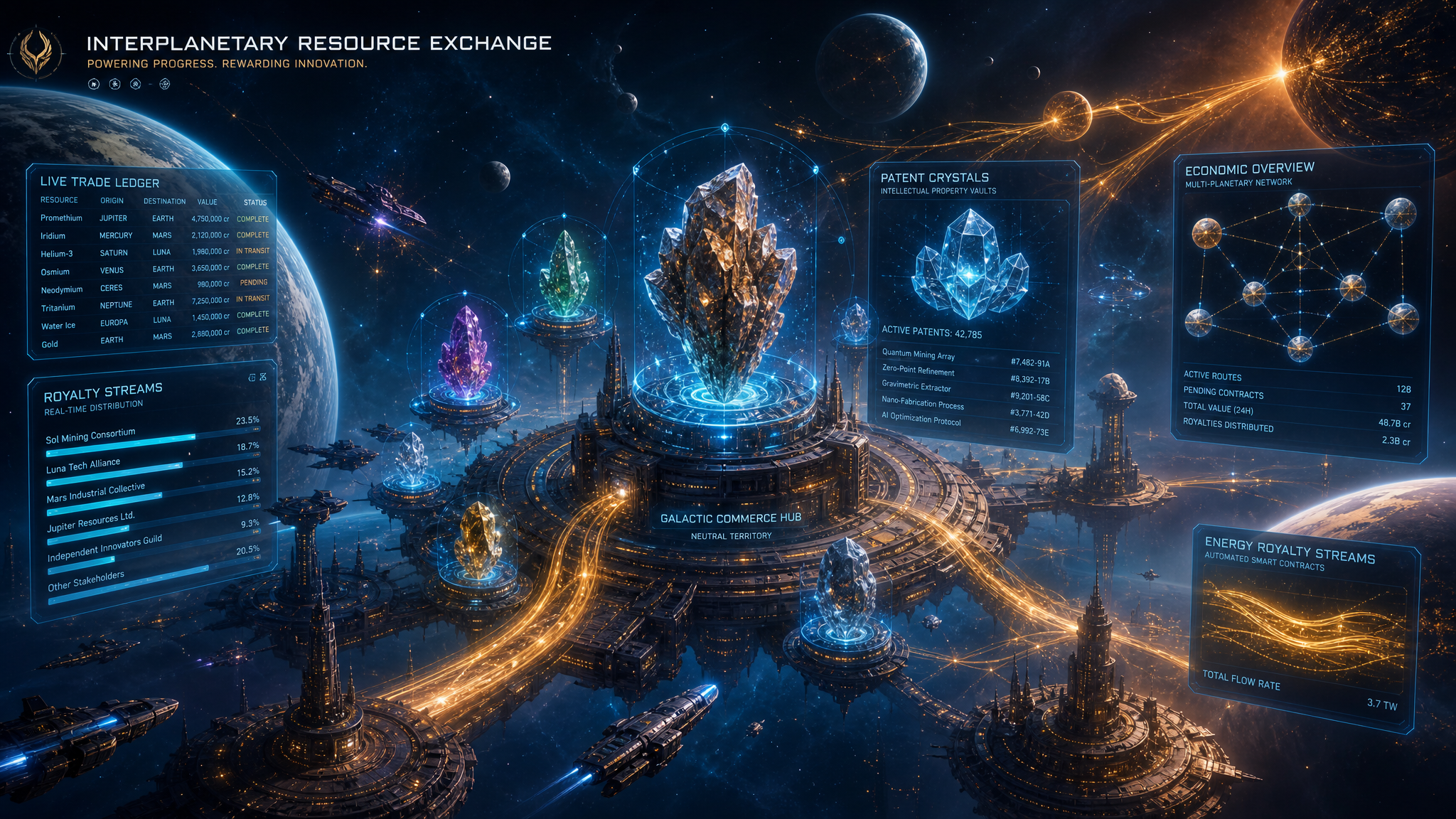
Exo-Economics: Resource Royalties, Pattern Rights, and the Economy Beyond Earth
Space Resources & MiningDeep Dive

Exo-Economics: Resource Royalties, Pattern Rights, and the Economy Beyond Earth

A credible space economy will depend less on possession than on the protocols that govern extraction, trade and trust.

AI AssistedSociety OS Research18 June 202618 min read

Key Insight: In space, the scarcest asset may not be ore but the governed pattern that makes ore economically legible.

The asteroid and the ledger

On 13 October 2023, NASA launched a spacecraft towards 16 Psyche, a metal-rich asteroid orbiting between Mars and Jupiter. If all goes to plan, the probe will arrive in 2029 and begin studying an object that has captured the public imagination precisely because it encourages absurd arithmetic. Popular headlines have long attached fantastical notional values to metallic asteroids, often by multiplying terrestrial spot prices by estimated mineral abundance. The sums quickly become meaningless: the putative value exceeds current global output, current industrial demand and any plausible path to monetisation. Yet the hype obscures the more interesting question. Not what the rock is “worth”, but how any value from it could ever be organised, governed and distributed.

That is the real frontier of exo-economics. Before the first economically meaningful tonne of off-world material enters a terrestrial or orbital supply chain, someone will need to determine who may extract it, under what authority, with what environmental and safety obligations, how autonomous systems are constrained, how disputes are audited, and who receives a royalty if no sovereign land title exists in the ordinary sense.

Space law today gives only partial answers. Engineering is racing ahead. Finance is still mostly speculative. The missing layer is institutional design.

The Sovereign Standard approaches that gap not as a claim of jurisdiction over space, still less as a substitute for treaty law, but as a proposed open framework for preserving sovereignty in systems increasingly run by software, agents and machine-mediated infrastructure. In the frontier domain, space is one application among many. Its practical implementation mechanism is the 42 Protocols, Society OS's deployable stack for identity, trust, execution and coordination. Within that stack, F-ACT — the Framework for Agent Conformance & Trust — provides the vendor-neutral governance layer for autonomous agents operating where delay, distance and danger make human supervision intermittent. Its governing maxim is simple: govern before execution — not after.

In orbit, on the Moon or around an asteroid, that principle ceases to be elegant theory and becomes basic economic plumbing.

The law we have, and the law we do not

Any serious discussion of space resources begins with three instruments: the 1967 Outer Space Treaty, the 1979 Moon Agreement, and the more recent Artemis Accords.

The Outer Space Treaty remains the constitutional baseline of space law. It declares outer space the province of all humankind, forbids national appropriation by claim of sovereignty, use, occupation or any other means, and makes states internationally responsible for national activities in space, including those conducted by non-governmental entities. It also requires authorisation and continuing supervision of private actors by states parties.

That architecture matters enormously. It means a company cannot simply plant a flag on an asteroid and convert celestial geography into fee simple ownership. But the treaty was drafted in the 1960s, before commercial launch, reusable rockets, autonomous robotics and machine-driven in-situ extraction were live industrial possibilities. It says rather little about how extracted resources are to be treated once removed.

The Moon Agreement tried to go further. It framed the Moon and its natural resources as the common heritage of humankind and envisaged an international regime to govern exploitation when such exploitation became feasible. The problem is not textual ambition but political uptake. Major spacefaring powers have not ratified it. As a result, it has limited practical force in structuring contemporary commercial activity.

The Artemis Accords, by contrast, have become the most operationally consequential recent instrument, not because they are a treaty replacing the Outer Space Treaty, but because they translate broad principles into programme-level norms among participating states. They address interoperability, emergency assistance, registration, release of scientific data, preservation of heritage and the deconfliction of activities through so-called safety zones. They also acknowledge that extraction and utilisation of space resources can be conducted consistently with the Outer Space Treaty.

That still leaves large unresolved questions:

  • Is the right model for space resources analogous to fishing, mining, salvage, spectrum allocation, intellectual property, or something else altogether?
  • If sovereign appropriation is barred, what is the legal character of exclusive operational control over a site or process?
  • How should royalties work when there is no ordinary territorial sovereign collecting them?
  • What happens when extraction, transport, refining and exchange are executed largely by autonomous systems across multiple jurisdictions and long communication delays?
  • How are inspection, liability and revocation handled when the operational actor is not merely a corporation, but a governed agent network acting under delegated authority?

For now, national laws have moved faster than global settlement. The United States in 2015 and Luxembourg in 2017 enacted laws recognising rights over extracted space resources under specified conditions. The United Arab Emirates and Japan have also developed legal frameworks supportive of commercial space activity. These do not resolve the international question; they are attempts to create certainty for operators licensed by those states. One can see the logic. Capital requires legal legibility. But exo-economics built solely on national statutes risks fragmentation, forum shopping and eventually conflict.

A durable space economy will require an additional layer: norms and mechanisms that can operate across jurisdictions, across agents and across machine-executed transactions.

Why royalties in space are harder than royalties on Earth

On Earth, royalties usually attach to a recognisable source of authority. A state grants a concession. A landholder licences extraction. A regulator imposes a levy. A patent holder earns from licensed use of an invention. Even where the details are contentious, the institutional picture is familiar.

Space breaks that familiarity in three ways.

First, location is not sovereignty. An extraction platform on the Moon or a robotic mission to a near-Earth asteroid may control a site operationally without owning the underlying territory.

Second, the value chain is overwhelmingly procedural. The economic breakthrough is unlikely to come from brute possession of material alone. It will come from the sequence that identifies a body, maps it, secures approach vectors, coordinates robotic extraction, verifies composition, allocates processing capacity, assures safety, handles custody, and settles trade. In other words, the value sits in the pattern.

Third, autonomy is not optional. Latency and distance mean many off-world operations will be managed by software agents acting within delegated bounds, not by a human pressing buttons in real time. The further activity moves from Earth, the more governance has to be embedded into the execution environment itself.

In space, the scarcest asset may not be ore but the governed pattern that makes ore economically legible.

This is where conventional property discourse becomes insufficient. The harder problem is not simply who owns a chunk of nickel-iron once it has been separated from an asteroid. It is who has standing over the governed pattern that made the extraction possible, trustworthy and commercially interoperable.

In a machine-mediated frontier, value accrues to the party that makes action governable, auditable and revocable.

That is the intuition behind pattern rights: not a claim to celestial sovereignty, and not a magical substitute for public law, but a structured entitlement linked to the governance pattern that coordinates legitimate extraction and exchange.

From mineral title to pattern rights

Pattern rights will sound unfamiliar to lawyers because they sit between several older categories without fitting neatly into any of them. They are not conventional real property rights in land. They are not merely patents, which protect inventions for limited periods under territorial legal systems. Nor are they simply contract rights, because they can shape multilateral coordination across actors who may never negotiate bilaterally in the ordinary sense.

A pattern right, in the sense proposed here, would attach to a recognised extraction-and-settlement protocol: the rules, identity structures, attestations, audit trails and execution constraints that make a resource operation intelligible to participants, regulators, financiers and counterparties. If the market recognises that protocol as the basis on which extraction is certified and trade is settled, then economic yield can be routed through it.

That yields a different answer to the royalty question. Whoever governs the extraction protocol earns the yield — not because they own the asteroid, but because they steward the economically recognised pattern by which value becomes lawful, trusted and exchangeable.

This is not unprecedented in spirit. Much of the modern economy already pays for standards, licences, clearing systems and trusted rails rather than for raw possession alone. Semiconductor firms earn through process knowledge and design rights. Payments networks earn by governing settlement rails. Commodity exchanges create value by standardising grade, delivery and trust. In each case, the pattern organises the market.

Space merely makes this explicit.

The Sovereign Standard therefore offers a useful framing: where conventional sovereignty cannot be directly projected, preserve sovereignty at the level of identity, authority, auditability and revocation. The 42 Protocols then operationalise that framing. Rather than beginning with territory, they begin with the minimal conditions under which off-world action can be recognised as legitimate and therefore economically valuable.

The 42-Protocol mechanism in the frontier domain

Society OS's contribution is not to declare new law for space. It is to propose a mechanism by which legal, technical and economic coordination can be made tractable.

The 42 Protocols are the implementation stack that operationalises the Sovereign Standard across six domains: Individual, Economy, Enterprise, State, Mind and Infrastructure. In the frontier context, they offer a way to bind together identity, trust, machine action and contractual execution where conventional institutions are too distant, too slow or too fragmented.

Three elements are especially relevant.

Human-Twin-Agent identity

Off-world systems will increasingly depend on the Human-Twin-Agent Protocol: a triadic identity structure linking the human principal, the digital twin through which rights and obligations are represented, and the operational agent acting within constrained authority. In space operations, that matters because responsibility cannot disappear into automation.

A lunar regolith processor, orbital refinery scheduler or asteroid prospecting drone may act autonomously, but it must still be attributable. Who authorised it? Under which mission scope? With access to which data? Under what revocation conditions? If an asset transfer or extraction event occurs, the actor must be more than a machine ID. It must be a governed identity relation.

HEARTrank and trusted coordination

Complex resource markets need ranking systems for trust. HEARTrank, within the Sovereign Stack, addresses what is trusted by scoring and ordering entities, processes and transactions on transparent criteria rather than opaque reputation theatre. In space, this could mean differentiating between extraction outputs verified under rigorous telemetry and audit conditions and outputs with weak provenance.

That distinction is not cosmetic. Commodity value depends on confidence in origin, composition, chain of custody and compliance. A tonne of platinum-group material with poor provenance may be economically inferior to a lesser quantity certified under a trusted pattern.

WISE Contracts and machine-executed law

The third element is WISE Contracts: instruments designed to execute law, not merely code. This distinction is crucial. Smart contracts in the narrow blockchain sense are often brittle because they automate instructions without sufficiently embedding legal context, authority checks or equitable remediation.

Whoever governs the extraction protocol earns the yield.

In space, execution cannot be blind. A machine-executed agreement governing extraction quotas, transport windows, refining rights or royalty distribution must recognise mission licences, treaty constraints, environmental thresholds, emergency overrides and chain-of-command rules. WISE Contracts are intended to carry these conditions into execution, so that the transaction rail reflects the governing order rather than bypassing it.

The motif is worth noting because it captures the ambition succinctly: 42 years. 42 protocols. 42 papers. Not a single gadget, but a civilisational stack.

F-ACT and the governance of autonomous off-world systems

If the 42 Protocols provide the mechanism, F-ACT provides the agent-governance spine inside it. This is where exo-economics stops being abstract and becomes operational.

An asteroid extraction mission will not be a single robot obediently executing a preloaded script. It will be a dynamic agent fleet: prospecting systems, navigation systems, hazard assessment models, extraction controllers, inventory managers, settlement agents and compliance monitors. Some will be provided by the mission operator, others by subcontractors, equipment manufacturers or insurers. Their outputs will interact continuously.

Without a common governance model, this becomes unfinanceable.

F-ACT's normative core is ASDAR — Authority, Scope, Data, Audit, Revocation.

  • Authority: who empowered the agent to act?
  • Scope: what exactly may it do, and within what limits?
  • Data: which inputs may it access, process or transmit?
  • Audit: what evidence records its actions and decisions?
  • Revocation: how is its authority modified, suspended or terminated?

These are not bureaucratic niceties. They are the conditions under which a remote autonomous action can be recognised by counterparties and supervised by regulators. F-ACT's conformance tiers make that legibility explicit:

  • L0 Unattested: an agent operates without meaningful declared governance.
  • L1 Declared: governance claims are stated but not strongly enforced.
  • L2 Enforced: policy constraints are technically enforced in operation.
  • L3 Provable: conformance is demonstrable through robust evidence and verification.

In a terrestrial consumer application, one may tolerate L1 systems. In a robotic mining operation with high-value cargo, hazardous machinery and treaty-sensitive activities, the commercial market is likely to converge on L2 or L3 for critical functions. Insurers, launch providers, port operators, orbital logistics platforms and state supervisors will want something stronger than promises.

This is where the royalty question circles back. A pattern right is only collectable if the pattern can be shown to govern real behaviour. F-ACT supplies that proof layer for autonomous action. It turns governance from aspiration into evidence.

What a space royalty regime could actually look like

If one strips away the romance of science fiction, a workable exo-economic royalty system would probably emerge in stages.

Stage one: mission-licensed extraction

Near term, states will continue licensing and supervising private operators under national law, consistent with their reading of the Outer Space Treaty and associated obligations. Royalties, where they exist, may initially resemble terrestrial concession structures: licence fees, regulatory payments, or contractual shares owed to mission financiers, platform operators or technology licensors.

Stage two: protocol-recognised output

As activity scales, markets will demand standardisation. Exchanges, refiners, insurers and logistics networks will begin to prefer output verified under recognised extraction protocols. This is where pattern rights become economically meaningful. The governing protocol does not need to “own space”; it needs to become the trusted basis on which output is accepted, priced and settled.

At this stage, royalties could be routed automatically through WISE Contracts each time certified output is transferred, processed or used as collateral. The royalty is not a tax on celestial territory. It is a fee attached to the trusted pattern that made the asset legible to the market.

Stage three: multilateral clearing and settlement

Eventually, as lunar and cis-lunar industry matures, one could imagine multilateral clearing regimes for space-derived commodities, orbital energy inputs, volatiles, metals and manufacturing feedstocks. Here the need for common governance becomes sharper. Different national regimes will still matter, but the market will also need neutral standards for identity, provenance, compliance and dispute evidence.

This is the level at which the Sovereign Standard becomes useful as a shared conceptual architecture and the 42 Protocols as deployable infrastructure.

Markets for off-world resources will be made not only by rockets and robots, but by ledgers, attestations and governed execution.

None of this requires legal fantasy. It requires an honest recognition that markets for off-world resources will be made not only by rockets and robots, but by ledgers, attestations and governed execution.

The geopolitical reality check

Any discussion of space trade must remain grounded in the actual strategic landscape. America is returning humans to the Moon through Artemis. SpaceX's Starship, if it reaches operational reliability at scale, could dramatically lower the cost of moving mass beyond Earth orbit. China has pursued an ambitious and disciplined lunar programme through Chang'e, including sample return and far-side achievements, and has set out plans for a long-term International Lunar Research Station with partners. Europe, Japan, India, the Gulf states and others are all shaping the next layer of space capability.

That means exo-economics will not emerge from a blank slate designed by a single institution. It will arise amid plural legal traditions, strategic competition, uneven industrial depth and divergent views on openness, licensing and resource governance.

The answer, therefore, is not to pretend that one framework can replace politics. It is to design for interoperability where interests overlap.

The Sovereign Standard is best understood in that light: a proposed open framework for retaining human and institutional sovereignty in machine-mediated systems. In space, it offers a way to articulate what must remain governable even when operations are distributed across jurisdictions and partially delegated to software agents. F-ACT, nested within it, supplies a neutral conformance model for those agents. The 42 Protocols make the whole thing implementable.

That is especially relevant because the frontier economy will be deeply hybrid. Some functions will be public and treaty-bound; others commercial and fiercely innovative; others still quasi-common, such as emergency assistance, traffic coordination or shared infrastructure. A coherent framework has to travel across all three.

Scarcity beyond Earth

There is another conceptual trap in asteroid-mining discourse: the assumption that abundance abolishes economics. If a metal-rich body contains extraordinary quantities of commercially useful material, the naïve conclusion is that wealth becomes infinite. In practice, abundance simply shifts scarcity elsewhere.

The scarce assets in an off-world economy are likely to include:

  • launch capacity and delivery reliability
  • energy availability in situ
  • verified access windows and transport corridors
  • refining and processing capability
  • trusted telemetry and provenance data
  • legal recognisability across jurisdictions
  • governed autonomy with auditable constraints
  • settlement rails accepted by counterparties

In short, the scarce thing is often not the atom but the arrangement.

This is why pattern rights deserve serious treatment. They describe how value accrues when the principal bottleneck is not physical discovery but coordinated legitimacy. The institution that governs a recognised extraction pattern may earn more durable economic yield than the actor that merely touches the rock first.

That principle has terrestrial analogues. In digital markets, open technical standards often create larger and more resilient ecosystems than proprietary enclosure alone. In trade, trusted certification can determine market access as much as productive capacity. In finance, the central question is often not who has the asset, but whose records and rules are accepted for settlement.

Space extends the same logic into harsher conditions.

A frontier worth governing

The temptation in every new domain is to postpone governance until after scale arrives. That would be a mistake in space. Once extraction, refining and transport systems are deeply embedded, the incentives to retrofit auditability, revocation and equitable royalty logic become weaker, not stronger. Path dependence hardens quickly when physical infrastructure is expensive and operational risk is high.

That is why the most important design work in exo-economics must happen early. Not because asteroid mining is about to flood Earth with platinum, but because the first credible frameworks will shape what counts as legitimacy when the industry finally arrives.

The Sovereign Standard does not claim to settle international space law. It proposes a way of thinking: preserve sovereignty through explicit authority, constrained execution, accountable identity and auditable systems. The 42 Protocols turn that into deployable infrastructure. F-ACT ensures that autonomous off-world actors can be supervised in principle and in evidence.

Society OS's broader intellectual project reaches across identity, data, money, health, governance and frontier domains through the Living OS and the Sovereign Stack. Its current patent position comprises 504 provisional/unexamined claims in one Australian provisional application (2026900773), filed on 2 February 2026. That application is unexamined, confers no granted or enforceable rights, and will lapse on 2 February 2027 unless taken further. But the more important point is not intellectual-property theatre. It is the architecture itself: complete by construction, intended to make machine-mediated civilisation governable.

Space is simply where the need becomes impossible to ignore.

When the first truly valuable off-world resource streams begin to move, the defining contest may not be over who discovered the richest asteroid. It may be over whose protocol the world trusts to govern extraction, verify provenance, distribute royalties and settle claims without collapsing into geopolitical farce.

In exo-economics, as in so much else, the future belongs not merely to those who reach the frontier, but to those who can govern the pattern by which the frontier becomes a market.

Sources & Further Reading

  1. 1.United Nations Office for Outer Space Affairs — Treaty on Principles Governing the Activities of States in the Exploration and Use of Outer Space (1967)
  2. 2.United Nations Office for Outer Space Affairs — Agreement Governing the Activities of States on the Moon and Other Celestial Bodies (1979)
  3. 3.NASA — The Artemis Accords
  4. 4.NASA — Psyche Mission Overview
  5. 5.U.S. Congress — U.S. Commercial Space Launch Competitiveness Act (2015)
  6. 6.Luxembourg Space Agency — Space Resources
  7. 7.NASA — Artemis Campaign Development
  8. 8.SpaceX — Starship
  9. 9.China National Space Administration — Lunar Exploration Programme
Asteroid MiningResource RoyaltiesSpace TradePattern RightsPsyche Mission
The engine behind the Signal

Where this connects to Society OS

The Sovereign Intelligence Hub is the free, open front door of Society OS — the sovereign operating system that turns the ideas you just read into working governance. Where this piece names a problem, Society OS is building the machinery to solve it: AI agents that act with your authority, trust you can verify, and compliance that runs as code.

The 42-Protocol Stack

The governance engine beneath every article — led by the Sovereign Trinity: Human-Twin-Agent identity, HEARTrank trust, and WISE Contracts that execute law, not just code.

F-ACT — the open agent standard

The vendor-neutral framework for governing AI agents before they act: Authority, Scope, Data, Audit, Revocation — free to read, cite and implement.

The Sovereign Platform

Put it to work: govern a fleet of AI agents with verifiable authority, tamper-evident evidence, and compliance-as-code across your whole operation.

Explore membershipRead the F-ACT standard

Continue Reading

More from the Sovereign Intelligence Hub

The Lunar Resource Economy Has Arrived — Its Governance Has Not
Space Resources & Mining

The Lunar Resource Economy Has Arrived — Its Governance Has Not

18 min read
The first off-world fortunes may come from accountancy, not asteroids
Space Resources & Mining

The first off-world fortunes may come from accountancy, not asteroids

11 min read
The Hard Part of Space Mining Is Proving What Exists
Space Resources & Mining

The Hard Part of Space Mining Is Proving What Exists

11 min read
The Orbital Balance Sheet
Space Resources & Mining

The Orbital Balance Sheet

18 min
The Hardest Currency in Space May Be Jurisdiction
Space Resources & Mining

The Hardest Currency in Space May Be Jurisdiction

11 min read
The New Geography of Compute
Space Resources & Mining

The New Geography of Compute

15 min

Never miss a signal

Weekly intelligence, no noise

The Sovereign Intelligence Hub — Society OS

© 1989–2026 Society OS Pty Ltd. All rights reserved.