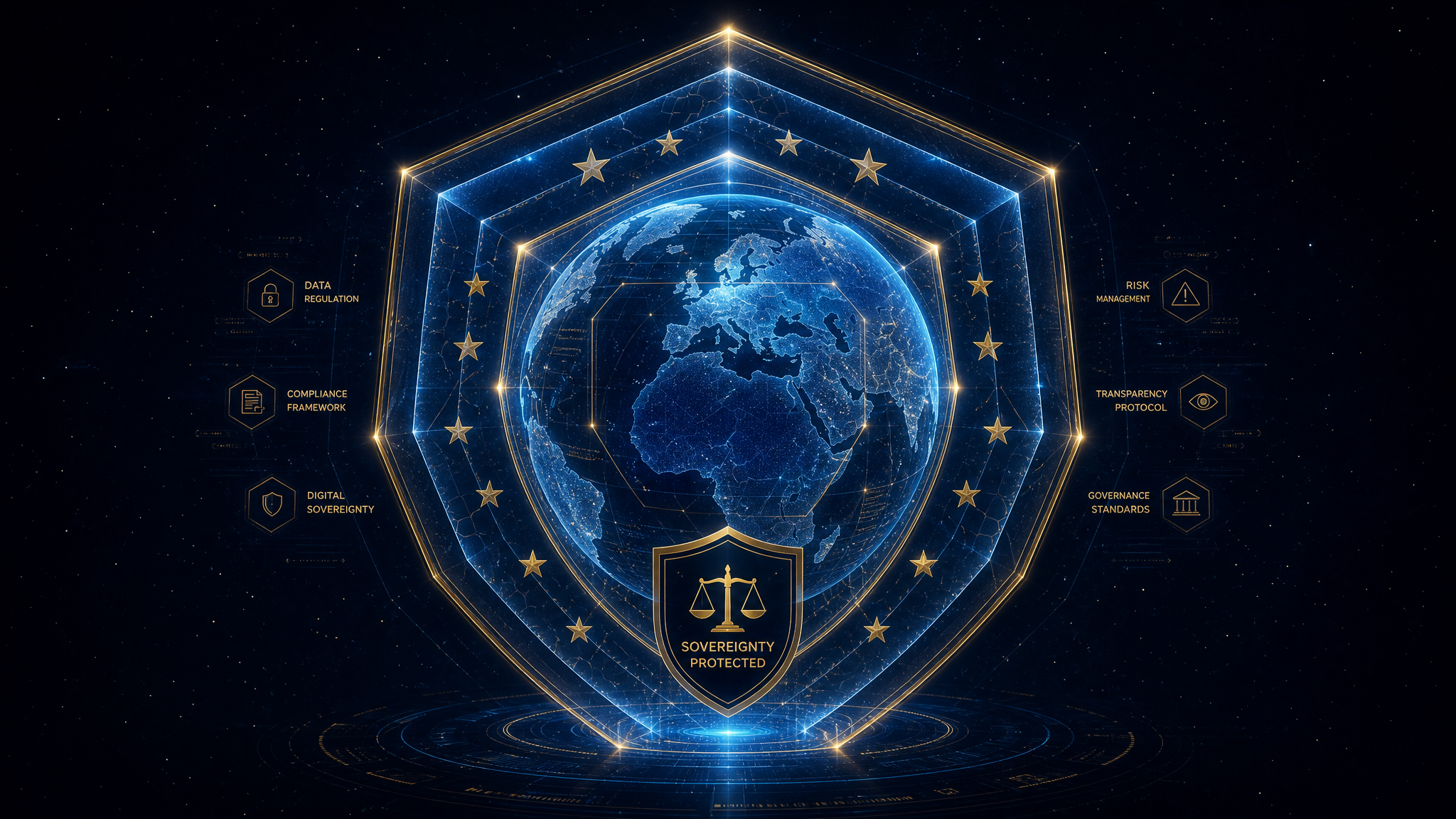
A form, a checkbox, a silent surrender
Open almost any digital service in Europe and the ritual is familiar. A cookie banner slides up. A privacy notice sprawls across several screens. Somewhere beneath the surface, recommendation models profile your behaviour, fraud systems score your transactions, and support tools begin to pass your words through machine-learning pipelines you will never inspect. The law says you have rights. The architecture says someone else still governs.
That mismatch is the true story of modern compliance. GDPR gave individuals powerful entitlements, from access and portability to objection and erasure. The EU AI Act now adds obligations for providers and deployers of certain AI systems, especially those deemed high-risk. Yet for most people, regulation remains something done around them rather than through them. They are protected in theory, processed in practice.
Society OS starts from a different premise. The individual should not live primarily as a data subject inside other institutions' systems. The individual should be able to act as a governed centre of authority: deciding what data may be used, by whom, for what purpose, through which agent, for how long, with what audit trail, and under what conditions of revocation. That is not an act of legal secession, nor a refusal of regulation. It is a better way to inhabit regulation.
This is where The Sovereign Standard matters. It is the broad framework for retaining sovereignty in the AI age across identity, data, money, health, governance and new frontiers. Within it sits F-ACT, the Framework for Agent Conformance & Trust: a vendor-neutral standard for AI-agent governance whose normative core is ASDAR — Authority, Scope, Data, Audit, Revocation. And the mechanism that operationalises both is the 42 Protocols, Society OS's deployable stack, led by the Sovereign Trinity of Human-Twin-Agent identity, HEARTrank trust, and WISE Contracts that execute law, not merely code.
The principle is crisp: govern before execution — not after.
What the law actually says — and where it falls short for individuals
The legal architecture in Europe is more sophisticated than critics often admit. GDPR already recognises that control over personal data matters not merely for consumer convenience but for dignity, autonomy and fair treatment. It requires a lawful basis for processing, imposes data minimisation and purpose limitation, and grants rights including:
- access to personal data;
- rectification of inaccuracies;
- erasure in certain circumstances;
- restriction of processing;
- data portability;
- objection to certain forms of processing;
- safeguards relating to automated decision-making.
The EU AI Act, adopted in 2024, adds a complementary layer. It prohibits some AI uses outright, such as certain manipulative or exploitative practices and some forms of social scoring. It sets obligations for high-risk systems in areas like employment, education, essential services and law enforcement; introduces transparency duties for some AI interactions and synthetic content; and creates a framework for general-purpose AI models.
This is real progress. But it still leaves the individual in a structurally weak position.
Rights are reactive; systems are proactive
Most privacy rights are exercised after a system has already been built, data has already been ingested, and business logic has already been set. Subject access requests, objections, complaints and appeals are important, but they are largely remedial instruments. They assume the person's main role is to respond.
AI governance often suffers from the same problem. A model card is published; a disclaimer is shown; a human review channel exists somewhere. Yet the operational question — who authorised this agent to do this with my data in this context? — is often not answered at the level of the individual.
Controllers remain central; people remain peripheral
Under GDPR, the distinction between controller and processor is foundational. Controllers determine the purposes and means of processing. Processors act on their behalf. In practical life, large organisations therefore sit at the strategic centre of data power. Even where a person can export a file or withdraw consent, they rarely command the rules of execution across multiple services.
There is a narrow legal point worth making carefully. In many circumstances, an individual using personal tools will not become a controller in the formal GDPR sense for all downstream processing, particularly where the household exemption or another legal structure applies. One should not collapse architecture into legal status. But the deeper institutional lesson remains: the person needs controller-like agency in practice, even when the law allocates formal roles differently across contexts.
That is the paradigm shift the excerpt gestures towards. Not legal theatre, but operational sovereignty.
From subjecthood to sovereignty
To call someone a “sovereign citizen” in a European compliance context is risky language if used carelessly, because it can suggest pseudo-legal immunity from the state. That is not the proposition here. The relevant idea is much more serious: a sovereign person is one who can govern their digital extensions coherently across jurisdictions and platforms without pretending to stand outside the law.
In this sense, sovereignty has three layers.
Govern before execution — not after.
First, identity sovereignty
You must be able to prove who is acting. The 42 Protocols approach this through the Human-Twin-Agent Protocol: a structure in which a human principal, a persistent digital twin, and authorised software agents are bound into a governed relationship. The question is no longer simply whether a login succeeded. It is whether this specific agent is acting with valid authority from this specific person or community, within this specific scope.
That matters under existing law. The EU's eIDAS framework already provides a basis for trusted electronic identification and trust services across member states. The revised eIDAS regime, with the move towards the European Digital Identity Wallet, points towards portable credentials and stronger user control. A sovereign architecture should be able to ingest such credentials, not fight them.
Second, data sovereignty
The practical problem with privacy online is not only that data is collected. It is that permissions are broad, storage is fragmented, retention is opaque and secondary use is routine. A sovereign data posture turns these from buried terms into active controls.
Under the Sovereign Standard, the person or community defines:
- what classes of data exist;
- where they may reside;
- which agents may access them;
- what transformations are permitted;
- what logs must be produced;
- how and when permissions lapse.
This aligns with GDPR's spirit more closely than the prevailing click-through model does. Data minimisation becomes an enforceable design rule. Purpose limitation becomes executable scope. Storage limitation becomes timed access and cryptographic deletion policies where feasible.
Third, execution sovereignty
Most digital systems still confuse instruction with governance. A chatbot can be prompted. An API can be called. A smart contract can fire. But governance asks a harder question: under what legal, social and technical conditions should execution be allowed at all?
This is where WISE Contracts become important. Their purpose is not merely to automate transactions, as much of the first generation of blockchain tooling attempted to do. It is to encode obligations, permissions, attestations and recourse in a form that allows machine execution to remain legible to human norms. Law, in other words, is not an afterthought stapled to software. It is part of the execution environment.
F-ACT: the grammar of governed agents
If the AI era is defined by anything, it is proliferation. One assistant becomes ten tools; ten tools become an agent fleet; a fleet becomes a governed agent network interacting with your calendar, messages, bank records, health metrics and work systems. Without a common governance grammar, convenience quickly outruns consent.
F-ACT is designed to supply that grammar.
ASDAR in practice
Its normative core — Authority, Scope, Data, Audit, Revocation — is deliberately plain-spoken.
- Authority: who empowered this agent to act?
- Scope: what may it do, in which domain, under what limits?
- Data: what inputs may it access, derive, store or share?
- Audit: what evidence of actions, decisions and hand-offs must exist?
- Revocation: how can authority be withdrawn cleanly and immediately?
These are not abstract principles. They map neatly onto real compliance pain points.
Take a personal finance agent that analyses bank transactions, categorises spending and proposes movements between accounts, stablecoins and tokenised assets. Under GDPR, transaction records can plainly be personal data. Under anti-money-laundering regimes, some transfers trigger monitoring and reporting obligations. Under the Markets in Crypto-Assets Regulation in the EU, certain cryptoasset services now fall within formal supervisory structures. If such an agent acts across multiple venues, the user needs more than a dashboard. They need pre-declared authority, bounded execution, traceable logs and a hard stop.
Or take a health co-pilot that ingests wearable data, lab results and medication schedules. Health data is a special category of personal data under GDPR, attracting heightened protection. AI tools in healthcare can also fall into the EU AI Act's high-risk categories depending on function and context, while software with medical purposes may engage the Medical Devices Regulation. Here, revocation and audit are not cosmetic features. They are clinical necessities.
Conformance tiers, from promises to proof
Rights are reactive; sovereignty makes governance proactive.
F-ACT's conformance tiers make a useful distinction often missing in AI governance debates:
- L0 Unattested: no credible governance claim;
- L1 Declared: the agent states its rules and limits;
- L2 Enforced: technical controls constrain behaviour;
- L3 Provable: evidence demonstrates conformance.
That ladder matters because much of today's AI safety and compliance discourse remains trapped at L1. Firms publish principles, labels and policy PDFs. Users are expected to trust that reality resembles documentation. A sovereign architecture pushes towards L2 and, where proportionate, L3.
The strategic gain for individuals and communities is straightforward. Instead of asking whether a provider is generally “ethical”, they ask whether this particular agent's authority, scope, data flows, auditability and revocation are declared, enforced or provable.
The 42 Protocols as the operating mechanism
Standards without machinery become aspiration. Machinery without standards becomes risk. The 42 Protocols aim to close that gap.
42 years. 42 protocols. 42 papers. The motif is not a branding flourish so much as a claim about civilisational timescale: if AI is to become ambient infrastructure, the institutions around it must be designed for endurance.
Across the six domains — Individual, Economy, Enterprise, State, Mind, Infrastructure — the protocols offer a deployable means of operationalising the Sovereign Standard.
The Sovereign Trinity
Three elements are especially salient for Earth-bound compliance.
Human-Twin-Agent identity answers the question of who acts. It binds a flesh-and-blood principal to a persistent twin and a set of authorised agents.
HEARTrank answers the question of what is trusted. In a world of synthetic media, cloned voices, generated documents and probabilistic outputs, trust can no longer be a vague brand attribute. It must be computed from provenance, attestations, reputation and behavioural history.
WISE Contracts answer the question of which acts execute. Not every technically possible action should be legally or socially permitted. WISE Contracts make policy executable.
A day in the life of a sovereign person
Consider a plausible near-future European household.
A parent uses a digital identity wallet to prove entitlement for a public service. Their Human-Twin-Agent profile authorises a benefits agent only to retrieve the minimum claims data necessary for this transaction, for one session, with no onward sharing. A HEARTrank layer verifies the public authority endpoint and flags any mismatch in certificates or provenance. A WISE Contract records the purpose, duration and audit requirements. If the service later attempts to reuse the data for profiling unrelated eligibility questions, the scope fails.
The same person then uses a personal health agent to combine smartwatch data, blood panels and dietary logs. The agent can summarise trends and prepare questions for a clinician, but it cannot transmit raw health data to a wellness advertiser, train an external model without explicit authorisation, or retain sensitive data beyond the agreed period. Access by a family member caring for an elderly relative can be time-bound and role-specific.
Later, a community energy cooperative manages household battery participation in a local flexibility market. Here the individual is not acting alone but through a civic structure closer in spirit to a DAO, though typically anchored to recognised legal forms because energy markets, taxation and consumer protection remain firmly regulated on Earth. The cooperative's agents negotiate bids, dispatch storage and reconcile payments, but only within collectively agreed parameters. Governance is not eliminated by automation; it is made more exact.
That is practical sovereignty. It does not abolish institutions. It rebalances them.
Beyond privacy: money, health and collective organisation
The sovereign-life cluster is wider than personal data.
The mature alternative to surveillance capitalism is not anarchic individualism. It is governed interoperability.
Money: from bank rails to programmable assets
The rise of stablecoins, tokenised funds and on-chain settlement is forcing regulators to reconsider where money ends and software begins. Europe has moved earlier than many jurisdictions with MiCA. Central banks continue to explore retail and wholesale digital currency designs. Meanwhile, decentralised finance has shown both the power of programmable liquidity and the fragility of systems that pretend code alone is governance.
For a sovereign person, the question is not whether to reject regulated finance or embrace crypto utopianism. It is how to maintain agency across both. A governed financial agent should know when an instruction requires stronger authentication, when a transfer crosses a policy threshold, when a wallet interaction exposes excessive permissions, and when transaction history should remain local rather than sprayed across counterparties.
Health: the frontier where governance becomes intimate
Longevity science is progressing unevenly but materially, from better biomarker tracking and omics analysis to AI-assisted drug discovery and more personalised prevention. As medicine becomes more data-intensive, the need for patient-governed infrastructure becomes acute.
A person trying to extend healthy lifespan may generate a dense stream of sensitive information: sleep, glucose, heart-rate variability, scans, sequencing, prescriptions, symptom journals. The current default is balkanised portals and consent forms. A sovereign stack would instead let the person hold a coherent governance layer over this mosaic: clinicians receive what they need; researchers receive narrowly permissioned datasets or federated access where suitable; consumer applications receive almost nothing by default.
Governance: communities as compliance actors
Not all sovereignty is individual. Housing associations, local cooperatives, parent groups, research commons and diaspora networks increasingly need digital governance structures of their own. Many will experiment with DAO-like decision systems, multisignature controls and shared treasuries. But the lesson of the past few years is clear: collective digital governance only works when authority and accountability are explicit.
F-ACT and the 42 Protocols are relevant here because communities will deploy agents too: to manage funds, vote execution, grant allocations, procurement, communications and dispute workflows. The same ASDAR logic applies at group scale.
What sovereignty is not
A useful framework must also mark its boundaries.
First, sovereignty is not exemption from regulation. GDPR, the EU AI Act, consumer law, financial rules, medical-device law and anti-discrimination law still apply according to context. The point is not to escape them, but to become legible and resilient within them.
Second, sovereignty is not maximal self-custody in every domain. Some functions are sensibly delegated to trusted institutions. The issue is whether delegation is bounded, revocable and auditable.
Third, sovereignty is not a licence for opacity. If your agent acts in markets, workplaces, schools or public services, other parties may require evidence of compliance and fair dealing. That is precisely why open standards matter.
The mature alternative to surveillance capitalism is not anarchic individualism. It is governed interoperability.
Finally, sovereignty is not achieved through slogans. It requires operational detail: key management, credential portability, event logging, revocation design, fallback procedures, legal wrappers, human review channels and user experience that ordinary people can actually navigate.
The strategic choice now
Europe's regulatory direction is clear enough. Data governance will tighten. AI governance will become more sector-specific. Digital identity rails will strengthen. Financial and health infrastructures will grow more machine-readable. In that world, the old bargain — hand over data, trust the platform, rely on rights of complaint later — will look increasingly archaic.
The practical alternative is to build a Living OS for personhood: a Sovereign Stack in which identity, data, money, health and governance are coordinated rather than scattered. The Sovereign Standard supplies the worldview and the published framework. F-ACT provides the narrow, technical, vendor-neutral grammar for governing agents. The 42 Protocols provide the mechanism that makes the model deployable in daily life.
There is an intellectual elegance to this arrangement, but its importance is more concrete than philosophical. As AI systems spread, every serious institution will ask some version of five questions: who authorised this, what was it allowed to do, what data did it use, what evidence exists, and how can it be stopped? Those are ASDAR questions. They are as relevant to a teenager's study assistant as to a municipal procurement agent or a clinical triage workflow.
The citizens who fare best in the coming decade will not be those who imagine they can hide from regulation, nor those who surrender themselves to it as passive subjects. They will be those who learn to compose compliance as an instrument of agency.
Earth compliance, then, is not the art of surviving forms. It is the craft of designing governed digital life before someone else does it for you.
Sources & Further Reading
- 1.EUR-Lex: General Data Protection Regulation (Regulation (EU) 2016/679)
- 2.EUR-Lex: Artificial Intelligence Act
- 3.European Commission: European Digital Identity
- 4.EUR-Lex: eIDAS Regulation
- 5.EUR-Lex: Markets in Crypto-assets Regulation (MiCA)
- 6.EUR-Lex: Medical Devices Regulation
- 7.European Data Protection Board: Guidelines on automated individual decision-making and profiling