On a February night, the phone call sounded real
In early 2024, voters in New Hampshire received a robocall that appeared to come from Joe Biden, urging them not to vote in the primary. It was fake. The voice had been cloned. The incident quickly became a political scandal, but it was also a preview of a wider media problem: the marginal cost of simulating a trusted human voice has collapsed.
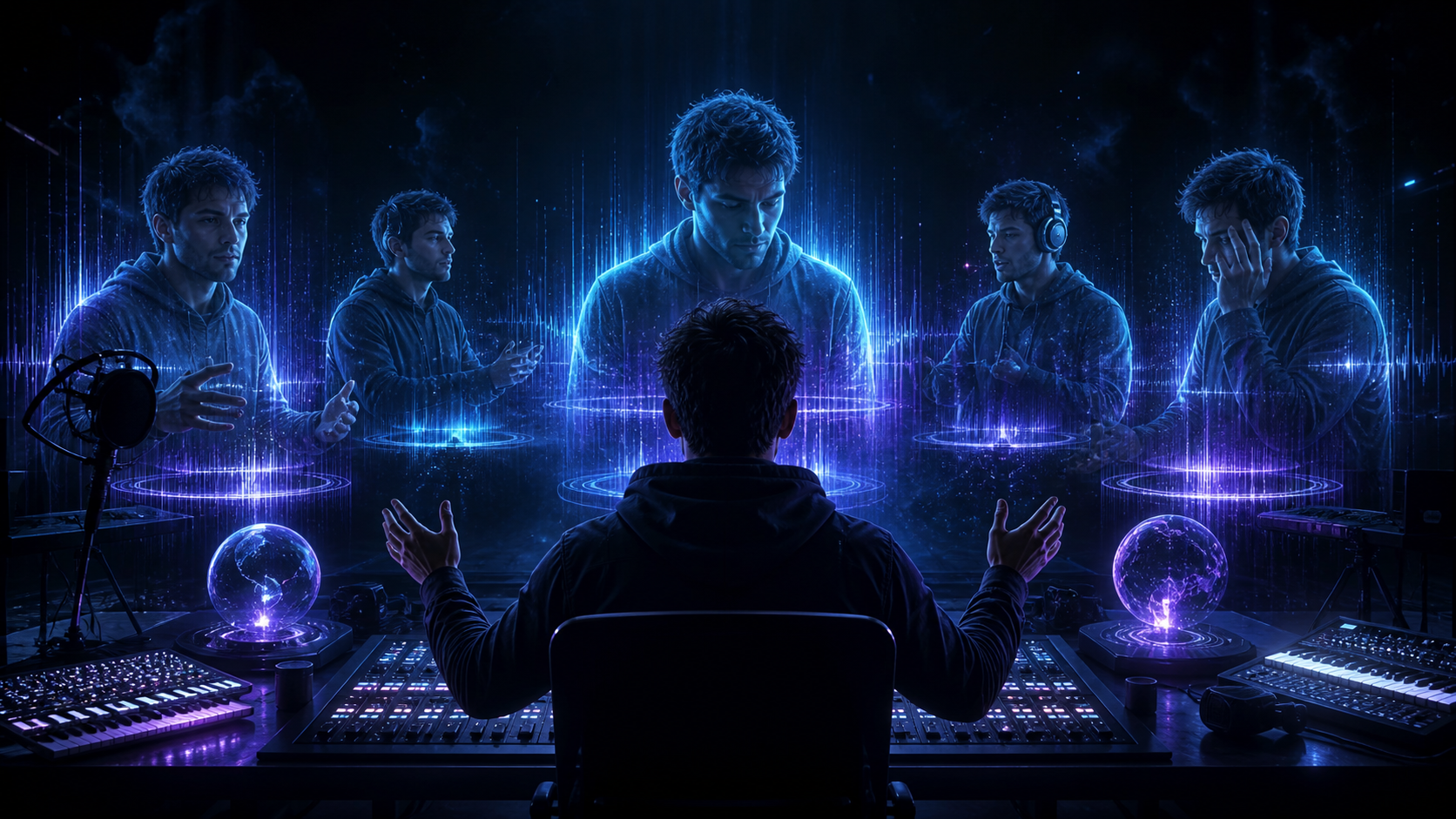
That matters far beyond elections. For creators, presenters, educators and media personalities, the same underlying tools now promise something intoxicating: be everywhere at once. A podcast host can turn one recording into clips, translations, dubbed editions and avatar-led explainers. A YouTuber can publish in Spanish, Hindi and Portuguese without entering a second studio session. A newsletter writer can generate audio versions in their own synthetic voice. What once required a production company increasingly looks like a software workflow.
For the Voice tribe, the old bottleneck — the irreplaceability of time in front of a microphone or camera — has loosened dramatically. The promise is real. So is the danger.
The temptation is simple: if one can publish ten times as much, why not? The answer is that a creator’s true asset was never output volume. It was trust. And trust, unlike content, does not replicate cleanly.
The production constraint has dissolved
A few years ago, credible voice cloning was costly, fiddly and often uncanny. Today it is a product category. ElevenLabs offers synthetic speech and voice cloning used by publishers, developers and independent creators. HeyGen and Synthesia offer talking avatars and AI-generated presenters for training, marketing and explainer content. Adobe has integrated generative audio and video tools into mainstream creative workflows. OpenAI, Google and Meta have each pushed synthetic media further into everyday software.
The consequence is not merely better tools. It is a structural change in media production.
A single source asset can now be atomised and reassembled across formats:
- a long-form interview becomes short vertical clips for TikTok, Instagram Reels and YouTube Shorts;
- an English narration becomes dubbed editions for Latin America, India and continental Europe;
- a static newsletter becomes an audio briefing in the writer’s synthetic voice;
- a recorded course becomes an avatar-led localisation programme for several markets;
- a live stream becomes a week of post-produced fragments, captions, summaries and scripted follow-ups.
This is not hypothetical. MrBeast has spoken publicly about dubbing strategy and globalisation of his content. YouTube has introduced tools for multi-language audio tracks, reflecting a broader shift towards internationalised creator distribution. Spotify has experimented with AI voice translation for podcasters, including well-known hosts, using voice synthesis to preserve vocal identity across languages. The creator economy’s ambition has moved from cross-posting to near-ubiquity.
Seen narrowly, this is efficiency. Seen properly, it is the industrialisation of presence.
The trust budget
Every audience relationship carries a finite, spendable reserve of trust. It is accumulated slowly through consistency, judgement, taste and the subtle signs of actual human attention. It is depleted quickly when followers sense that what looked personal was in fact automated, synthetic or strategically insincere.
That is the central asymmetry of cloned media. AI lets a creator spend trust much faster than they can earn it.
Audiences do not merely consume information from creators; they infer relationship. They notice cadence, timing, responsiveness, vulnerability and effort. A creator who appears daily in a feed may feel intimate, even when the underlying connection is one-to-many. Synthetic media can preserve the surface cues of that intimacy while removing the human labour that originally made it credible.
The result is not simply “more content”. It is a subtle tax on perceived authenticity.
Scholars have long described parasocial relationships as one-sided but emotionally meaningful bonds between audiences and media figures. In the social-media era, those bonds have become tighter and more interactive. A creator’s audience often believes it knows not just what the person makes, but who they are. Once a clone enters the workflow, that assumption becomes unstable. Was this actually recorded? Did they actually say this? Are they really responding to me, or has my attention been routed through a system?
Those questions are corrosive precisely because they spread backwards. Undisclosed synthetic output does not only cast doubt on the new material; it can retroactively poison the old.
Authenticity is not style transfer
Many creators make a category error. They assume that because a model can reproduce their voice, face, pacing and verbal tics, it can reproduce their authenticity. It cannot.
Authenticity is not a vocal timbre. It is not a head tilt, a laugh pattern, a preferred phrase or colour grading. It is the audience’s belief that there is a meaningful link between the message and the person behind it — that the view expressed was actually held, the recommendation actually meant, the reply actually considered.
Voice clones and avatars do not scale trust; they consume it.
Generative systems are excellent at style transfer. They are poor substitutes for situated intent.
This distinction is easy to miss because the synthetic artefact can be astonishingly convincing. Anyone who has used modern dubbing or avatar platforms knows the shock of hearing familiar vocal texture reproduced with near-frictionless fluency. Yet realism is not the same thing as authorship. A creator may technically “own” the output because it was generated from their source materials or under their instruction. That does not mean an audience experiences it as equally authored.
The strongest creators understand this instinctively. They use cloning as leverage on work they genuinely made and stand behind. The synthetic layer handles translation, cleanup, accessibility, repackaging and formatting. It does not invent convictions, feign intimacy or simulate a level of personal presence that does not exist.
The uses that create value
There is nothing inherently dishonest about cloned media. In several use cases, it is plainly useful and arguably beneficial.
Translation and localisation
If a creator has recorded a thoughtful episode in English, using AI dubbing to make it accessible in other languages can be an unambiguous good — provided the meaning is preserved and the process is disclosed. Viewers gain access; the creator gains reach; the original authorship remains intact.
Accessibility and format adaptation
Text-to-speech in a familiar voice can make newsletters or essays more accessible for listeners. Generative editing can remove production friction, produce captions, compress long-form footage into short clips and fit content to platform norms. None of this necessarily deceives anyone.
Evergreen and instructional material
Corporate training providers have been among the earliest adopters of avatar tools precisely because some forms of communication are informational rather than relational. A compliance explainer or software tutorial does not always require high-touch human presence.
Estate and rights-managed projects
There are also lawful, consensual uses in entertainment. The estates of public figures and some living artists have licensed likeness and voice rights under negotiated terms. Whether one likes the aesthetics is another matter; the point is that consent and governance matter.
Used this way, AI is not replacing the creator. It is reducing waste around the creator’s real work.
The uses that destroy value
Problems begin when the clone crosses from extension into impersonated presence.
Synthetic replies and fake intimacy
The most corrosive use is allowing an avatar or voice clone to appear responsive in situations where the audience reasonably assumes the creator is personally present. A fan asks a question and receives a warm video reply in the creator’s cloned voice; a subscriber thinks they are hearing a direct message; a community member assumes a real recommendation reflects real attention. Here the deception is not technical but relational.
Manufactured opinions
A clone should not generate fresh personal views on politics, ethics, relationships, finance or health as if they came from the creator. That is not scaling content; it is outsourcing judgment while retaining borrowed credibility.
Sponsored content without clear boundaries
The economics of creator media make this especially risky. If synthetic likeness is used in advertisements, endorsements or affiliate funnels without conspicuous disclosure and real review, audiences will quite reasonably conclude that the person’s identity has been reduced to an extraction surface.
Posthumous or perpetual output
Use the clone to extend reach, never to fake presence.
The fantasy of “publishing forever” — keeping a creator active through automation even in their absence — may appeal to managers and estates. But continuous output without continuous personhood often feels eerie because the audience understands, at some level, that the social contract has been severed.
This is why the draft article’s central rule survives scrutiny: use the clone to extend reach, never to fake presence. That principle is not sentimental. It is commercially rational.
Regulation is arriving, but markets will move first
Lawmakers are beginning to intervene, although unevenly. The European Union’s AI Act includes transparency obligations for certain AI-generated and manipulated content. Several American states have introduced or passed laws addressing deepfakes in elections or non-consensual sexual imagery. The US Federal Communications Commission moved in 2024 to outlaw AI-generated voices in robocalls under the Telephone Consumer Protection Act. Platforms, too, are adjusting: YouTube has expanded disclosure expectations around altered or synthetic content, especially where realistic depictions could mislead.
The legal direction is clear even if the details are still forming: synthetic realism that can mislead people will attract scrutiny.
Yet the sharper operators in media should not wait for regulation. They have a stronger immediate incentive: preserving audience confidence. A creator discovered to have used undisclosed cloning may comply with the letter of a future rule and still suffer irreversible reputational damage today.
Disclosure, then, is not merely a compliance exercise. It is a commercial strategy.
Clear signalling can be simple:
- “This episode has been dubbed using AI, reviewed by our team.”
- “Audio in this clip uses a licensed voice clone based on my original recording.”
- “This avatar presents material I wrote and approved; replies are handled by the team unless stated otherwise.”
That sort of candour does not weaken the brand. In many cases it strengthens it by demonstrating respect for the audience’s interpretive rights — their right to know what kind of media experience they are having.
The economics of abundance and the premium on the real
When synthetic production becomes cheap, authenticity becomes more valuable, not less.
This is a familiar economic pattern. Abundance in one layer shifts scarcity elsewhere. Cheap photography made exceptional taste more valuable. Infinite digital distribution made attention more valuable. Generative media makes verified human intention more valuable.
Creators who misunderstand this will chase output volume and flatten their own differentiation. If every channel is filled with frictionless, vaguely personalised, endlessly repurposed content, then mere visibility ceases to be a moat. The distinctive asset becomes the trace of an actual mind at work.
That may take paradoxical forms:
- fewer, more deliberate direct-to-camera moments;
- occasional live sessions where the audience knows the person is genuinely there;
- visible behind-the-scenes process rather than polished synthetic continuity;
- stronger editorial signatures that cannot be reduced to vocal texture alone;
- explicit demarcation between authored work, team-produced work and AI-mediated work.
In other words, the winners may not be those who appear most omnipresent. They may be those who make human presence legible again.
Platforms are poor custodians of identity
One reason this problem is becoming acute is that today’s platforms were built to optimise engagement, not provenance. They are excellent at recommending content and weak at preserving the context of how it was made.
A clip reaches a viewer stripped of production history. The viewer does not automatically know whether it was recorded live, heavily edited, dubbed, fully synthetic or assembled from fragments. Even where labels exist, they are often inconsistent, easy to miss or contextually thin.
This is where governance becomes more than a media ethics slogan. As creator workflows increasingly rely on agentic tools — systems that can edit, publish, localise, respond and distribute with limited human friction — the crucial question is not only what the model can generate, but under what authority it may act.
That is precisely the sort of problem addressed by F-ACT, the Framework for Agent Conformance & Trust, within The Sovereign Standard. Its normative core, ASDAR — Authority, Scope, Data, Audit, Revocation — is relevant here because cloned media is ultimately an agency problem.
- Authority: who authorised this clone or agent to speak in the creator’s name?
- Scope: what is it allowed to do — translate, caption and reformat, or also respond and improvise?
- Data: what source material trained it, and with whose consent?
- Audit: can the creator, team or audience verify what was generated and approved?
- Revocation: can the system be shut off or permissions withdrawn quickly if misuse occurs?
When synthetic production becomes cheap, verified human intention becomes more valuable.
The principle is simple: govern before execution — not after. In creator media, that means setting hard boundaries before a clone begins to publish, not attempting reputational repair once followers discover that “you” was software.
The 42 Protocols, Society OS’s implementation mechanism for the Sovereign Standard, are relevant here less as branding than as architecture. In a world of proliferating agent fleets, identity, trust ranking and executable permissions become foundational. If a creator’s Human-Twin-Agent identity is not clearly separated and governed, confusion is not an accident. It is the default state.
A practical code for cloned creators
The creators who use these tools well tend to converge on a pragmatic discipline.
1. Clone outputs, not personhood
Repurpose work already authored. Do not let the system invent new “you”.
2. Disclose at the point of experience
Do not bury synthetic-use language in a terms page. Tell the audience where they encounter it.
3. Reserve certain surfaces for the real human
Live Q&As, sensitive topics, major announcements, personal reflections and community replies should generally remain unmistakably human.
4. Review anything that sounds like judgment
Translation errors are annoying; synthetic advice in health, money or relationships can be damaging.
5. Protect training data and rights
Teams should know exactly which recordings, scripts and likeness assets were used, on what contractual basis, and by which vendors.
6. Build revocation in from the start
If a provider changes terms, leaks assets or produces harmful output, the creator should be able to switch the system off without ambiguity.
These are not merely best practices. They are the beginnings of professional norms for synthetic authorship.
The future belongs to the creators who draw the line
The cloned creator is not a dystopian fantasy. It is already a workflow. For many media businesses it will soon be standard operating procedure, especially in localisation, repackaging and archive monetisation. Pretending otherwise would be nostalgic and unserious.
But nor is it a simple productivity story. The technology that allows a creator to be in a dozen places at once also allows them to appear present where they are absent, attentive where they are automated, and authentic where they are merely simulated. That is the line that matters.
A creator’s audience will tolerate a great deal of mediation. They understand editing, teams, scripts, scheduling and production mechanics. What they do not forgive easily is concealed impersonation — the use of a trusted identity surface to imply a human relationship that is no longer there.
The durable principle, then, is not anti-technology. It is anti-fraudulence in the deeper, social sense of the word. Use AI to widen access, reduce friction and carry good work farther. Do not use it to counterfeit care.
In an age of infinite synthetic output, the rarest signal will be a message that still bears the weight of a person behind it. The creators who protect that distinction will not merely keep their reputations. They will command the premium that abundance always creates for the genuinely real.
Sources & Further Reading
- 1.Federal Communications Commission: FCC Outlaws AI-Generated Robocalls
- 2.Reuters: New Hampshire attorney general investigates AI robocall mimicking Biden
- 3.European Parliament: Artificial Intelligence Act
- 4.YouTube Help: Altered or synthetic content disclosures
- 5.Spotify Newsroom: Pilot of voice translations for podcasts
- 6.ElevenLabs
- 7.Synthesia
- 8.HeyGen
- 9.Horton and Wohl (1956): Mass Communication and Para-Social Interaction