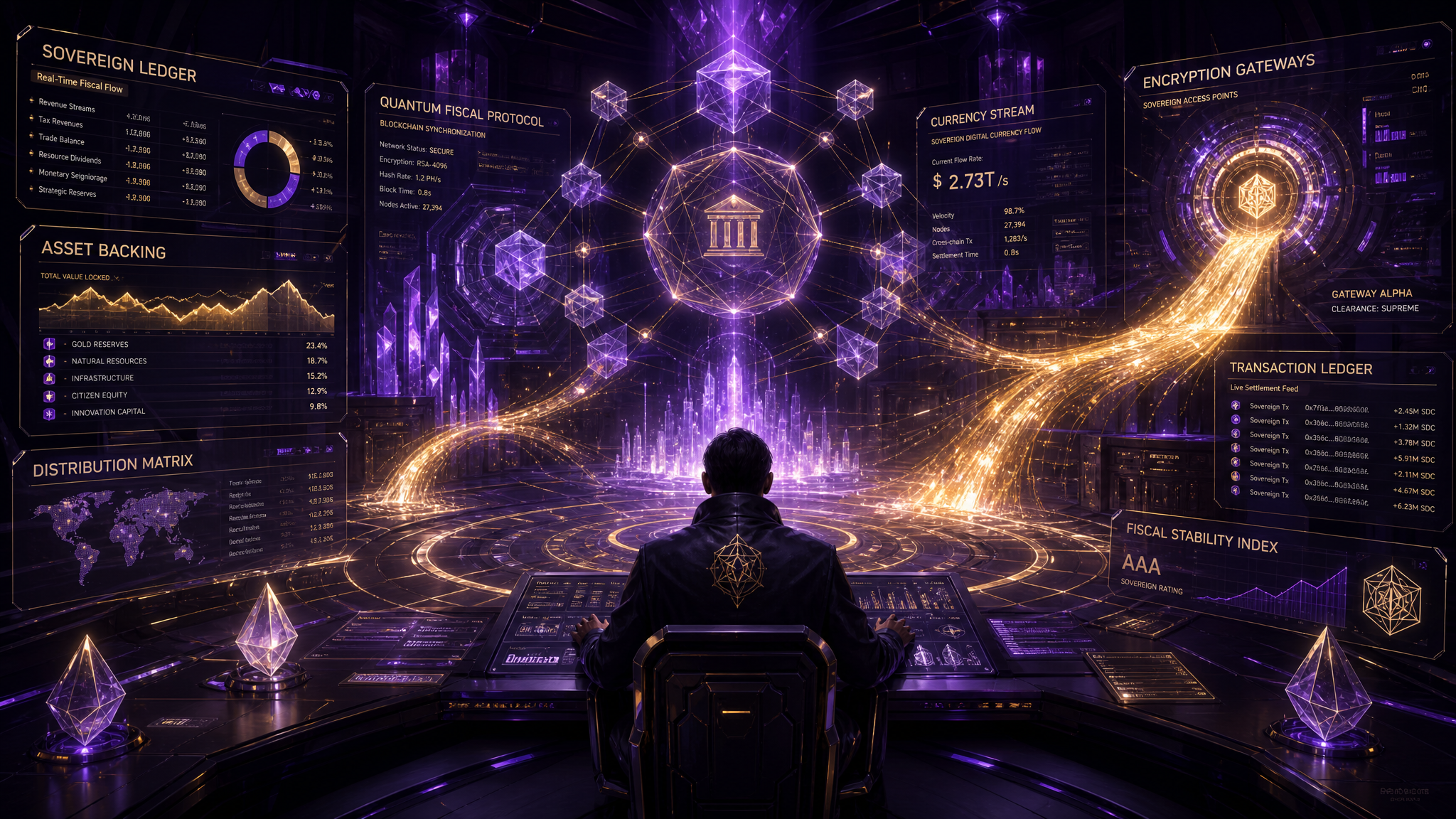
On a Tuesday morning, the treasury fits in a pocket
A freelance designer in Lisbon is paid by a client in Toronto in a dollar-backed stablecoin. Her pension contribution is routed automatically into a low-cost tokenised money-market fund. A portion of each payment flows to a shared wallet with two collaborators under pre-agreed spending rules. Another portion settles a royalty stream every time a design pattern she created is reused in a gaming environment. Her tax ledger updates as the transactions occur. No relationship manager calls. No branch opens. No intermediary decides whether the payment is inconvenient, unusual or worth delaying.
This is not a fantasy of bankless anarchy. It is a sketch of a different financial architecture: the one-person treasury.
Banks were built to intermediate scarcity. They pool deposits, transform maturities, assess counterparties and maintain ledgers. Those functions remain important. But digital identity, programmable money, cryptographic proof, tokenised assets and machine-readable policy are unbundling the bank into components that can increasingly be assembled around the individual. The result is not the disappearance of finance. It is the relocation of control.
In the sovereign economy, the key unit is no longer merely the account. It is the treasury: a governed financial operating system for a person, family, creator collective, co-operative, neighbourhood fund or micro-enterprise. Its job is to hold assets, route payments, enforce permissions, maintain records and execute obligations according to rules chosen in advance.
That distinction matters. An account is a container. A treasury is an institution, even when it belongs to one person.
From account holder to financial operator
Modern retail finance still assumes that most people are users of products assembled elsewhere. Your bank account stores balances. Your card network clears purchases. Your pension wrapper allocates long-term savings. Your payment processor decides risk thresholds. Your platform may even decide when you are paid for your work. The ordinary citizen lives amid financial rails but rarely governs them.
The internet changed distribution, but not always control. Financial technology made payments smoother, investing cheaper and budgeting easier, yet much of it remained a cleaner interface atop the same gatekeepers. The centralised ledger still sat somewhere else. The rules still changed somewhere else. Access could still be paused somewhere else.
The new possibility emerges from a convergence of technologies and legal forms:
- Stablecoins and tokenised deposits reduce the frictions of moving value digitally and globally.
- Smart contracts allow funds to be released according to explicit conditions.
- Multi-signature wallets and account abstraction make self-custody more usable and safer than earlier generations of crypto tooling.
- Tokenised funds and on-chain credit primitives create programmable savings, collateral and cash management.
- DAOs and digital co-operatives offer structures for group treasury management, albeit unevenly recognised in law.
- Open banking and data portability regimes make it easier to assemble a fuller financial picture around the user.
- Agentic software can monitor budgets, optimise liquidity, reconcile records and negotiate routine financial tasks.
Each of these exists today, though none is mature enough on its own to carry the whole burden of financial life. The important shift lies in their composition. Once identity, authority, data access and execution can be governed coherently, an individual can begin to act less like a consumer of financial products and more like the operator of a small treasury.
That is where The Sovereign Standard becomes useful. It is the broader framework for retaining sovereignty in the AI age across identity, data, money, health and governance. In money, its practical question is simple: who decides, who can act, on what authority, with what records, and how that authority can be withdrawn. The answer cannot rest on rhetoric about empowerment. It must be embedded in systems.
DeFi is useful precisely where it becomes boring
The phrase “decentralised finance” still carries the odour of speculative excess. That is unfortunate, because the most durable parts of DeFi are not the loudest. They are the quiet pieces of financial plumbing.
A mature one-person treasury does not require meme assets, perpetual leverage or ideological purity. It needs a handful of far more prosaic capabilities:
- secure custody and recovery;
- instant or near-instant settlement;
- transparent balances and transaction history;
- programmable disbursement rules;
- access to yield on idle cash within understood risk bands;
- collateralised liquidity where appropriate;
- auditable records for tax, compliance and governance.
On those terms, DeFi starts to look less like rebellion and more like software-defined treasury management. Stablecoins are the clearest example. Their rapid growth has attracted the attention of central banks, the Bank for International Settlements and regulators because they perform a genuine economic function: they provide programmable digital cash-like instruments for internet-native transactions. They also raise familiar concerns about reserves, redemption, market integrity and illicit finance. Regulation is therefore converging, not disappearing.
Europe offers perhaps the clearest signal. The EU’s Markets in Crypto-Assets Regulation, or MiCA, establishes a framework for issuers of crypto-assets, including asset-referenced tokens and e-money tokens, while imposing disclosure and conduct obligations on service providers. Whatever one thinks of the details, the significance is strategic: digital asset infrastructure is being pulled into recognisable regulatory space.
The same is true elsewhere. The Financial Stability Board has set out high-level recommendations for crypto-asset markets and global stablecoin arrangements. The Bank for International Settlements has repeatedly argued that stablecoins must meet standards of sound money if they are to be systemically useful. Securities regulators continue to scrutinise token offerings, staking services and lending products. The age of casual ambiguity is ending.
That is healthy. Sovereign finance does not mean escaping rules. It means making the rules legible, portable and enforceable at the level of the user or community.
A one-person treasury built on these rails can already do sensible things:
An account is a container. A treasury is an institution, even when it belongs to one person.
- keep working capital in fiat and short-duration instruments;
- maintain settlement balances in regulated stablecoins where permitted;
- automate invoice collection and splitting;
- escrow funds for milestones;
- allocate a small percentage of cashflow to reserve buffers;
- ring-fence tax liabilities;
- route long-term savings into diversified instruments;
- publish a verifiable record to accountants, lenders or collaborators without handing over full raw histories.
None of this abolishes banks. Some treasuries will still use bank accounts, custodians, brokers and payment institutions. But it changes their role. They become service providers within the treasury, rather than sovereigns over it.
Pattern royalties: from intellectual property to programmable income
If the one-person treasury is to matter beyond affluent technologists, it must serve not only investors but workers, creators and communities. That is where pattern royalties become economically interesting.
A pattern is a reusable structure that generates value: a design language, training workflow, software module, media format, community process, data schema, biomarker protocol, manufacturing method or distinctive service playbook. Historically, such patterns have been monetised indirectly through employment, consultancy, licensing, copyright, patents, franchise models or platform revenue shares. Those mechanisms remain important, but they are often blunt, delayed and heavily intermediated.
Programmable finance allows a different approach. If a pattern can be identified, versioned, attributed and linked to usage events, then royalty logic can be attached directly to its reuse. The payment need not depend on a platform’s goodwill or a quarterly reconciliation. It can become part of the transaction architecture.
This does not replace intellectual property law. Nor should it. Copyright, contract, database rights, trade secrets and patents all remain relevant, depending on the asset and jurisdiction. Society OS’s own patent position, for instance, is exactly 504 provisional/unexamined claims in one Australian provisional application (2026900773), filed on 2 February 2026. It is provisional and unexamined, confers no granted or enforceable rights, and lapses on 2 February 2027 unless taken further. In other words, the legal substrate matters, and honesty about its status matters too.
But much value today is not captured because it falls below the threshold at which formal licensing is practical. A creator’s workflow template is reused fifty times. A community health protocol is adapted in three cities. A micro-enterprise’s pricing engine is embedded by partners. A musician’s generative stem structure is remixed across dozens of derivative works. These are economically real but administratively awkward.
A one-person treasury can make them tractable. The treasury can:
- register provenance and version history;
- define permissible uses and pricing bands;
- receive micropayments or recurring streams;
- split revenue among collaborators automatically;
- enforce revocation or suspension where use falls outside scope;
- present an auditable trail when disputes arise.
This is not only a creator story. It is a labour story. As AI systems absorb more routine production, the premium shifts towards distinctive patterns: curation, judgement, taste, trust, process design and domain-specific know-how. People will need ways to capture income from those patterns without becoming mini-corporations each time they create one.
Governing the machine that moves the money
The greatest risk in sovereign finance is not volatility. It is delegated action without disciplined governance.
As agentic tools become capable of paying invoices, rebalancing assets, filing forms, comparing rates and negotiating subscriptions, the treasury becomes partly autonomous. That increases convenience and danger in equal measure. A helpful financial agent with broad permissions is also a new attack surface, a new compliance risk and a new source of silent error.
This is why F-ACT matters. F-ACT, the Framework for Agent Conformance & Trust, is the neutral, open, vendor-neutral AI-agent governance standard within The Sovereign Standard. Its normative core is ASDAR: Authority, Scope, Data, Audit, Revocation. The principle is blunt and correct: govern before execution — not after.
Applied to a one-person treasury, ASDAR means:
- Authority: who empowered the agent to act, under what identity and with what legal or contractual standing.
- Scope: what the agent may do — for instance, pay utility bills up to a threshold, but not move pension assets or alter beneficiary designations.
- Data: which financial records, wallets, accounts and external APIs it may access, and for how long.
- Audit: what logs, proofs and explanations are produced for each decision and transaction.
- Revocation: how permissions are withdrawn instantly if the user changes their mind, the context shifts or the agent misbehaves.
The conformance ladder is equally practical:
- L0 Unattested: the agent claims capabilities but offers no meaningful proof.
- L1 Declared: permissions and behaviour are stated, but not technically enforced.
- L2 Enforced: controls are bound to execution through policy, architecture and access constraints.
- L3 Provable: key claims about behaviour, constraints and records are independently verifiable.
Most consumer AI today sits far closer to L0 or L1 than people realise. That is acceptable for drafting a shopping list. It is not acceptable for treasury operations.
Regulation is moving in the same direction. The EU AI Act is built around risk management, documentation, transparency and accountability, especially where AI affects rights, access or safety. GDPR already imposes obligations around lawful basis, data minimisation, access and automated decision-making. Financial regulation requires record-keeping, anti-money laundering controls, consumer protection and operational resilience. A treasury agent that handles money, identity and personal data cannot treat governance as an afterthought.
F-ACT turns that regulatory drift into a design discipline. The question is no longer whether an AI agent is “smart”. It is whether it is constrained enough to be trusted.
DeFi becomes durable precisely when it stops posing as revolution and starts behaving like treasury plumbing.
In sovereign finance, autonomy without revocation is merely a slower form of surrender.
The 42 Protocols: how sovereignty becomes operational
Frameworks are necessary, but insufficient. The decisive question is implementation.
This is where the 42 Protocols matter. They are Society OS’s deployable mechanism for operationalising The Sovereign Standard. Led by the Sovereign Trinity — Human-Twin-Agent identity for who acts, HEARTrank for what is trusted, and WISE Contracts for which execute law, not merely code — they provide the stack through which personal and community treasuries can actually function.
The motif is ambitious for a reason: 42 years. 42 protocols. 42 papers. Not because finance needs numerology, but because sovereignty needs a coherent system rather than a scatter of apps.
For the one-person treasury, several parts of this architecture are especially important.
Human-Twin-Agent identity
A treasury must know whether an action was taken by a human principal, a digital twin acting within durable preferences, or an agent executing a delegated task. This is more subtle than ordinary login security. It concerns legal and social identity, not merely credentials.
The Human-Twin-Agent Protocol distinguishes who the principal is, what persistent model of their preferences and permissions exists, and what machine actor is allowed to perform on their behalf. In financial life, that permits sensible separations:
- the human approves long-term policy;
- the twin maintains contextual continuity across accounts, goals and obligations;
- the agent executes bounded tasks such as reconciliation, budgeting or payment routing.
That is cleaner than the current jumble in which a bank app, a budgeting tool, an accountant and a cloud AI assistant each hold fragments of authority with inconsistent logs.
HEARTrank and trust routing
Treasury decisions are only as good as the counterparties and signals they rely on. HEARTrank provides a trust layer for evaluating which data feeds, counterparties, advisers, pools, protocols or communities merit reliance. In practice, that can help a user distinguish between a regulated stablecoin issuer and a dubious one, between a credible tokenised fund and an opaque yield product, or between a genuine community lending circle and a dressed-up pyramid.
Trust here is not social mood. It is structured evidence.
WISE Contracts
Conventional smart contracts execute code exactly, even when the social meaning of the transaction is disputed. WISE Contracts are designed to execute law, not merely code: the intent, permissions, conditions and recourse structure around a transaction.
For treasuries, that matters in milestone payments, royalty splits, household budgets, mutual-aid pools, creator collectives and community banks. A treasury should not merely transfer funds because a function was called. It should transfer funds because the governing conditions, authorities and evidence have been satisfied.
This is how the one-person treasury graduates from wallet to institution.
Community banking without the old gatekeepers
The one-person treasury is not a hymn to atomisation. Sovereignty is often exercised best in association.
For centuries, communities have built mutual financial forms when commercial banks would not serve them well: building societies, credit unions, rotating savings clubs, co-operatives, mutual insurers and local investment trusts. Their weakness was rarely social legitimacy. It was operational burden, regulatory complexity and scale.
Digital treasury architecture can revive the strengths of community banking without reproducing all the old friction. A neighbourhood energy co-operative, for instance, could maintain a governed treasury that:
In sovereign finance, autonomy without revocation is merely a slower form of surrender.
- receives member contributions;
- holds reserve buffers in low-risk instruments;
- pays approved suppliers under multi-party rules;
- distributes surplus according to agreed formulas;
- issues transparent reports to members;
- enforces caps, votes and emergency controls;
- interoperates with banks and payment institutions where necessary.
Likewise, a guild of independent carers, a local food network, a diaspora investment club or a scientific commons could each operate treasury functions with clearer permissions and auditability than many small associations enjoy today.
Legal form still matters. DAOs remain unevenly treated across jurisdictions; some places recognise forms of decentralised association more clearly than others, while many do not. Consumer credit, deposit-taking, securities issuance and payments are heavily regulated for good reasons. A community treasury cannot simply declare itself a bank because software is involved.
Yet software can dramatically reduce the cost of being governable. That is the hidden advantage. The future of community finance may belong less to institutions that are too small to bear compliance, and more to governed digital structures that make compliance native.
What sovereignty does not mean
The most serious objections to personal treasury architecture deserve respect.
Self-custody can go wrong. Keys can be lost. Smart contracts can fail. Stablecoin reserves can disappoint. Tokenised products can smuggle old risks into shiny wrappers. Retail users can be misled by complexity. Criminal abuse remains a persistent concern. And in crises, people may still prefer insured deposits at a supervised bank to software-mediated alternatives.
All true.
That is why the one-person treasury should not be sold as a romantic escape from institutions. It should be built as a layered model of optionality.
A prudent treasury might include:
- insured bank deposits for ordinary bills and emergency access;
- regulated e-money or stablecoin balances for programmable settlement where permitted;
- diversified long-term investments through established wrappers where available;
- governed on-chain components for escrow, royalties, group treasury and machine execution;
- strict agent permissions under F-ACT;
- recovery and inheritance procedures;
- jurisdiction-specific tax and compliance logic.
Sovereignty, in this sense, is not purity. It is the power to compose dependable financial functions around the person rather than forcing the person to fit the institution’s default stack.
This is also why the Living OS and the Sovereign Stack matter conceptually. Financial life is entangled with identity, health, work, family and governance. A treasury that cannot read consent, reflect life events, adapt to changing obligations or hand over gracefully in incapacity is not truly sovereign. It is merely clever.
The end of gatekeeping is really the end of default dependency
The phrase “end of financial gatekeeping” can sound incendiary. In practice, the shift is more measured and more profound. What is ending is not every intermediary. It is the assumption that intermediation must always be vertically integrated, opaque and user-subordinate.
The one-person treasury changes the centre of gravity.
Instead of asking a bank to define the permissible shape of your financial life, you define the treasury policy and invite banks, brokers, custodians, protocols and agents to serve inside it. Instead of waiting for a platform to invent a revenue share, you attach royalty logic to the pattern itself. Instead of handing broad power to a generic AI assistant, you constrain a treasury agent with Authority, Scope, Data, Audit and Revocation. Instead of treating community finance as administratively quaint, you make it digitally governable.
For some, this will begin modestly: a better invoice wallet, a split-payment rule, a family reserve account, a creator royalty stream. For others, it will evolve into full treasury operations: savings, budgeting, tax provisioning, investment policy, collaborative funding and governed agents operating across jurisdictions and asset classes.
The broader importance is civilisational. Money is not only purchasing power. It is timing, permission and memory. Whoever controls the ledger controls the sequence of possible actions. In the AI age, when software will increasingly initiate transactions, evaluate counterparties and arbitrate access, financial sovereignty cannot mean simply “having funds”. It must mean governing the systems that move them.
That is the practical promise of The Sovereign Standard in the domain of money. F-ACT supplies the governance discipline for agents. The 42 Protocols supply the operational mechanism. Together they allow the treasury to become personal, programmable and accountable without becoming reckless.
The bank branch will not vanish. Nor should it. But the most consequential financial institution of the coming decade may be far smaller and far closer to the human being it serves.
It may be a treasury of one.
Sources & Further Reading
- 1.European Union: Markets in Crypto-Assets Regulation (MiCA)
- 2.European Union: Artificial Intelligence Act
- 3.European Union: General Data Protection Regulation (GDPR)
- 4.Financial Stability Board: High-level Recommendations for the Regulation, Supervision and Oversight of Crypto-Asset Activities and Markets
- 5.Bank for International Settlements: Annual Economic Report 2023, Chapter III
- 6.European Banking Authority: Guidelines on internal governance under MiCA
- 7.UK Financial Conduct Authority: Cryptoassets